Characteristic polynomial: $\det(A-\lambda I)=0$
Search for scalars $\lambda$ such that $A - \lambda I$ is singular. A nontrivial kernel then supplies eigenvectors . The condition $\det(A - \lambda I) = 0$ is the characteristic equation.
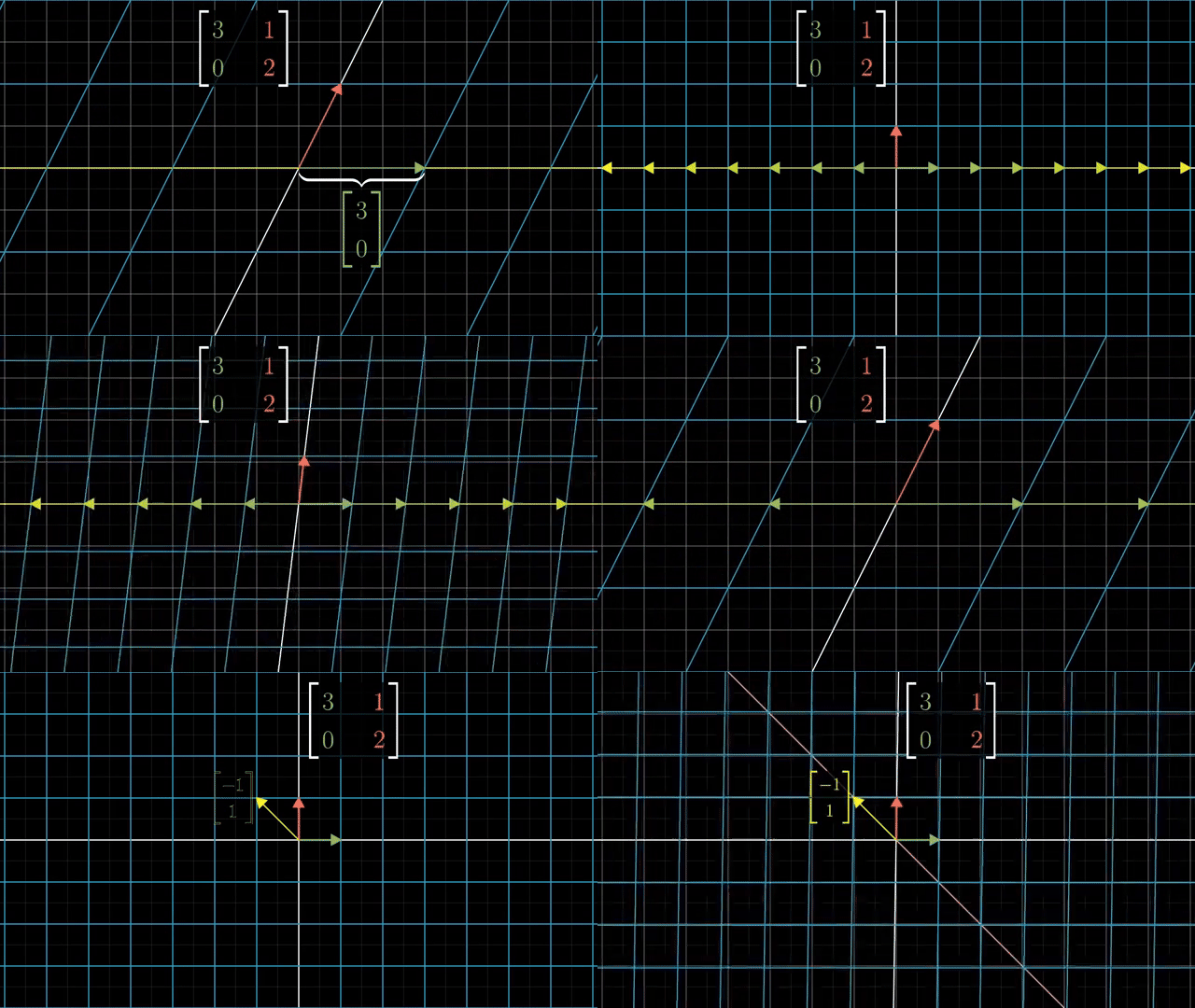
For an $n \times n$ matrix, $\det(A - \lambda I)$ is a degree-$n$ polynomial in $\lambda$. Its roots (in an algebraically closed field) are eigenvalues. Algebraic multiplicity counts how many times a root appears in the polynomial factorization.
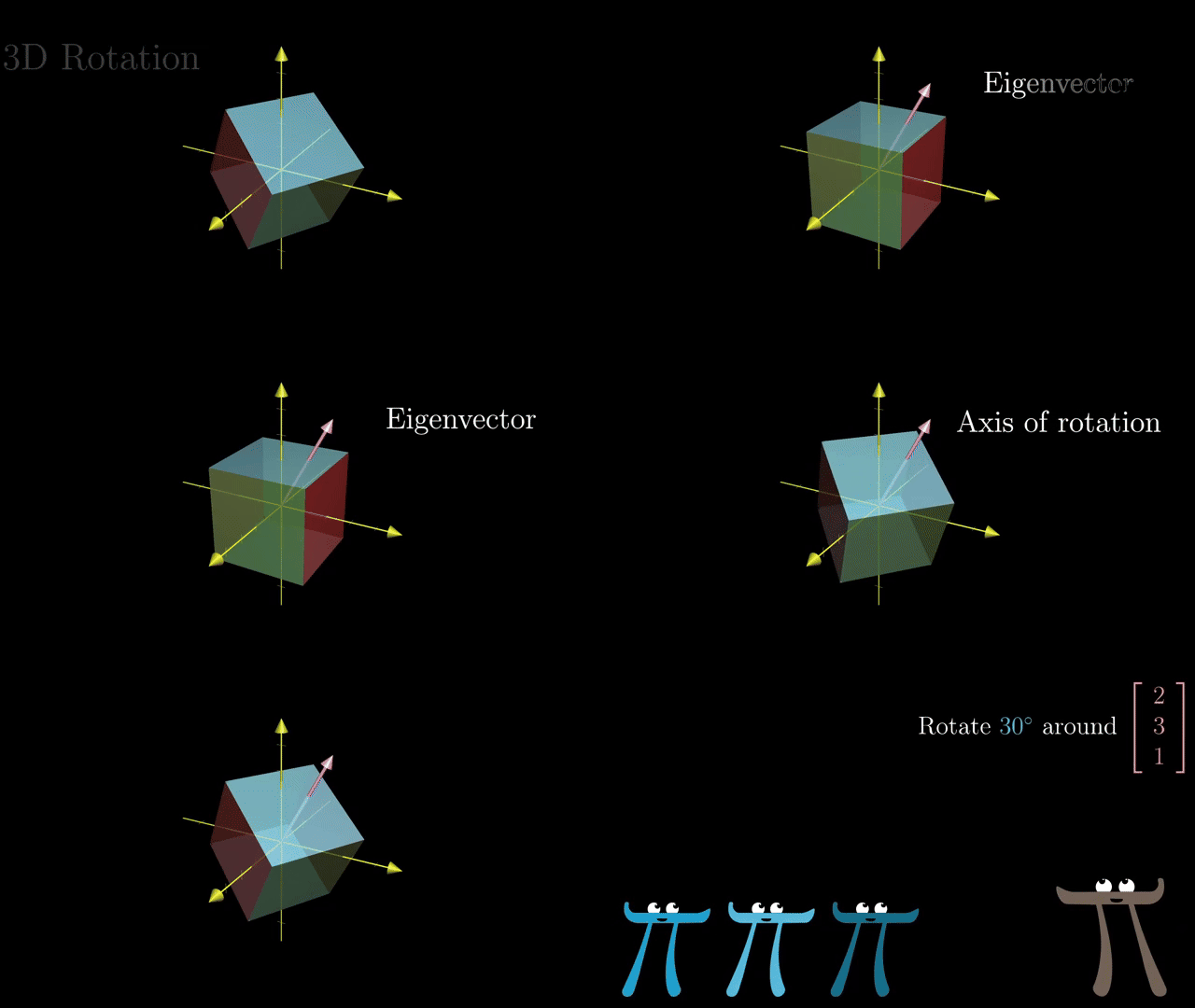
Real matrices can lack real eigenvalues when the characteristic polynomial has irreducible quadratic factors, as in rotation-like examples. Over $\mathbb{C}$, $n$ roots always exist counting multiplicity.
For hand calculation, expand $\det(A-\lambda I)$ only as far as needed, then factor. Numerical libraries switch to iterative methods when $n$ is large, but the polynomial definition remains the conceptual starting point.
Check your understanding. The tasks below rest on these ideas: Correct: $\det(A-\lambda I)=0$ is exactly the condition for $\lambda$ to be an eigenvalue. Not quite: they are not pivots, need not be integers, and are not simply the diagonal entries. Correct: algebraic multiplicity is the root's multiplicity in the characteristic polynomial. Not quite: the eigenspace dimension is the geometric multiplicity, and trace/pivots are unrelated. Correct: irreducible quadratics give complex-conjugate eigenvalues, so no real ones. Not quite: diagonal matrices have real eigenvalues, and zero determinant or positive trace do not force complex eigenvalues. Correct: a nontrivial null vector means $A-\lambda I$ is singular, i.e. its determinant is zero. Not quite: eigenvalues need not be zero, $A-\lambda I$ is the singular matrix here, and $\mathbf{v}$ need not be unit length.
Related cards
Video Content
Tasks
Card Info
- Topic: Mathematics
- Difficulty: Advanced
- Completed: 0 users
Creator
