Eigenvector: stays on its span, only stretches or flips
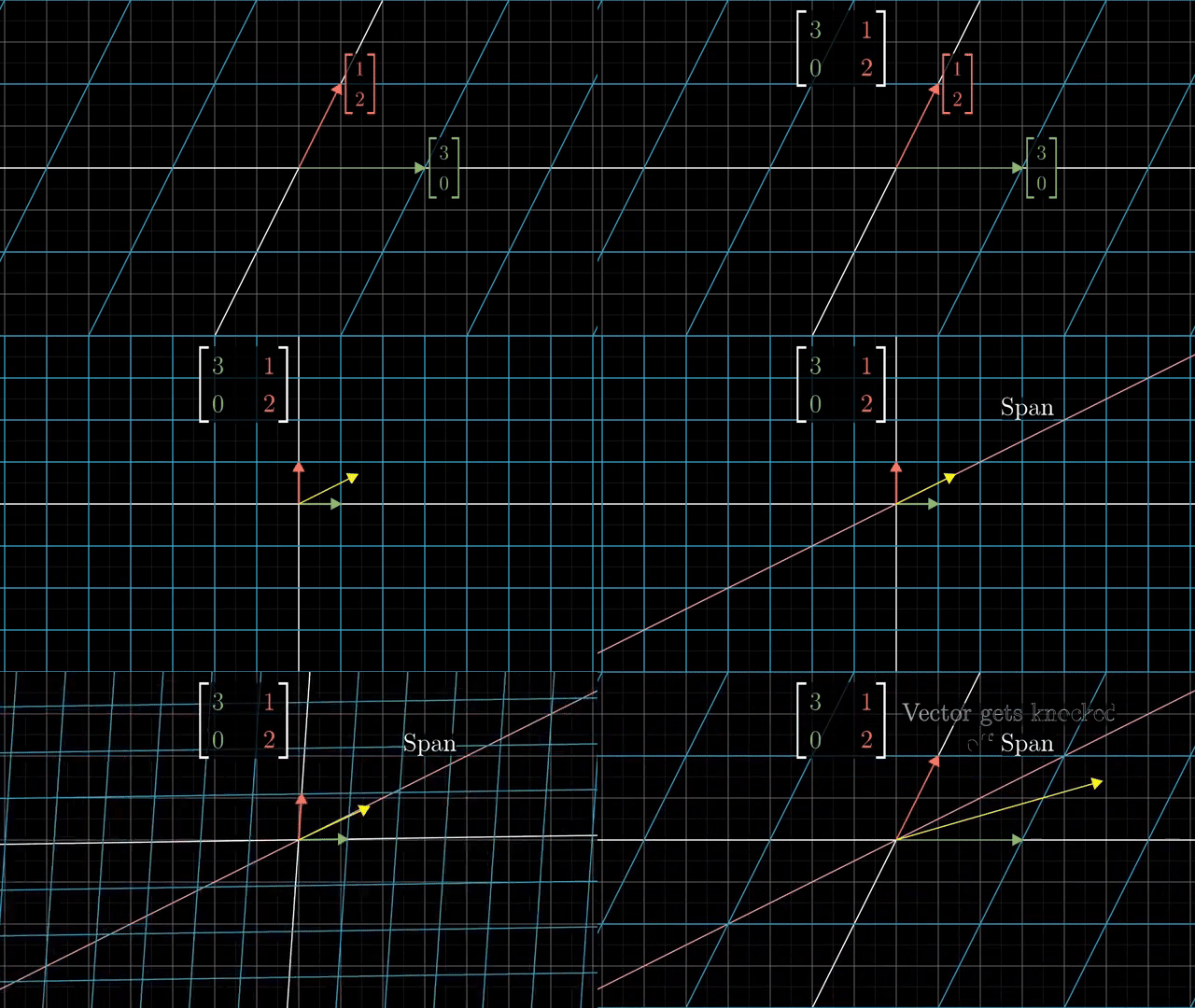
An eigenvector $\mathbf{v}$ satisfies $A\mathbf{v} = \lambda \mathbf{v}$: the map acts on $\mathbf{v}$ purely by the scalar $\lambda$, leaving its span fixed . Geometrically, $\mathbf{v}$ may stretch, shrink, or flip sign, but it does not rotate off its line.
Most vectors leave their span under a general matrix. Eigen directions are rare and informative because they reveal intrinsic axes of the transformation. The scalar $\lambda$ is the eigenvalue associated with $\mathbf{v}$.
The zero vector is excluded: scaling $\mathbf{0}$ is trivial and every matrix would qualify. Rotation by $90^\circ$ in $\mathbb{R}^2$ has no real eigenvectors because no nonzero direction maps back to itself up to scaling.
Equivalently, nontrivial $\mathbf{v}$ lies in the kernel of $A - \lambda I$ for some $\lambda$. That kernel viewpoint connects geometry to determinants in the next card.
When you find an eigenpair, test it by multiplying: $A\mathbf{v}$ should land on the same line as $\mathbf{v}$. If it does not, either $\lambda$ or $\mathbf{v}$ was miscomputed. Eigen directions are the ones where matrix multiplication looks like ordinary scaling.
Check your understanding. The tasks below rest on these ideas: Correct: $\lambda$ is the eigenvalue, the factor by which $A$ scales the eigenvector $\mathbf{v}$. Not quite: it is not a pivot, the determinant, or the trace. Correct: $\mathbf{0}$ trivially satisfies the equation for any $\lambda$, so it carries no information and is excluded by definition. Not quite: $\mathbf{0}$ can be scaled (to itself), no determinant rule is involved, and it does have coordinates. Correct: a quarter turn moves every line, so no real direction is merely scaled (its eigenvalues are complex). Not quite: there are no real eigenvectors, and $\lambda=1$ would fix a direction. Correct: the eigenvalue equation says $A$ scales $\mathbf{v}$ by $\lambda$. Not quite: $A\mathbf{v}=\mathbf{0}$ is the null space, the quadratic form gives a number not an eigenpair, and adding $\lambda$ is not a linear scaling.
Related cards
Video Content
Tasks
Card Info
- Topic: Mathematics
- Difficulty: Advanced
- Completed: 0 users
Creator
