Eigenbasis and diagonalization
When eigenvectors form a basis, $A = B D B^{-1}$ with diagonal $D$ listing eigenvalues on the diagonal . Columns of $B$ are eigenvectors; $D$ tells how much each direction scales.
Defective matrices lack a full eigenbasis. A shear in $\mathbb{R}^2$ typically has only one independent eigenvector even when the eigenvalue is repeated. Jordan blocks appear in advanced courses to complete the story.
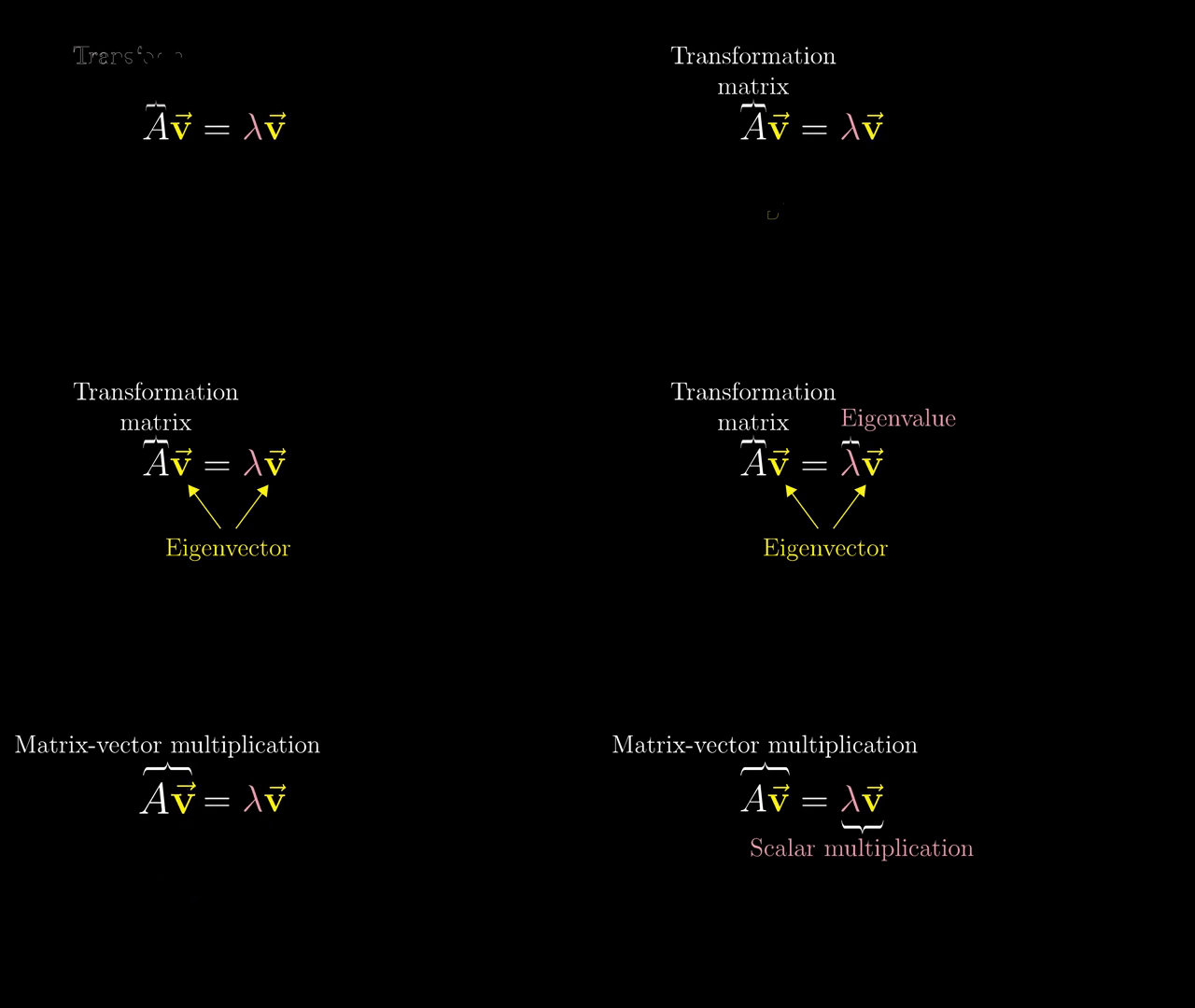
When diagonalization succeeds, matrix powers simplify: $A^k = B D^k B^{-1}$ and $D^k$ is cheap because you raise diagonal entries individually. That is the workhorse for recurrences and discrete dynamical systems.
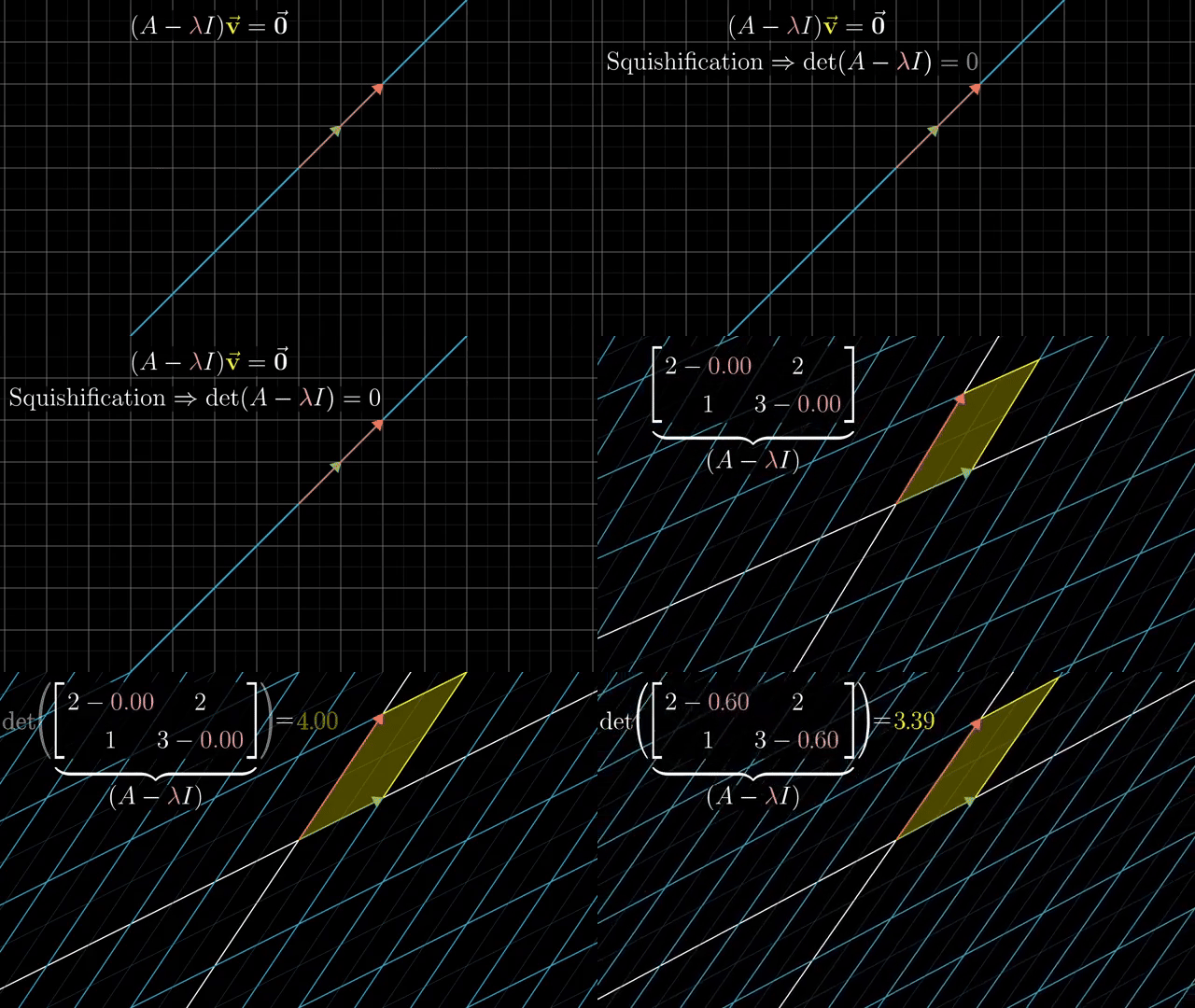
An eigenbasis is simply a basis made of eigenvectors of the map.
To test diagonalizability in small examples, find eigenvectors and check whether you can build $n$ independent ones. If yes, form $B$ from those columns and verify $B^{-1}AB$ is diagonal up to rounding error.
Check your understanding. The tasks below rest on these ideas: Correct: a full set of independent eigenvectors gives $A = BDB^{-1}$. Not quite: it is not forced to be the identity, can be invertible, and need not be symmetric. Correct: a shear has a repeated eigenvalue but only one eigen-direction, so no eigenbasis exists. Not quite: it is not diagonal, its eigenvalues are both $1$ (not $\pm 1$), and it does have eigenvalues. Correct: raising the diagonal $D$ to a power is easy, so $A^k$ follows cheaply. Not quite: the benefit is for powers, not just determinants, traces, or general inverses. Correct: an eigenbasis consists entirely of eigenvectors, which is what enables diagonalization. Not quite: it need not be orthonormal or standard, and null-space vectors are not generally eigenvectors.
Related cards
Video Content
Tasks
Card Info
- Topic: Mathematics
- Difficulty: Advanced
- Completed: 0 users
Creator
