Linear independence: no hidden redundancy in the generator list
Vectors are linearly independent when the only combination giving $\mathbf{0}$ is the trivial one with all coefficients zero. Equivalently, remove any vector and you shrink the span .
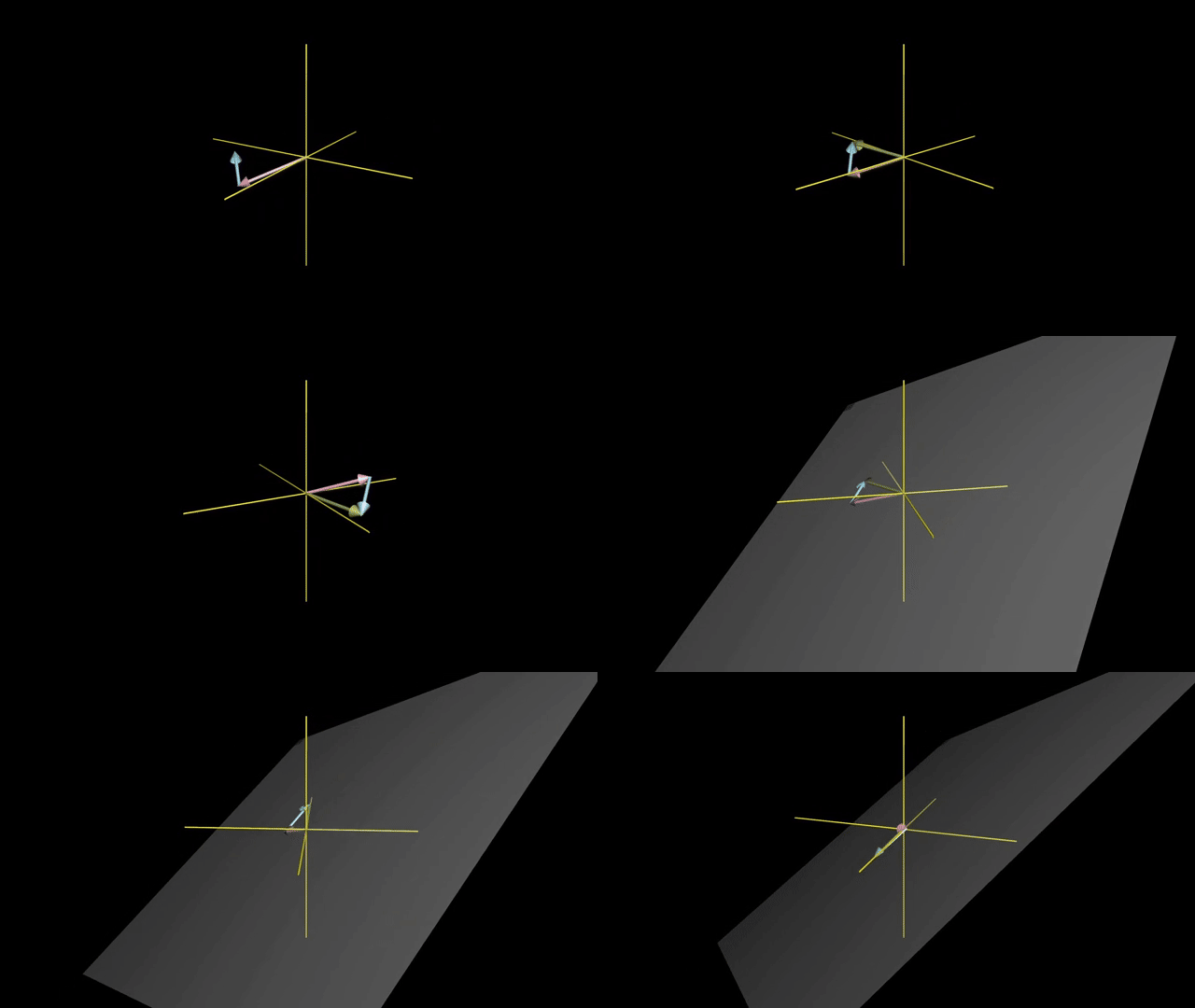
Pairwise non-parallel does not guarantee independence for three or more vectors. Coplanarity can hide dependence without any two being parallel. If $\mathbf{v}_3=\mathbf{v}_1+2\mathbf{v}_2$, the triple is dependent even when no pair is collinear.
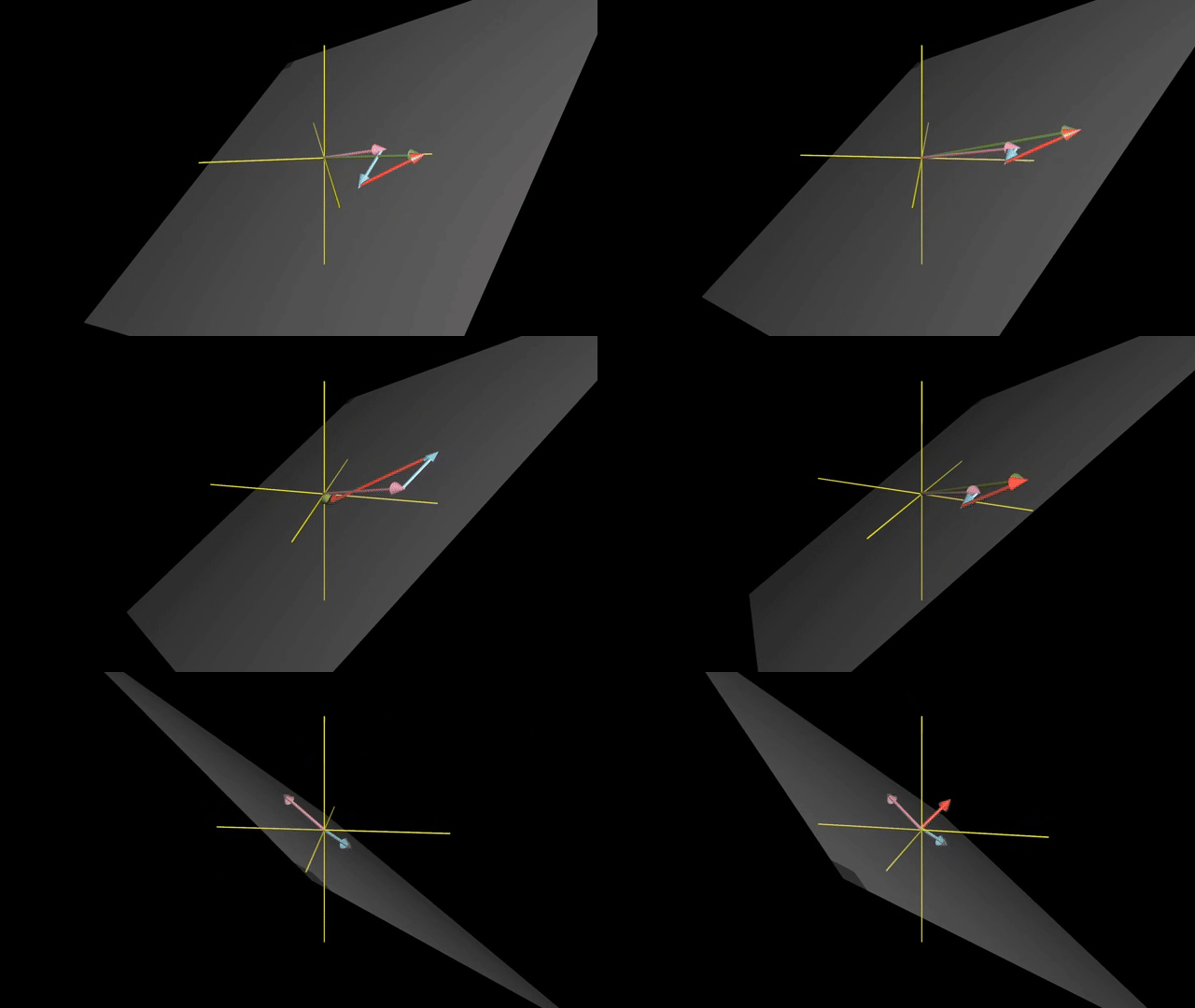
In $\mathbb{R}^2$, two vectors are independent if and only if neither is $\mathbf{0}$ and neither is a scalar multiple of the other. Dependence means a nontrivial annihilating combination $\sum c_i\mathbf{v}_i=\mathbf{0}$ with not all $c_i$ zero.
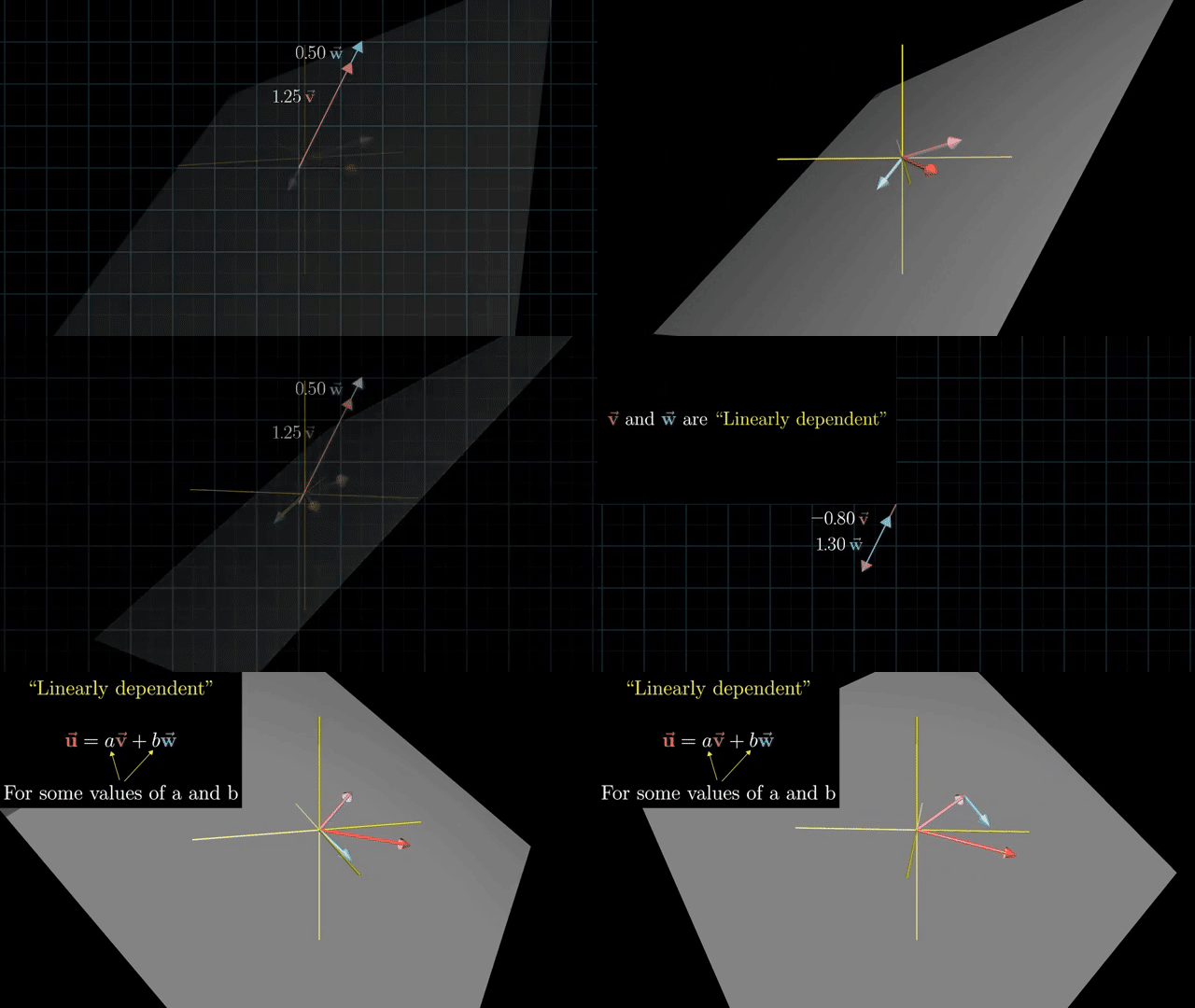
Intuition: a nontrivial relation lets you solve for one vector as a combination of the others unless its coefficient were zero. That vector adds no new direction the list could not already reach.
Check your understanding. The tasks below rest on these ideas: Correct: dependence means a nontrivial annihilating combination exists. Not quite: orthogonality and unequal lengths are unrelated, and dependence can occur with no two vectors parallel (e.g. three coplanar vectors). Correct: in the plane, non-collinearity of two nonzero vectors is precisely independence. Not quite: equal length, a unit dot product, or perpendicularity are neither necessary nor sufficient for independence. Correct: the stated relation is a nontrivial combination giving $\mathbf{0}$, so the triple is dependent. Not quite: dependence can hide among coplanar vectors with no parallel pair, and a dependent set is never a basis of three-space. Correct: pick a term with nonzero coefficient and rearrange the relation to express that vector via the rest. Not quite: a dependent set need not contain $\mathbf{0}$, need not be parallel, and says nothing about dot products.
Related cards
Video Content
Tasks
Card Info
- Topic: Mathematics
- Difficulty: Beginner
- Completed: 0 users
Creator
