Span: the flat region of everything reachable from a generating set
$\mathrm{span}\{\mathbf{v}_1,\ldots,\mathbf{v}_k\}$ is the set of all destinations produced by some choice of coefficients. In $\mathbb{R}^3$, one nonzero vector spans a line; two non-collinear vectors span a plane; three independent vectors can reach the full space .
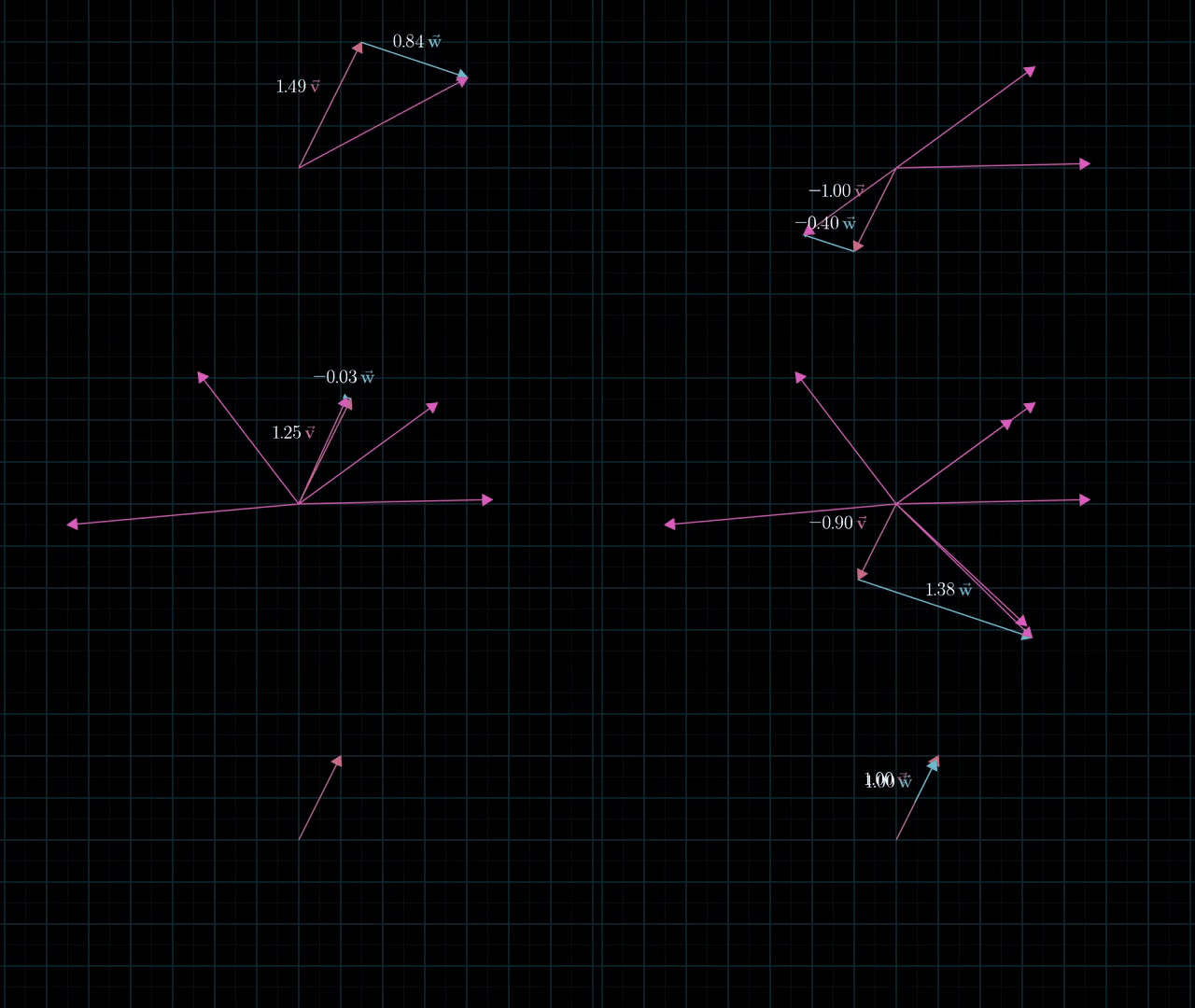
Watch dependence degeneracies: if every generator lies in a plane, no amount of scaling escapes that plane. Span is intrinsic to the generating set, not "whatever the drawing looks like." If $\mathbf{w}$ already lies in $\mathrm{span}\{\mathbf{u},\mathbf{v}\}$, then adding $\mathbf{w}$ does not enlarge the span.
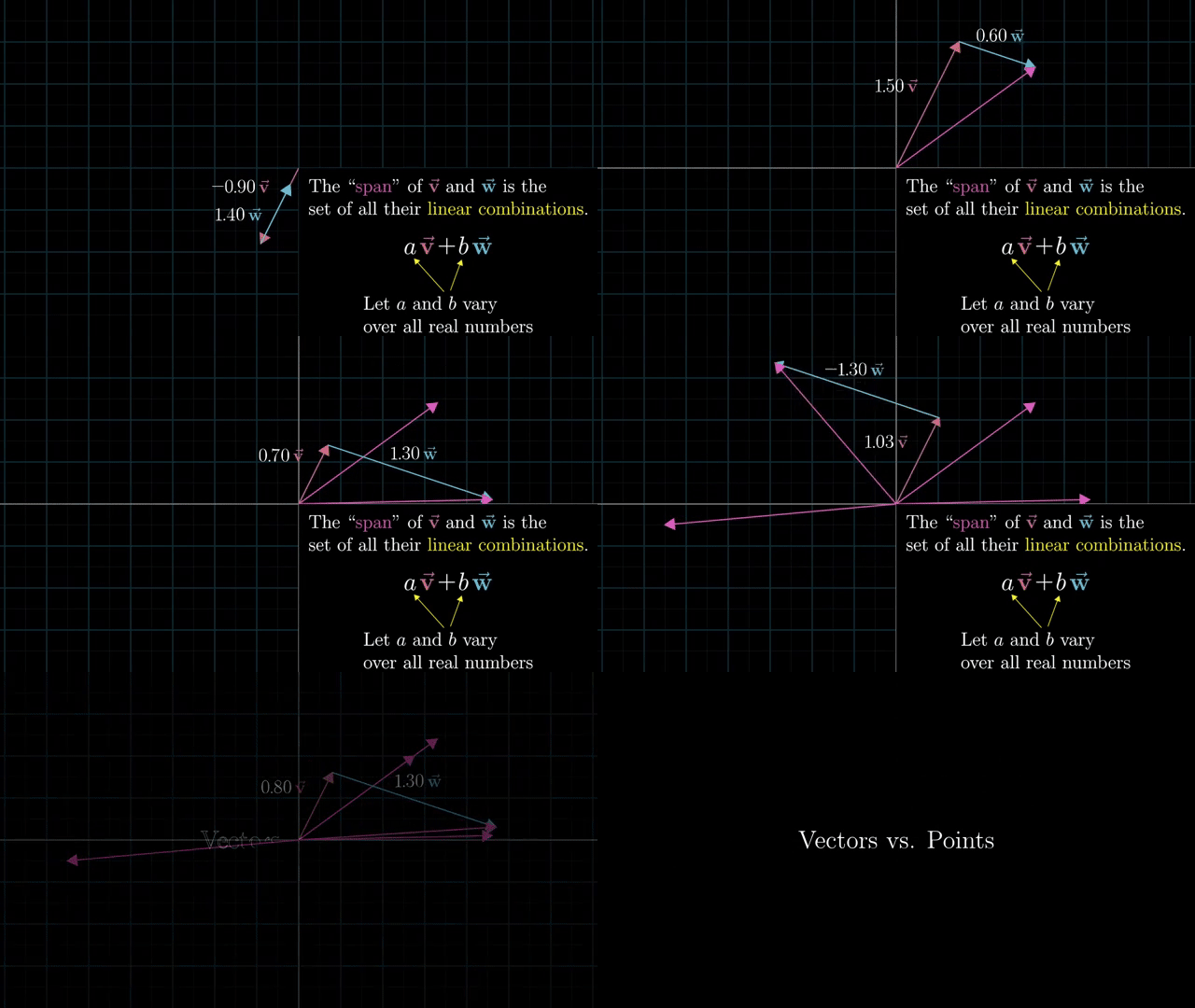
The span of any set of vectors is always a subspace: closed under addition and scalar multiplication, and always containing $\mathbf{0}$. Two collinear nonzero vectors in $\mathbb{R}^3$ span only the line through the origin along their shared direction.
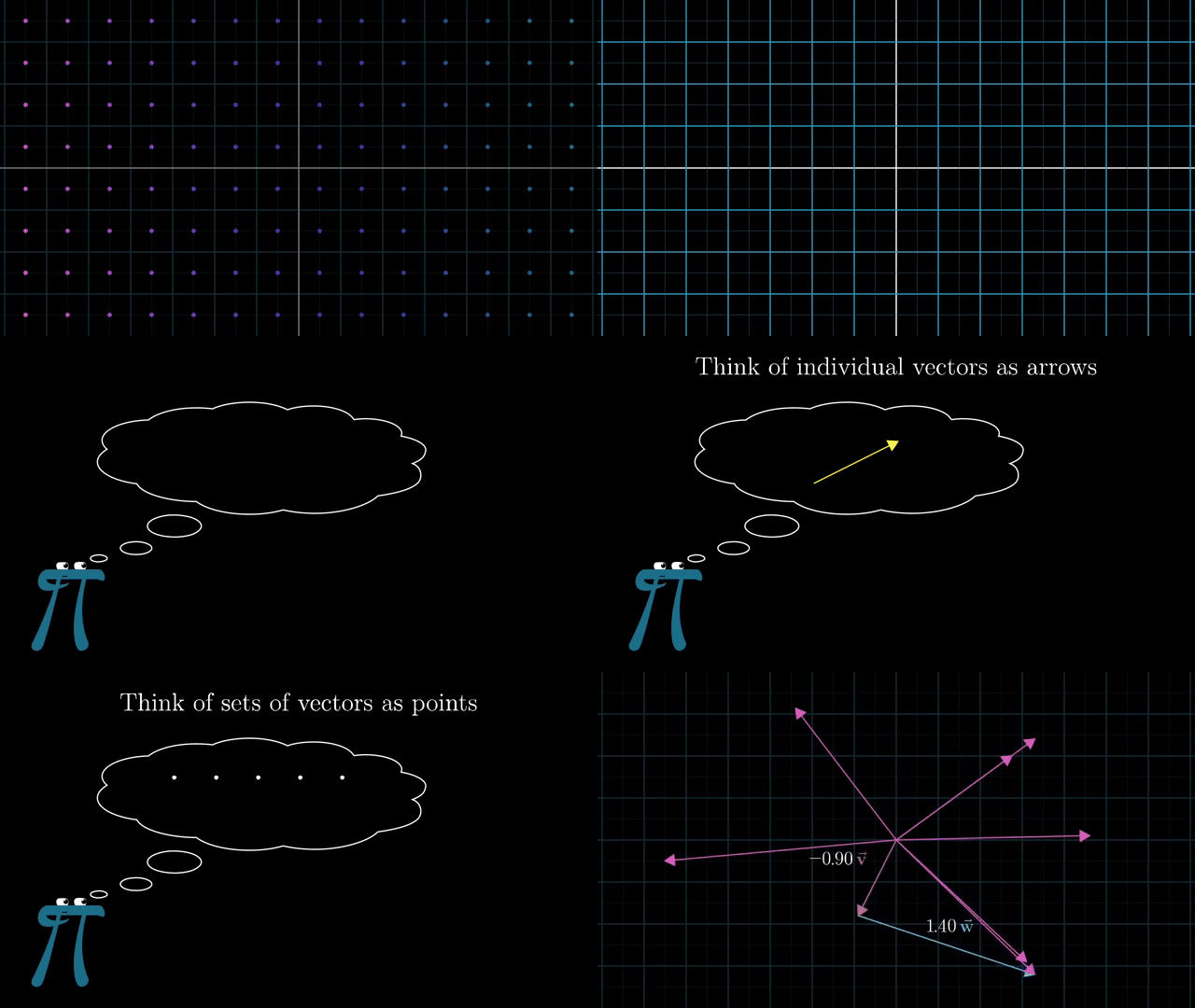
Example: $\mathrm{span}\{\hat{\mathbf{i}}\}$ in $\mathbb{R}^3$ is the $x$-axis, all vectors with second and third coordinates zero. That is a one-dimensional subspace even though the ambient space is three-dimensional .
Check your understanding. The tasks below rest on these ideas: Correct: a redundant generator adds no new reachable points, so the span is unchanged. Not quite: a dependent vector cannot suddenly reach all of space or collapse the span to a line or to nothing. Correct: by construction the span contains all combinations, so it is closed under the operations and holds the origin. Not quite: spans are continuous subspaces, contain rather than oppose their generators, and need not fill the whole space. Correct: collinear vectors are scalar multiples, so every combination stays on their shared line through $\mathbf{0}$. Not quite: a plane or all of space needs two or three independent directions, and a span is a continuum, not just the listed vectors. Correct: scaling $\hat{\mathbf{i}}$ alone reaches every $(t,0,0)$, a one-dimensional subspace. Not quite: a plane or all of space requires more independent directions, and the span is the whole line, not one point.
Related cards
Video Content
Tasks
Card Info
- Topic: Mathematics
- Difficulty: Beginner
- Completed: 0 users
Creator
