Basis: minimal spanning set, no junk directions, no missing directions
A basis for a subspace is an independent spanning family; order matters because coordinates list coefficients in that sequence. Dimension counts basis size .
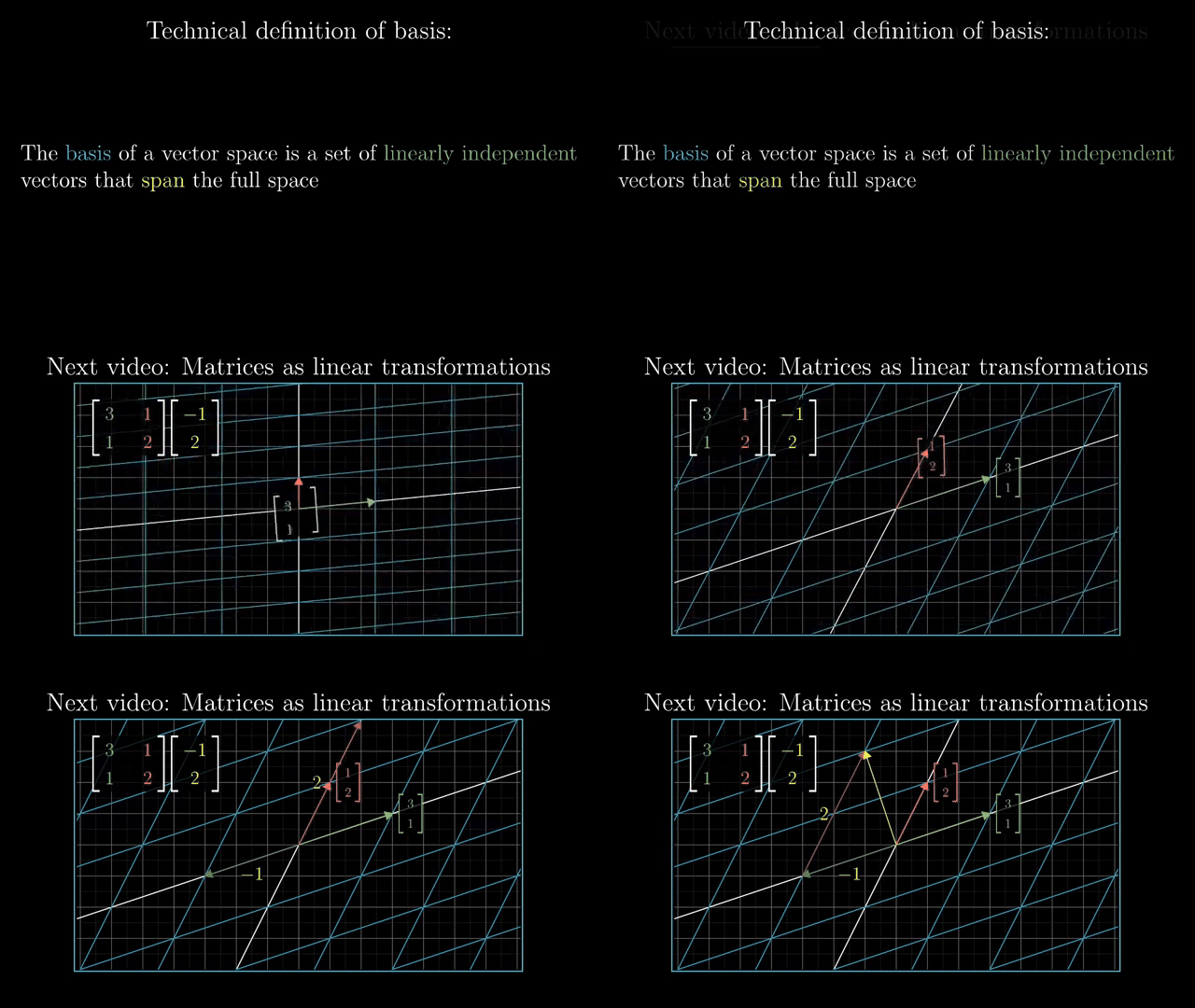
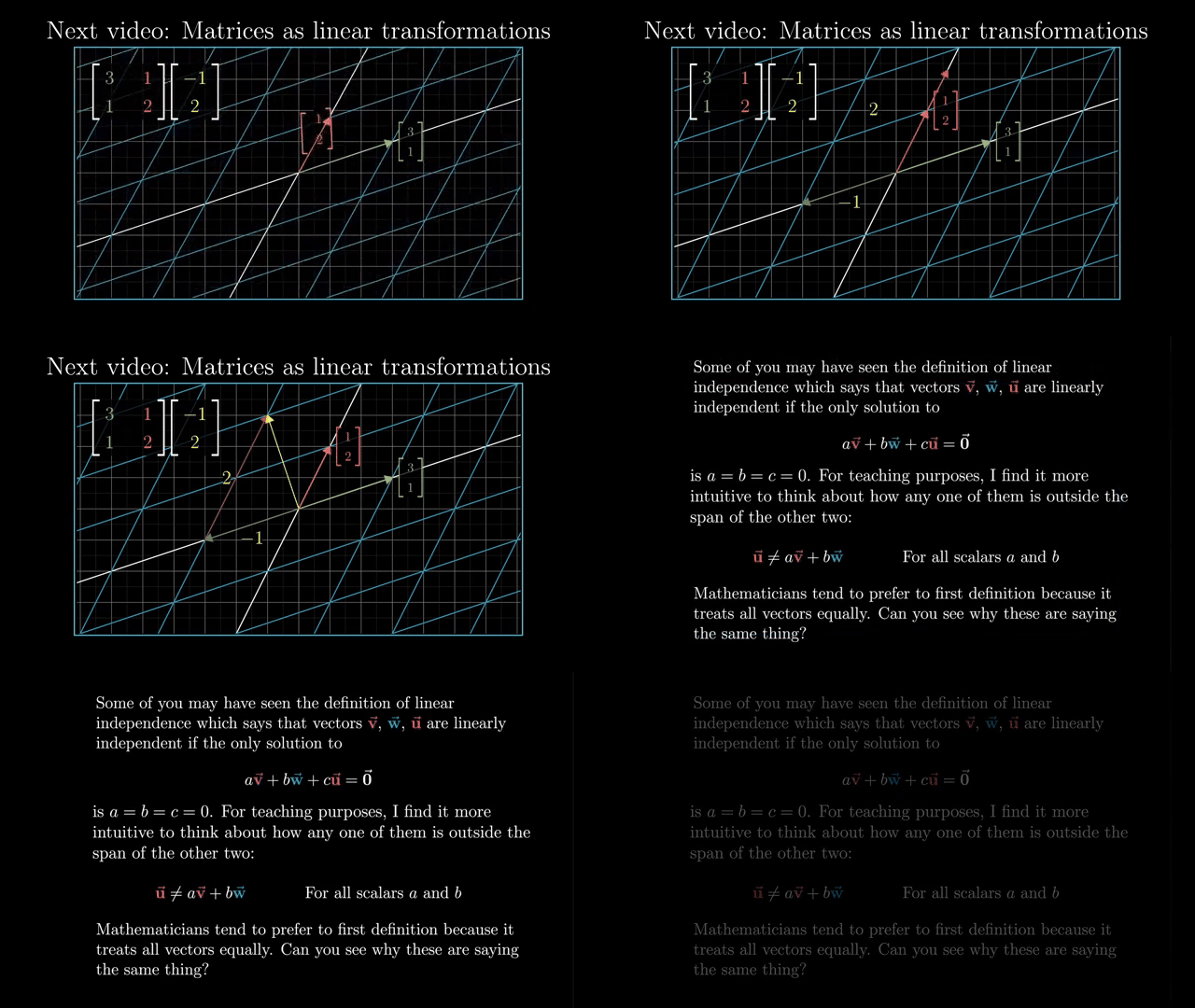
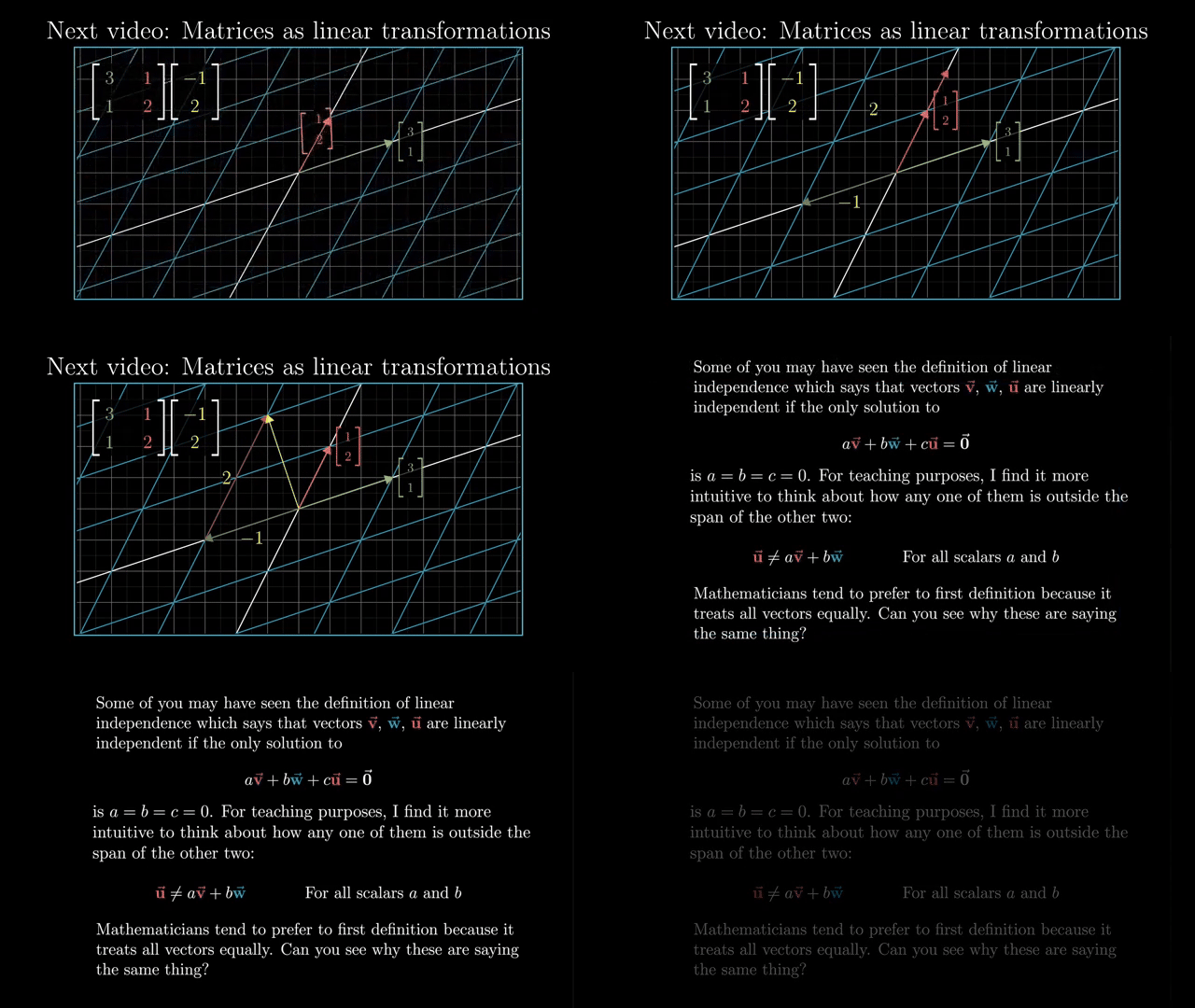
Every basis of a fixed subspace has the same cardinality by the dimension theorem. Coordinates relative to an ordered basis are unique because independence forbids two different combinations naming the same vector. Different coefficient lists would subtract to a nontrivial null combination.
The standard basis of $\mathbb{R}^n$ has $n$ vectors with a single $1$ entry each. It is one convenient orthonormal basis among infinitely many. Bases need not be orthogonal; oblique bases are clumsier numerically yet perfectly valid.
$\mathbb{R}^3$ has dimension $3$ because any basis contains three independent vectors spanning three-space. That number is intrinsic to the space, not to how you draw it .
Check your understanding. The tasks below rest on these ideas: Correct: the dimension theorem guarantees all bases of a subspace share one cardinality. Not quite: that count is intrinsic, independent of angles, not fixed at two, and can be smaller than the ambient dimension for a proper subspace. Correct: if two coefficient lists gave the same vector, their difference would be a nontrivial null combination, contradicting independence. Not quite: uniqueness needs no length rule, no commuting matrices, and no orthonormality. Correct: $\mathbf{e}_1,\ldots,\mathbf{e}_n$ each have one $1$ entry, giving $n$ vectors. Not quite: the other counts confuse the basis size with subset counts, a fixed pair, or matrix-entry counts. Correct: dimension is the basis size, and every basis of $\mathbb{R}^3$ has three vectors. Not quite: entry counts, basis choice, and the number of points in the space do not determine dimension.
Related cards
Video Content
Tasks
Card Info
- Topic: Mathematics
- Difficulty: Beginner
- Completed: 0 users
Creator
