Linearity revisited: additivity + homogeneity
A map $T$ is linear when $T(u+v) = T(u) + T(v)$ and $T(cu) = cT(u)$. That pair of rules generalizes grid intuition to abstract domains .
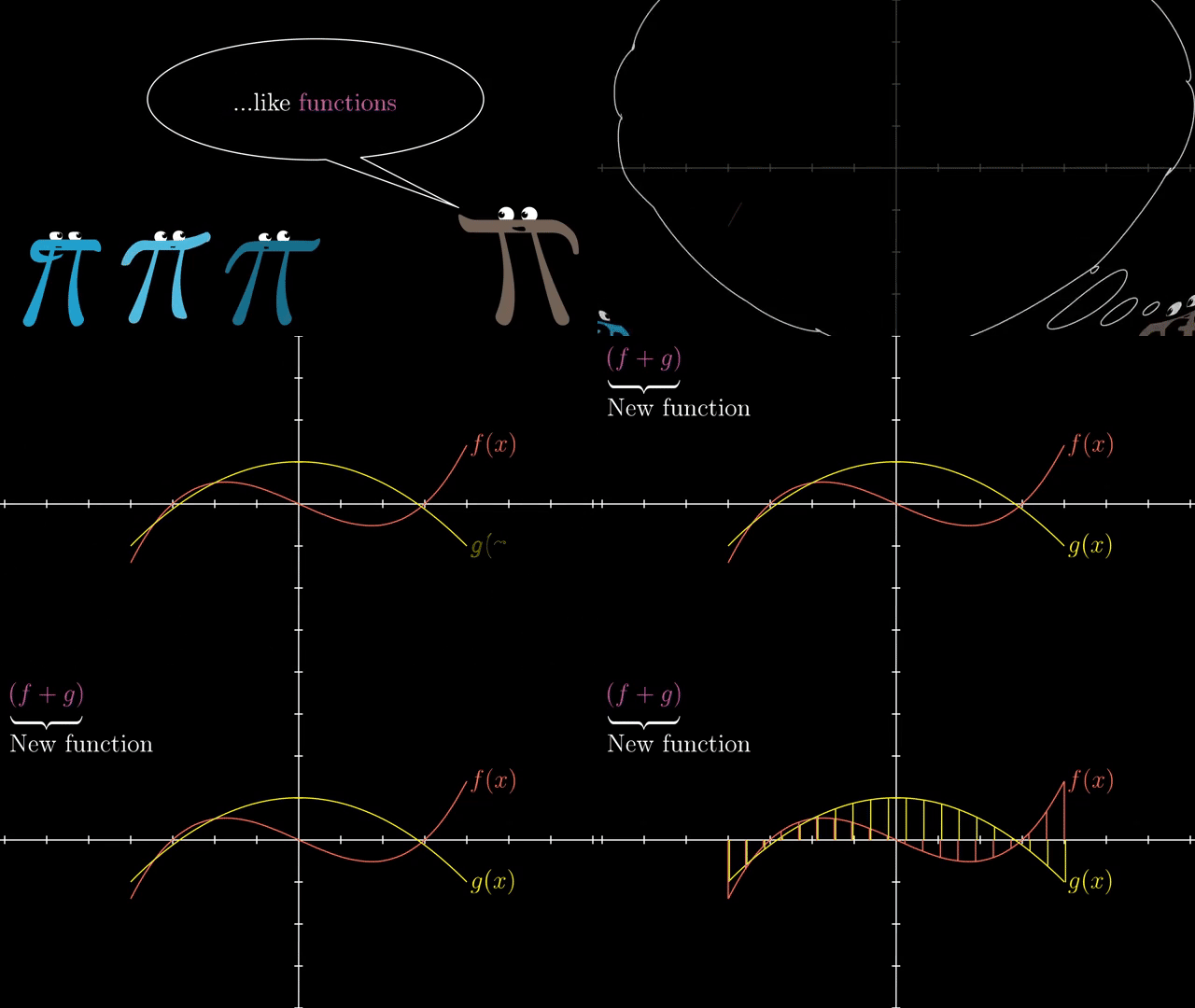
The derivative operator is linear on differentiable functions because the sum rule and constant-multiple rule match additivity and homogeneity. Integration over a finite interval is linear from integrable functions to reals.
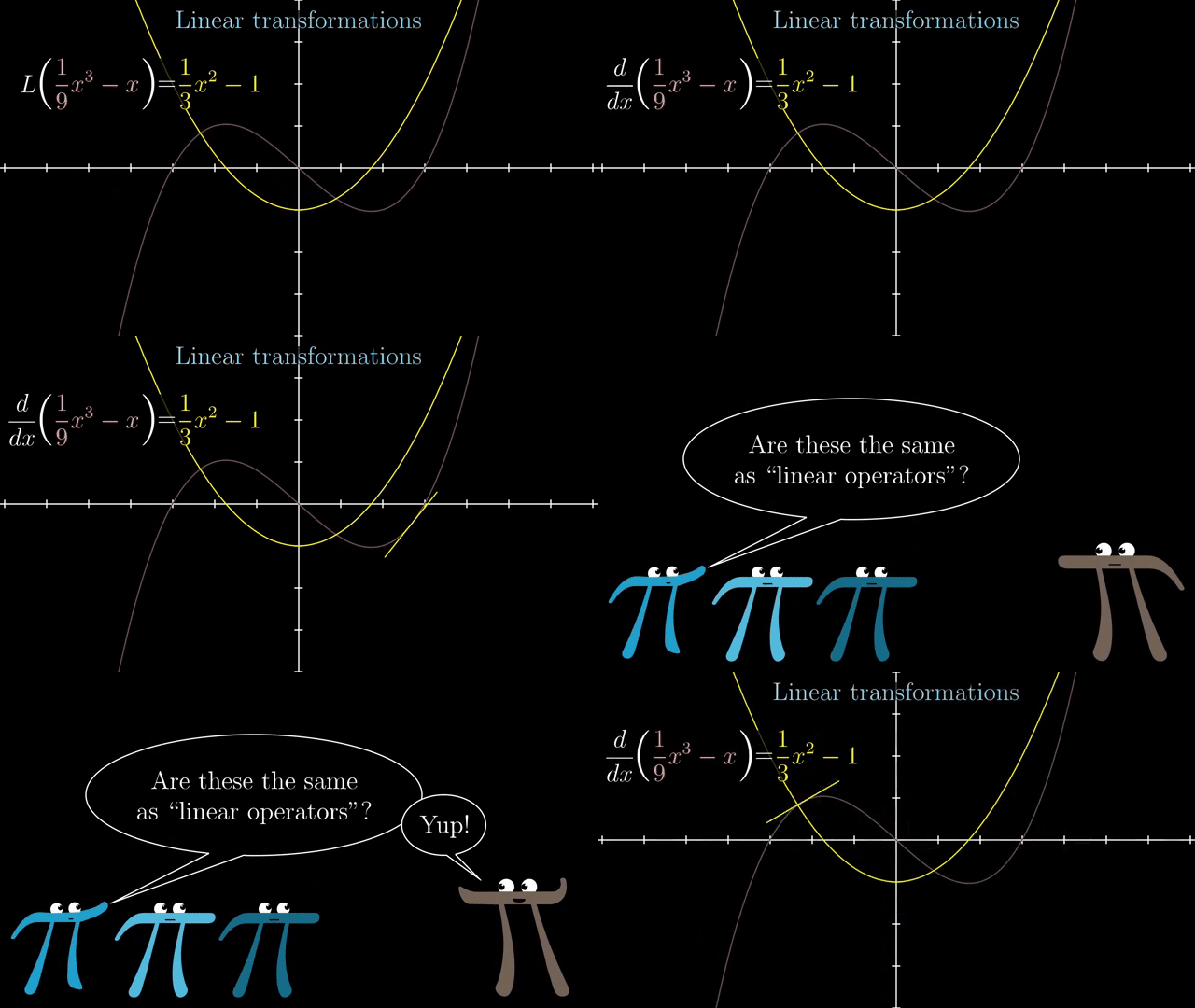
Squaring entries coordinatewise is not linear: $(u+v)^2 \neq u^2 + v^2$ in general, so $f \mapsto f^2$ fails additivity. Nonlinear operators abound outside the linear-algebra core.
Quick test: verify $T(cu)=cT(u)$ on a simple vector before checking additivity. Many student errors come from maps that scale correctly on axis directions but fail on sums.
Check your understanding. The tasks below rest on these ideas: Correct: $(f+g)' = f' + g'$ and $(cf)' = cf'$ are exactly additivity and homogeneity. Not quite: the chain and product rules are about compositions and products, and the derivative is not constant. Correct: the integral of a sum is the sum of integrals, and constants factor out. Not quite: it is linear for all integrable functions, not just polynomials, and it is well defined. Correct: squaring fails additivity, since $(f+g)^2 \neq f^2 + g^2$. Not quite: differentiation, scaling, and integration are all linear. Correct: squaring introduces cross terms, breaking additivity. Not quite: it is continuous, preserves dimension, and the failure is about additivity, not fixed points.
Related cards
Video Content
Tasks
Card Info
- Topic: Mathematics
- Difficulty: Advanced
- Completed: 0 users
Creator
