Polynomial coordinates and infinite-dimensional flavor
Coefficients of a polynomial act like coordinates with respect to the basis $\{1, x, x^2, \ldots\}$. Each polynomial has finite support in that list even though the basis itself is infinite .
The space of all polynomials of unbounded degree is infinite-dimensional: no finite spanning set exists. The degree-$d$ polynomials form a subspace of dimension $d+1$ with basis $\{1, x, \ldots, x^d\}$.
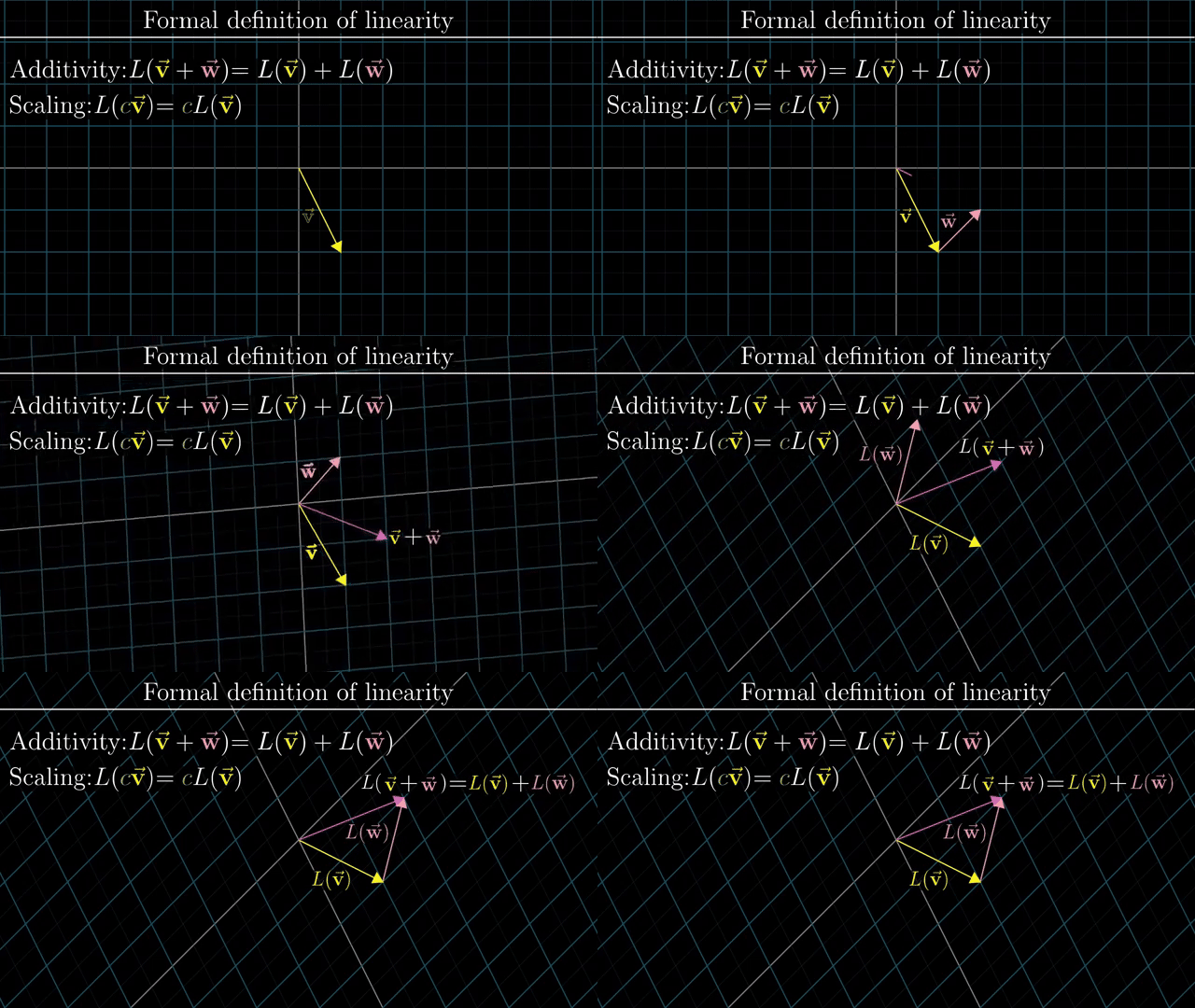
Differentiation lowers degree: $D x^n = n x^{n-1}$. On coefficient sequences this looks like a shift with integer weights, the same "where basis vectors land" viewpoint from Chapter 3 revisited on a larger habitat.
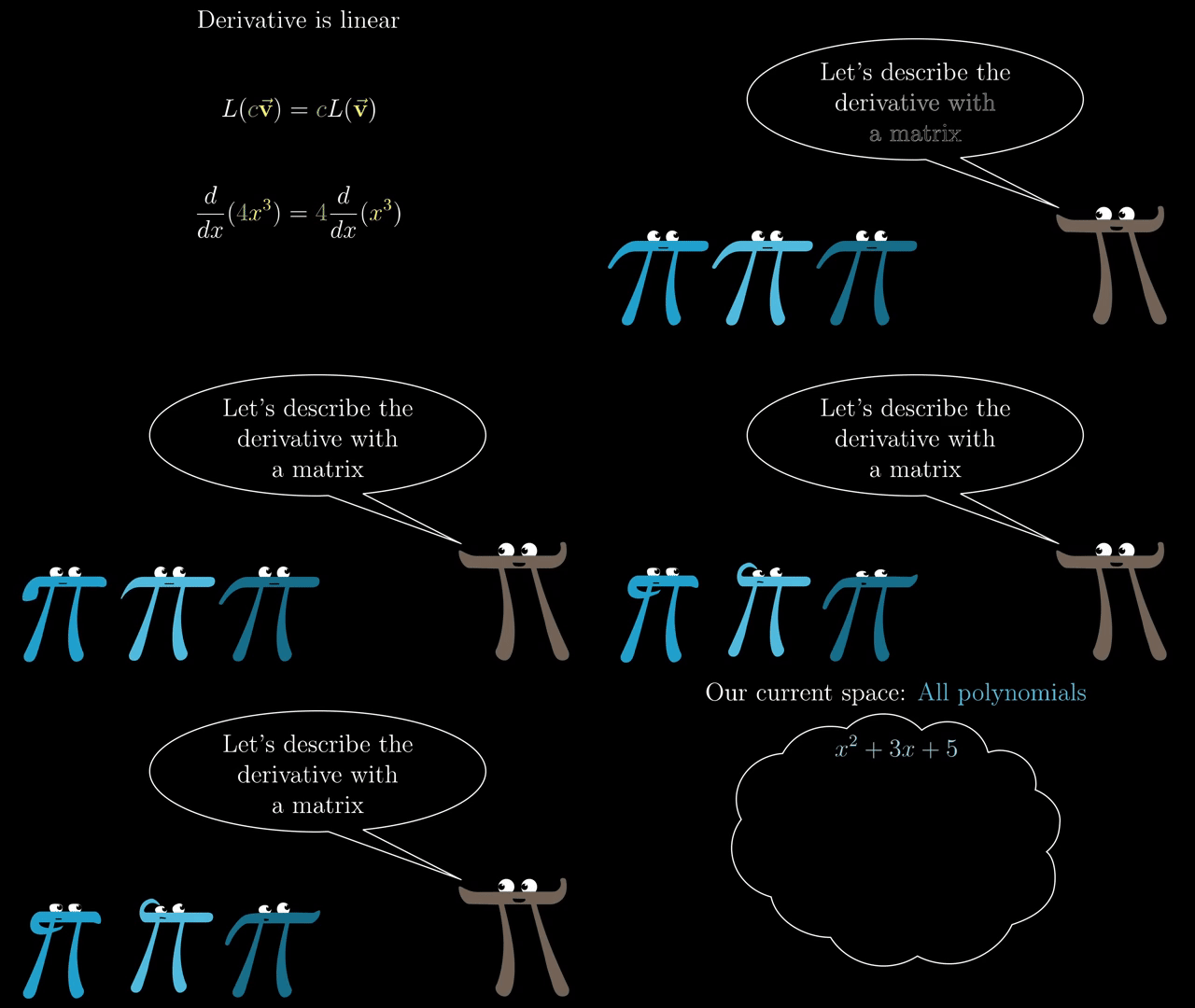
A linear transformation is still specified by where basis vectors go, even when the basis is infinite.
Finite-degree polynomials are a comfortable middle ground: infinite family of basis monomials, but each vector uses only finitely many coordinates. That is how infinite dimension first appears without losing computability.
Check your understanding. The tasks below rest on these ideas: Correct: the monomials $1, x, x^2, \ldots$ form an infinite basis, so the space is infinite-dimensional. Not quite: it is not a fixed finite dimension. Correct: the $d+1$ monomials from $1$ up to $x^d$ are a basis. Not quite: it is $d+1$, counting the constant term, not $d$, $2^d$, or $d^2$. Correct: differentiation lowers degree by one and multiplies by the exponent, a weighted shift on coefficients. Not quite: it is not diagonal, the identity, or a permutation. Correct: the derivative is a linear map, still described by where each basis monomial goes. Not quite: a determinant, eigenvalue, or dot product is not the operator itself.
Related cards
Video Content
Tasks
Card Info
- Topic: Mathematics
- Difficulty: Advanced
- Completed: 0 users
Creator
