Geometry: eigen directions reveal intrinsic stretching
Reading columns shows where basis vectors land, but eigenvectors summarize natural axes of strain or rotation-scaling . They are the directions the map treats most simply.
Symmetric real matrices admit real eigenvalues and an orthonormal eigenbasis. That spectral theorem underlies principal component analysis in statistics: covariance eigenvectors are orthogonal data directions.
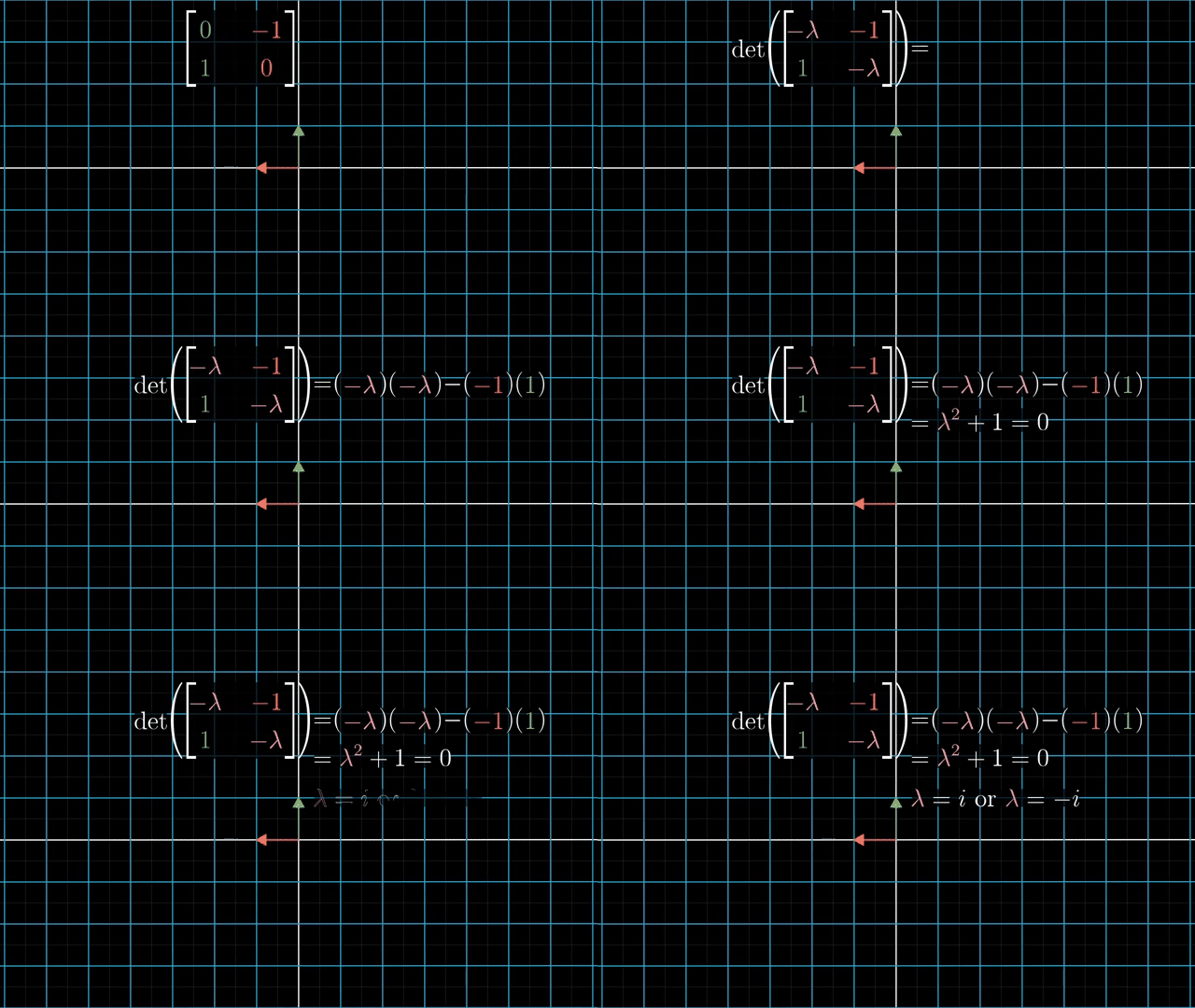
Non-normal matrices may lack orthogonal eigenvectors. Stability of $\mathbf{x}_{k+1} = A\mathbf{x}_k$ depends on eigenvalue moduli: magnitudes below $1$ contract those components under repeated application.

Geometry and spectrum together explain why diagonalization is more than symbol pushing: it aligns coordinates with the map's intrinsic action.
In data analysis, orthogonal eigenvectors of a covariance matrix order directions by variance. In dynamics, eigenvalue moduli tell you which modes grow or decay under repeated application of the same matrix.
Check your understanding. The tasks below rest on these ideas: Correct: the spectral theorem guarantees real eigenvalues and orthogonal eigenvectors for symmetric matrices. Not quite: it does have eigenvectors, a real trace, and real eigenvalues. Correct: only normal matrices are guaranteed an orthonormal eigenbasis; non-normal ones may not have one. Not quite: they are not guaranteed orthogonal eigenvectors, do have eigenvalues, and need not be diagonal. Correct: components scale by $\lambda^k$, so eigenvalue magnitudes decide growth or decay. Not quite: the trace sign, a unit determinant, or the row count do not by themselves determine stability. Correct: PCA diagonalizes the covariance matrix, ordering orthogonal directions by variance. Not quite: sorting, searching, and hashing are unrelated to eigenvectors.
Related cards
Video Content
Tasks
Card Info
- Topic: Mathematics
- Difficulty: Advanced
- Completed: 0 users
Creator
