Bridge to the quick $2\times2$ eigenvalue trick
Chapter 15 compresses the quadratic characteristic polynomial for $2 \times 2$ matrices using trace and determinant . The roots are unchanged; only the bookkeeping shrinks.
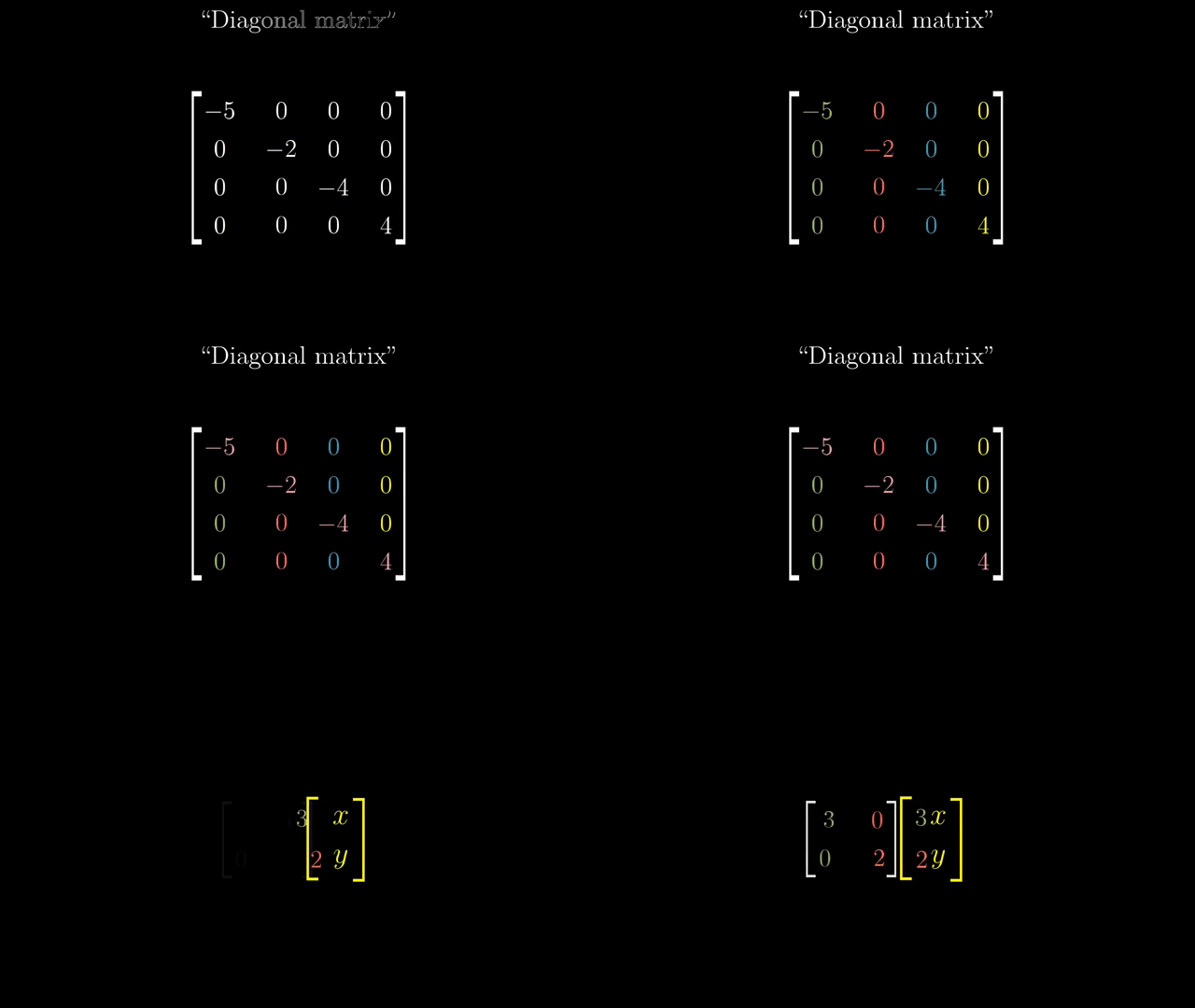
The characteristic polynomial for an $n \times n$ matrix has degree $n$. Complex eigenvalues of real matrices arise from irreducible quadratics and occur in conjugate pairs when they do.
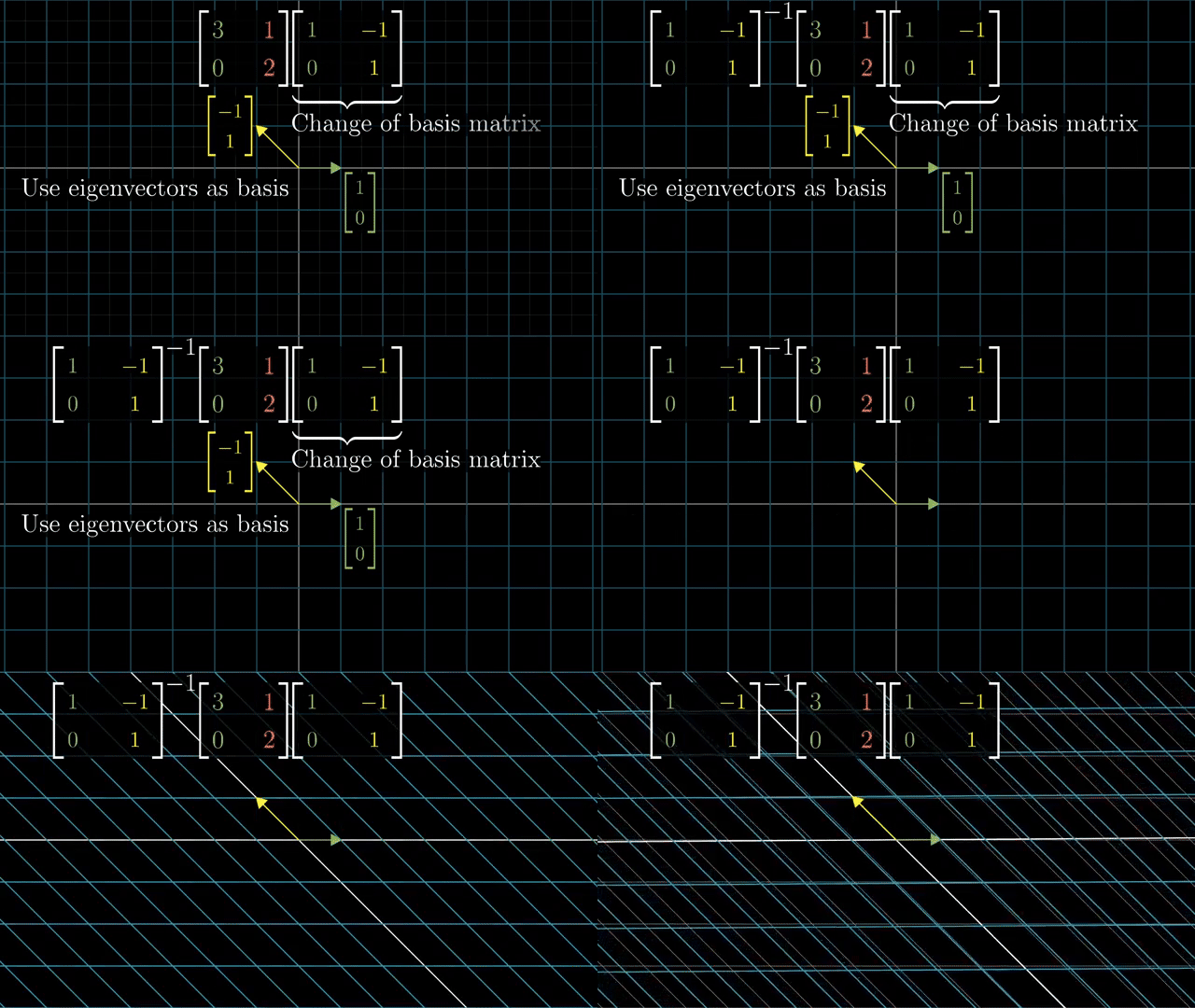
Diagonalizable does not imply normal: many diagonalizable matrices are non-normal. If every eigenvalue satisfies $|\lambda| \lt 1$, repeated application $A^k \mathbf{v}$ typically decays along contracting directions.
Chapter 15 returns to $2 \times 2$ matrices and compresses the quadratic characteristic polynomial into trace-determinant language you can apply on one line of scratch paper.
Keep the degree-$n$ picture in mind: the shortcut is a deliberate specialization, not a replacement for the full theory in higher dimensions.
Check your understanding. The tasks below rest on these ideas: Correct: $\det(A - \lambda I)$ is a degree-$n$ polynomial in $\lambda$. Not quite: it is degree $n$, not $1$, $2n$, or $n^2$. Correct: real-coefficient polynomials have complex roots in conjugate pairs. Not quite: a unit determinant, zero trace, or diagonal form do not produce this pairing. Correct: diagonalizable (an eigenbasis exists) is weaker than normal (an orthonormal eigenbasis exists). Not quite: the implication does not hold in general, in 2D, or under invertibility. Correct: each eigencomponent scales by $\lambda^k$, which shrinks when $\lvert\lambda\rvert\lt 1$. Not quite: magnitudes below $1$ contract rather than grow, persist, or stay fixed.
Related cards
Video Content
Tasks
Card Info
- Topic: Mathematics
- Difficulty: Advanced
- Completed: 0 users
Creator
