Trace and determinant from eigenvalues (with multiplicity)
Over $\mathbb{C}$, counting algebraic multiplicities,
$$\mathrm{tr}(A) = \sum_i \lambda_i, \qquad \det(A) = \prod_i \lambda_i.$$
These identities link spectrum to two numbers you can read quickly from a matrix .
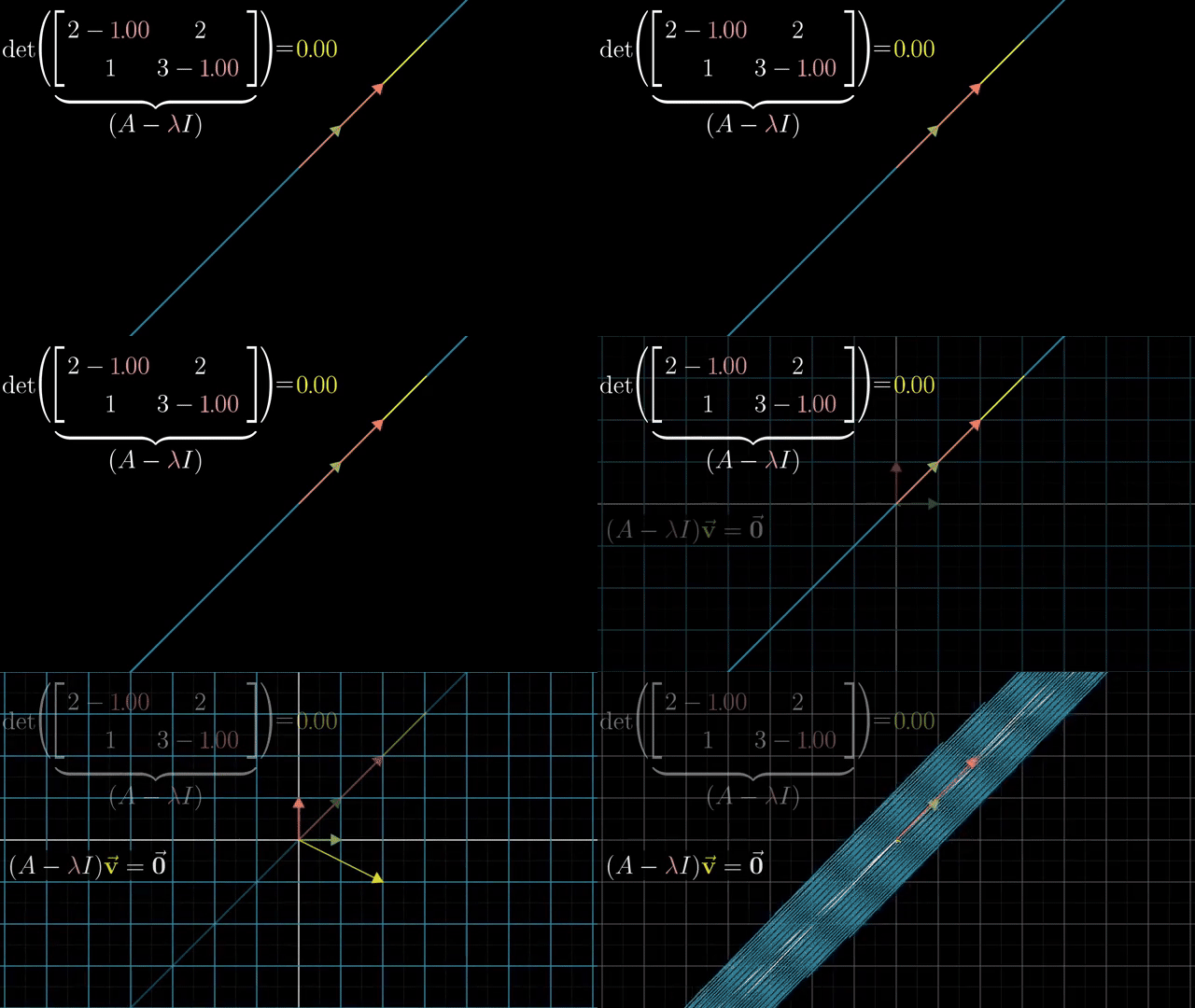
For $2 \times 2$ matrices they explain the trace-determinant shortcut in Chapter 15: eigenvalue sum equals trace, eigenvalue product equals determinant. A zero eigenvalue means $A$ is singular because the product of eigenvalues vanishes.

When eigenvalues are $2$ and $5$ for a $2 \times 2$ map, trace is $7$ immediately without finding eigenvectors explicitly.
Multiplicity matters: a repeated eigenvalue can still admit two independent eigenvectors (diagonalizable) or only one (defective). Trace and determinant tell you the eigenvalue list with algebraic multiplicities, not the geometric dimension of each eigenspace.
Computing $\mathrm{tr}(A)$ and $\det(A)$ first is often faster than solving for eigenvectors when you only need the spectrum of a $2\times2$ matrix.
Check your understanding. The tasks below rest on these ideas: Correct: $\lambda_1 + \lambda_2 = \mathrm{tr}(A)$. Not quite: the determinant is the product, and rank or a single entry are unrelated. Correct: $\prod_i \lambda_i = \det(A)$. Not quite: the trace is the sum, and rank/diagonal-sum are not the product. Correct: a zero eigenvalue makes the determinant (the product of eigenvalues) zero, so $A$ is singular. Not quite: it is the opposite of invertible, and unrelated to orthogonality or symmetry. Correct: the trace is the sum of the eigenvalues, $2 + 5 = 7$. Not quite: $10$ is the product (the determinant), $3$ is the difference, and $2.5$ is the mean.
Related cards
Video Content
Tasks
Card Info
- Topic: Mathematics
- Difficulty: Advanced
- Completed: 0 users
Creator
