Parsing the "backwards" feeling
Students often feel the change-of-basis story runs backward. The resolution is to separate geometry from coordinates. Columns of $B$ list her basis vectors in your language; multiplying by $B$ converts her numeric address of a geometric vector into yours .
Draw the picture: two skewed grids, one fixed arrow. Jennifer labels her first basis direction $\mathbf{b}_1$ with $(1,0)$ in her machine because her first slot means one step along $\mathbf{b}_1$. Coordinates are intrinsic to the chosen basis, not absolute lengths in space.
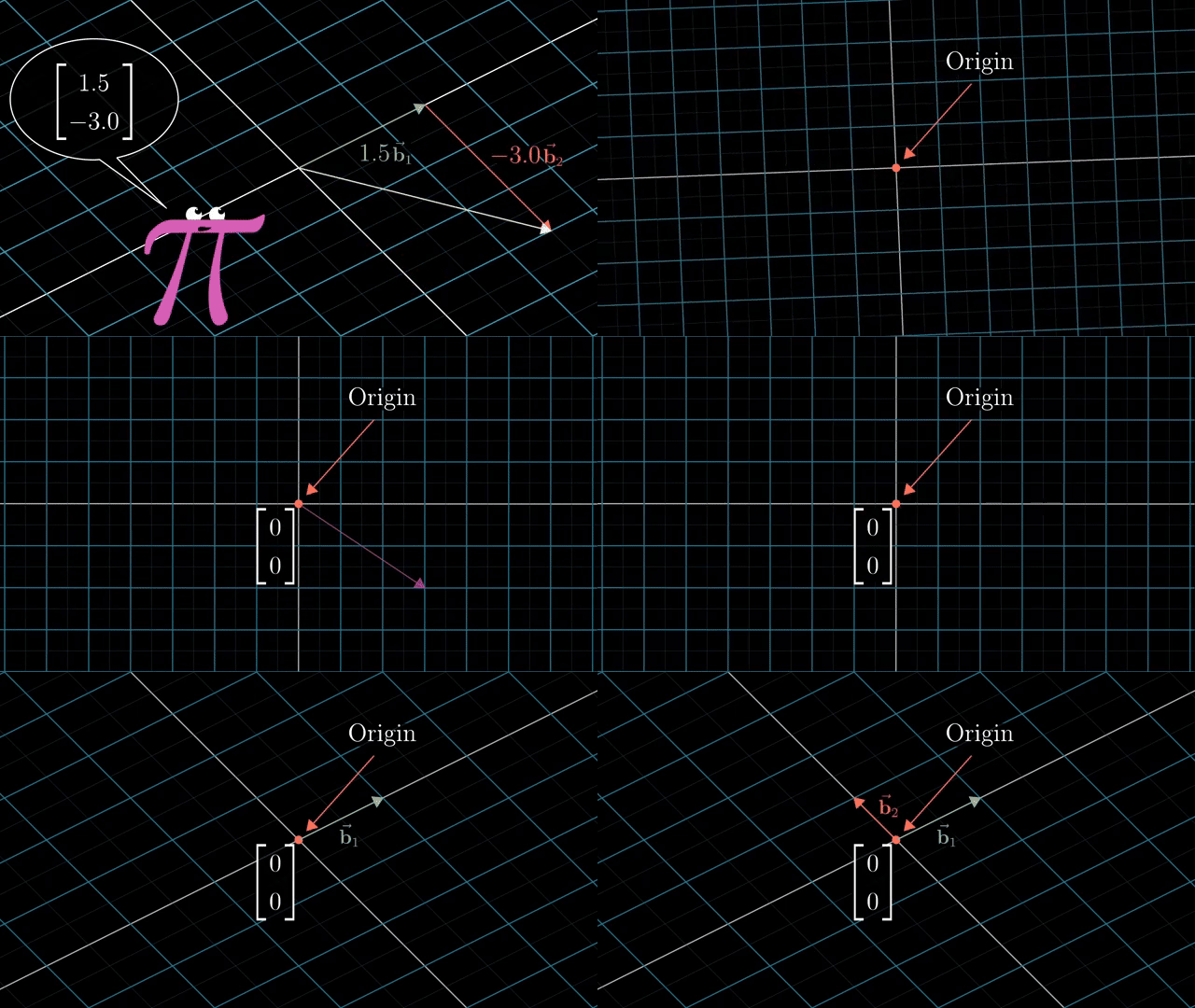
Space itself has no preferred coordinates. Two bases for the same subspace differ by an invertible square map on coefficients. That is why $B$ must be nonsingular: otherwise the proposed new labels would not form a genuine basis.
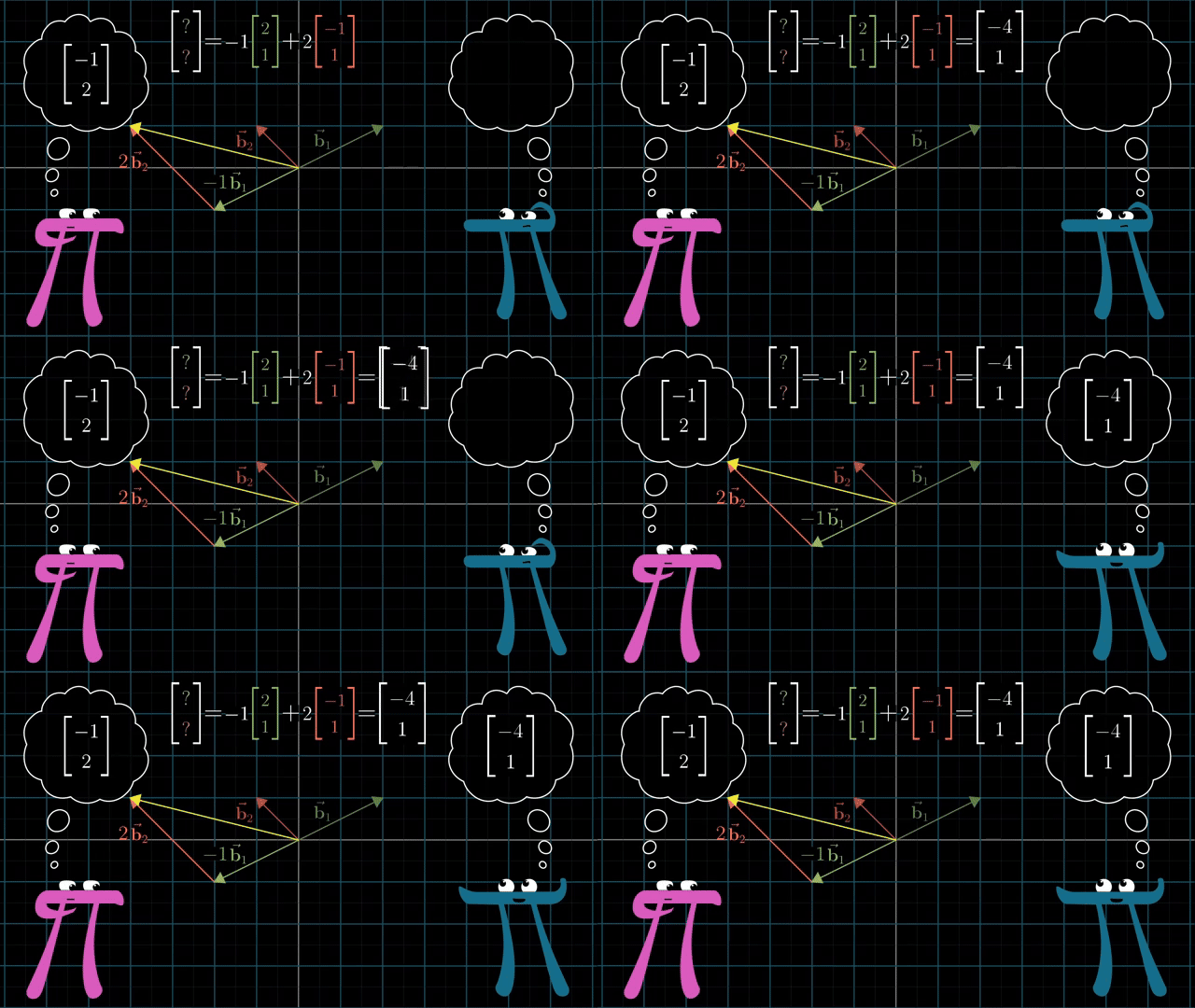
When numeric entries disagree for the same arrow, you are expanding one geometric vector in different linear combinations of basis directions.
Check your understanding. The tasks below rest on these ideas: Correct: coordinates are human bookkeeping; the geometry is basis-independent. Not quite: there is no privileged grid, space is spannable, and it has infinitely many bases. Correct: any two bases differ by an invertible change-of-basis matrix. Not quite: it need not be merely a permutation or rotation, and a projection is not invertible. Correct: in any basis, the $j$-th basis vector has coordinates with a single $1$ in slot $j$. Not quite: lengths are not absolute, no determinant rule forces this, and her basis need not be standard. Correct: the same vector has different coefficient lists in different bases. Not quite: neither of you is wrong, the arrow is fixed, and coordinates are systematic, not random.
Related cards
Video Content
Tasks
Card Info
- Topic: Mathematics
- Difficulty: Intermediate
- Completed: 0 users
Creator
