Transformations in alternate coordinates sandwich
If $M_{\text{yours}}$ is the matrix of a linear map in your coordinates, the same geometric transformation in Jennifer's coordinates is the similarity
$$M_{\text{hers}} = B^{-1} M_{\text{yours}} B.$$
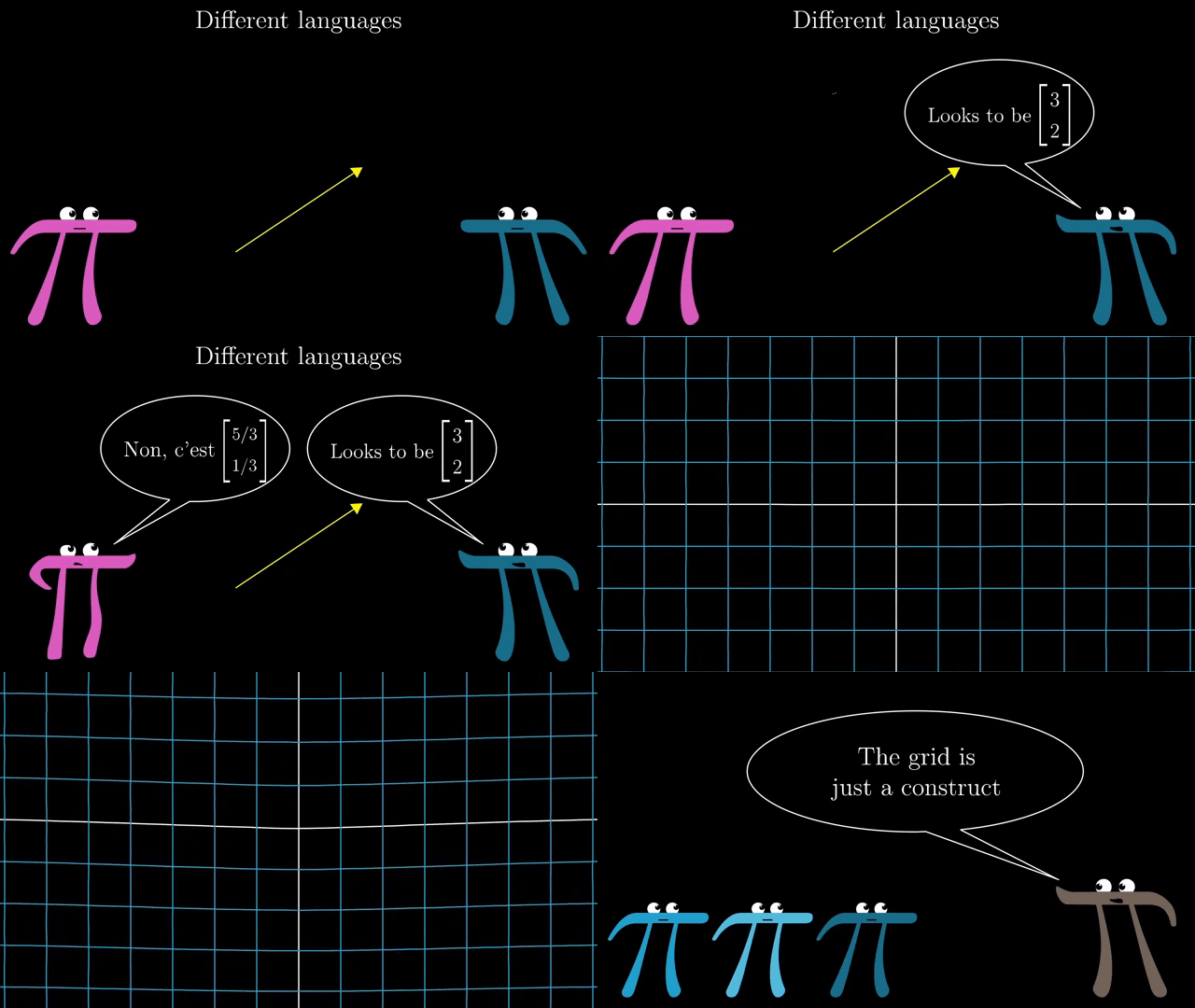
Read the sandwich as three steps: translate her input into your language, apply the map you already know, translate the output back to hers .
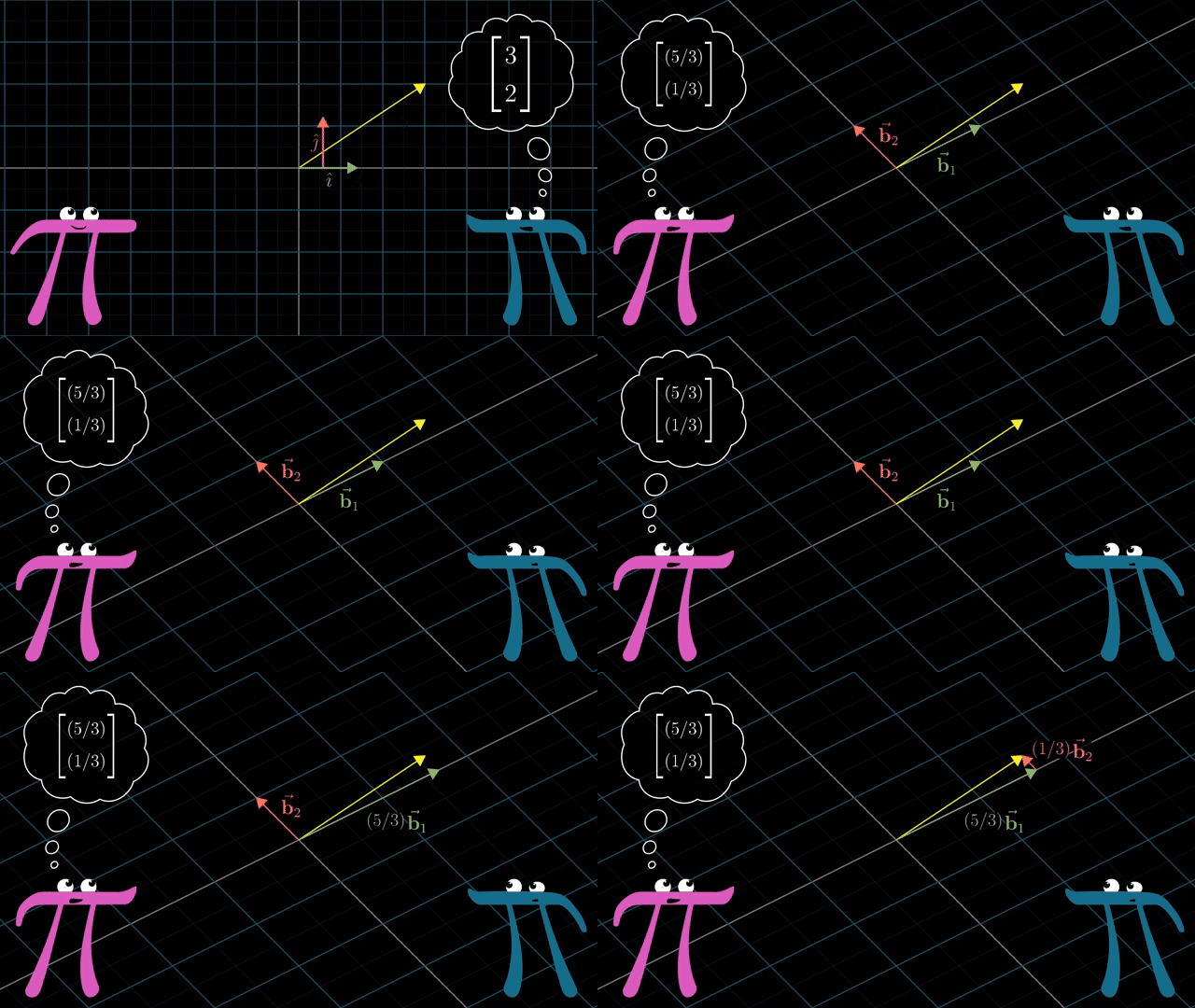
Example sketch: if $R$ is a rotation in your frame and $B$ changes from her skewed axes to yours, her rotation matrix is $B^{-1} R B$. Individual entries scramble, but eigenvalues, trace, and determinant stay the same because $B^{-1} M B$ is similar to $M$.
When $B$ is an orthogonal change between orthonormal bases, $B^{-1} = B^T$. That special case appears constantly in physics and graphics when switching between body and world frames.
Check your understanding. The tasks below rest on these ideas: Correct: you sandwich the map you already know (in your coordinates) between the translations. Not quite: $M$ is in your language, not hers, polar, or coordinate-free. Correct: similar matrices share eigenvalues, trace, and determinant even though entries scramble. Not quite: entries do change, the determinant equals $\det(M)$ (not necessarily zero), and columns differ. Correct: orthogonal matrices satisfy $B^{-1}=B^\top$, which is why body/world frame changes are cheap. Not quite: the inverse is the transpose, not zero, the negative, or a scaled copy. Correct: translate her input to yours ($B$), apply $R$, translate back ($B^{-1}$): $B^{-1}RB$. Not quite: the other orderings translate in the wrong direction or omit a step.
Related cards
Video Content
Tasks
Card Info
- Topic: Mathematics
- Difficulty: Intermediate
- Completed: 0 users
Creator
