Coordinates depend on basis; geometry does not
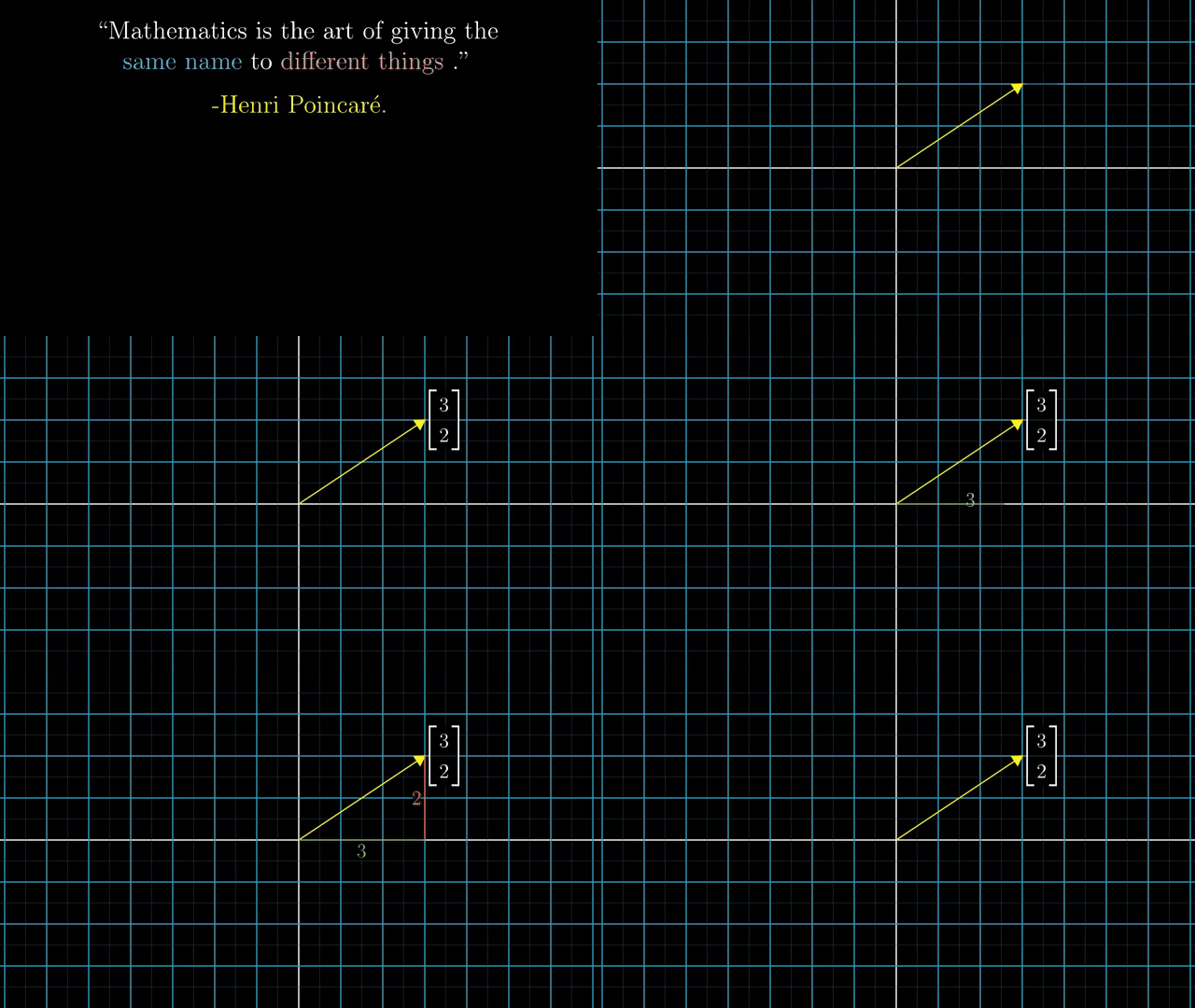
Two observers can use different skewed grids while agreeing on the same arrows in space. Their numeric labels differ because coordinates are bookkeeping relative to a chosen basis, not intrinsic labels stamped on the plane .
Suppose Jennifer's first basis direction is your $\begin{bmatrix}2\\1\end{bmatrix}$ and her second is $\begin{bmatrix}-1\\1\end{bmatrix}$. A geometric vector that you write as $\begin{bmatrix}3\\1\end{bmatrix}$ in the standard grid may appear as $\begin{bmatrix}1\\2\end{bmatrix}$ in her language. Same arrow, different address.
The change-of-basis matrix $B$ lists Jennifer's basis vectors as columns expressed in your coordinates. Multiplying by $B$ converts her coefficient vector into yours. The inverse $B^{-1}$ runs the translation backward.
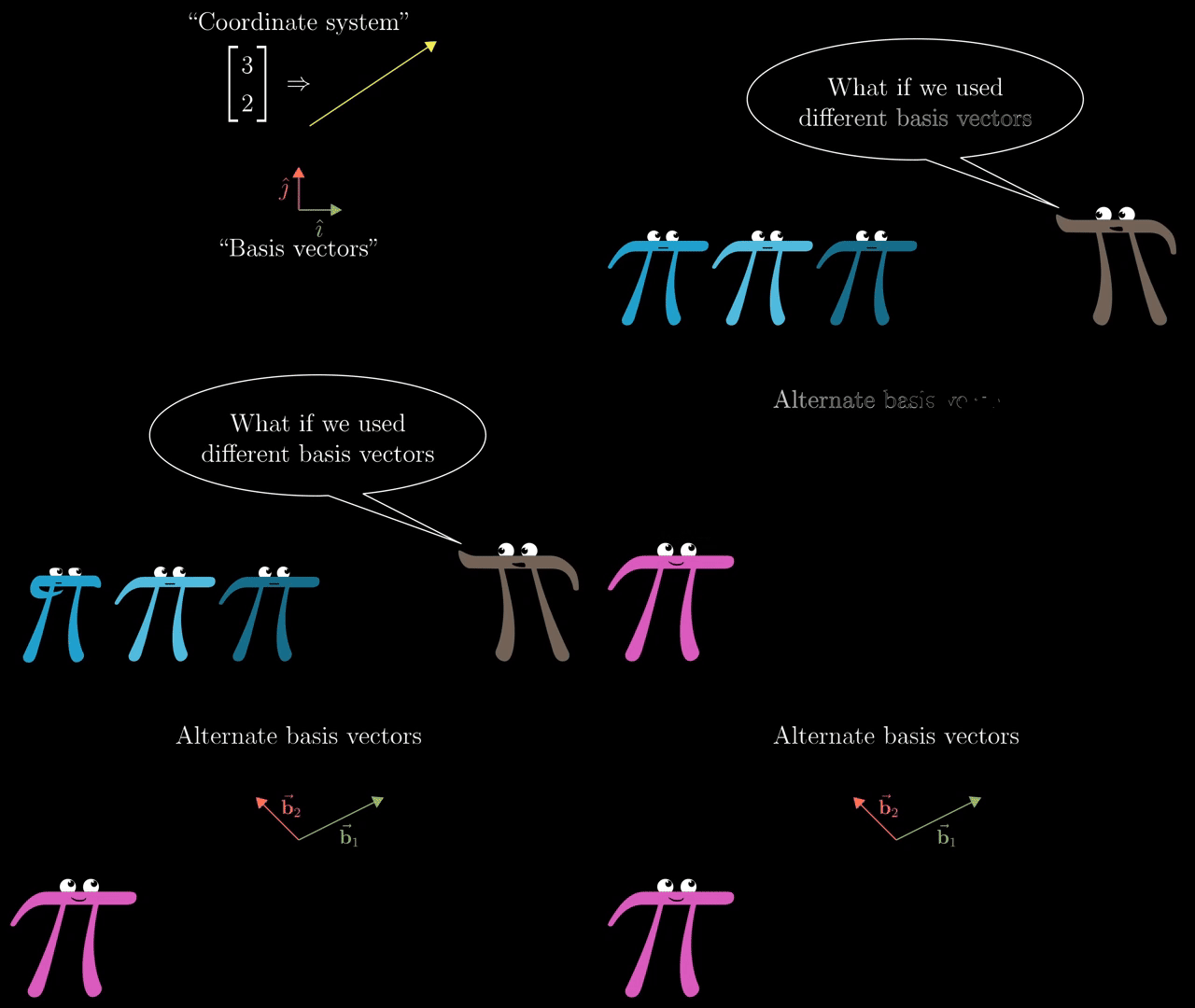
The origin stays universal in pure linear setups: both observers agree where zero is. What changes is how you decompose a vector into basis-direction steps.
Check your understanding. The tasks below rest on these ideas: Correct: $B$ lists the new basis directions expressed in the old language. Not quite: they are not the standard basis, random, or eigenvectors in general. Correct: $B$ (her basis in your coordinates) turns her coefficients into yours. Not quite: the zero matrix, a determinant, or repeating the vector do nothing useful. Correct: $B^{-1}$ runs the translation the other way, your-to-hers. Not quite: it does not collapse to zero, act only on eigenvectors, or leave coordinates unchanged. Correct: $B^{-1}$ re-expresses the same arrow in her basis. Not quite: it does not give standard coordinates, rotate, or compute a length.
Related cards
Video Content
Tasks
Card Info
- Topic: Mathematics
- Difficulty: Intermediate
- Completed: 1 users
Creator
