Bridge toward Cramer and signed volumes
Understanding how linear maps move oriented normals prepares determinant-based solution formulas in Chapter 12 . Signed volume of $\mathbf{a},\mathbf{b},\mathbf{c}$ changes sign when you swap two vectors (antisymmetry).
Three dependent vectors imply scalar triple product zero: coplanar from the origin. For invertible $T$, $\det(T)$ appears when comparing oriented volumes before and after the map.
Chapter 12 reuses this language when determinants become ratios of volumes in Cramer's rule. The through-line is oriented size, not symbol pushing.
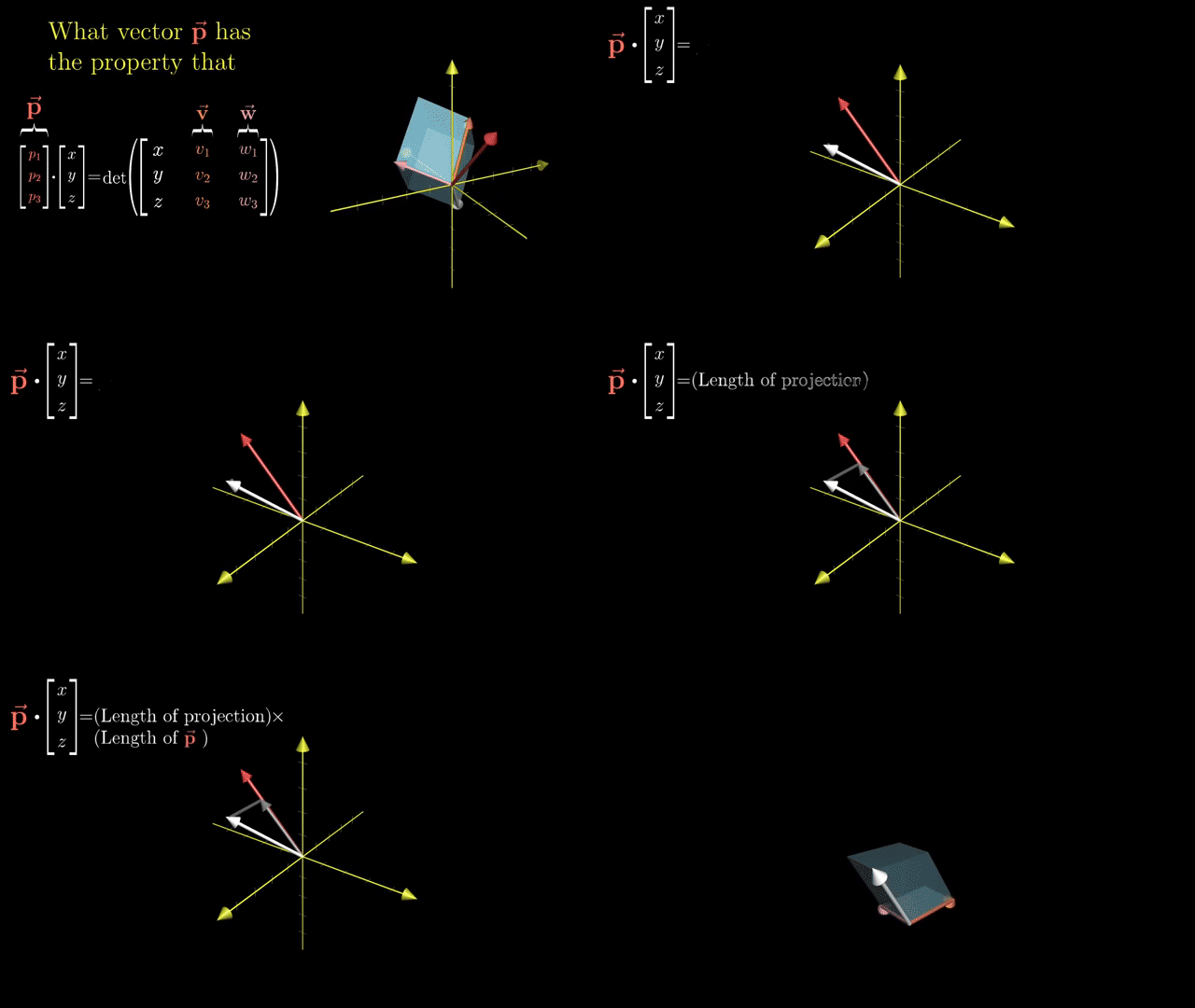
Cyclic permutation of $\mathbf{a},\mathbf{b},\mathbf{c}$ preserves the scalar triple product up to even permutations. Odd permutations flip sign. This is the same orientation bookkeeping Cramer ratios rely on.
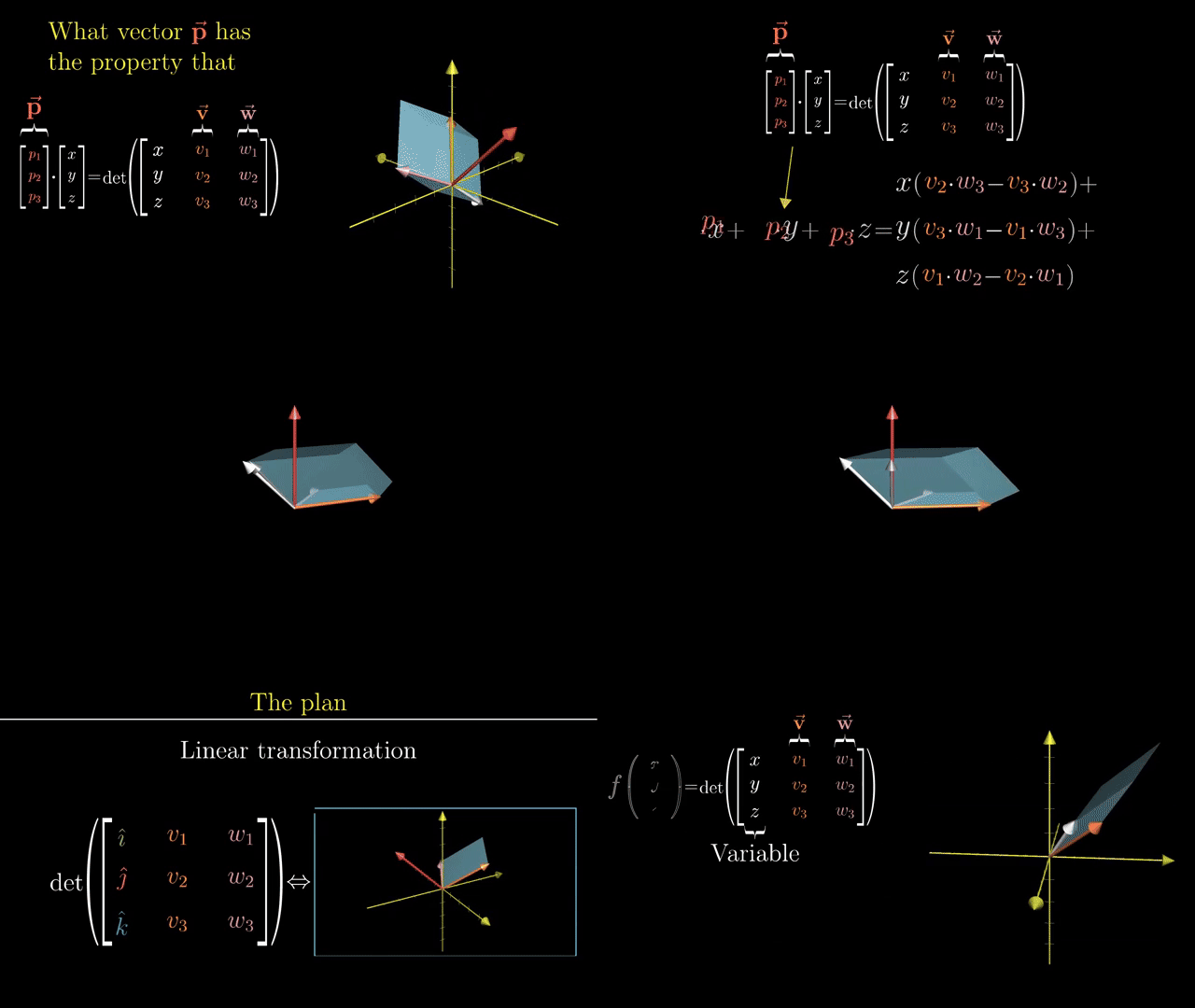
Keep oriented volume language active: determinants are not arbitrary polynomials; they measure how linear maps scale signed volume.
Before Cramer, you should be comfortable saying that swapping two columns flips sign, scaling one column scales the determinant, and dependent columns collapse volume to zero.
If you can explain why $\mathbf{a}\cdot(\mathbf{b}\times\mathbf{c})$ changes sign when two vectors swap, you are ready for Cramer's geometric ratios.
Signed volume zero is the geometric definition of linear dependence for three vectors from the origin; keep that phrase ready for the next chapter.
Related cards
Video Content
Tasks
Card Info
- Topic: Mathematics
- Difficulty: Advanced
- Completed: 0 users
Creator
