Edge cases with rank-deficient $T$
Kernel directions create ambiguity: many different inputs can share the same output under a singular map . Near-zero $\det(T)$ implies ill-conditioning for opposite cross estimates computed from transformed vectors.
If $T\mathbf{a}=\mathbf{0}$ for some $\mathbf{a}\neq\mathbf{0}$, then $T$ is not injective. Rank-2 maps $T:\mathbb{R}^3\to\mathbb{R}^3$ generically collapse space to a plane through the origin.
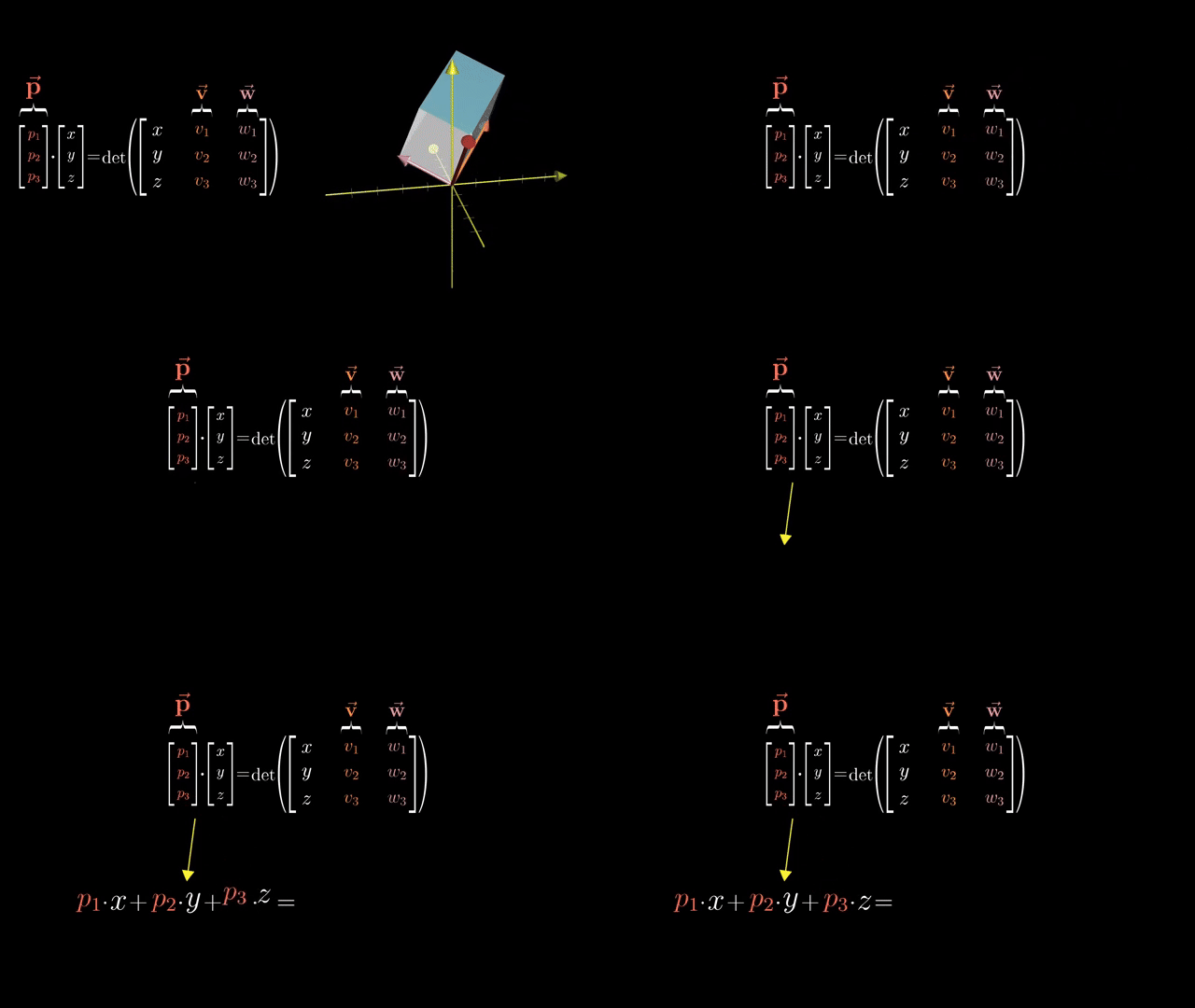
Graphics pipelines normalize surface normals after non-uniform scaling because cross products of scaled tangent vectors change length; normalization restores unit shading vectors even when $\det(T)\neq0$.
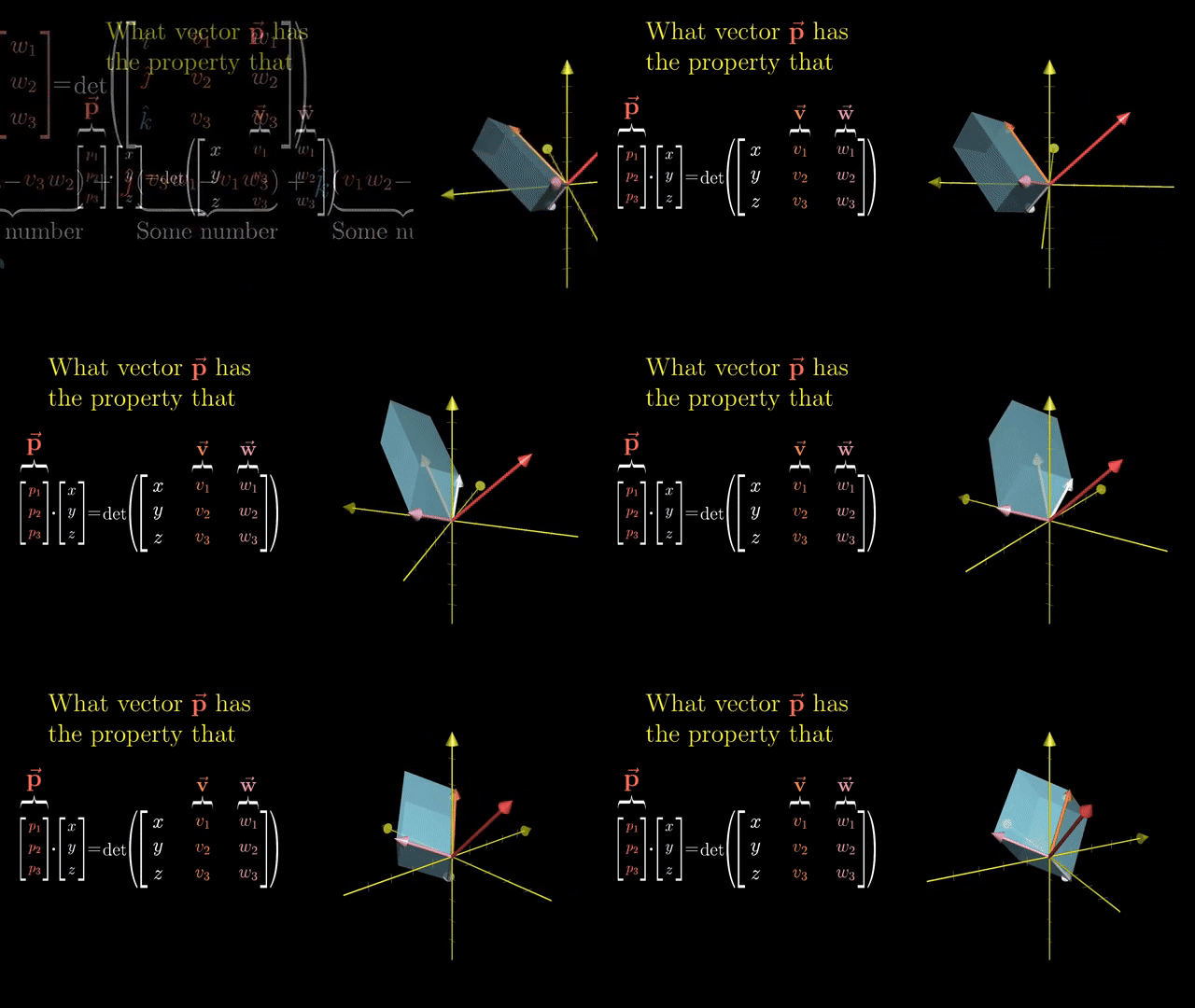
Numerically near-singular $T$ amplifies cross noise. Treat small determinants as warnings that oriented volume data is unreliable in floating point.
When $\det(T)$ is tiny, two nearly parallel transformed vectors can produce wildly unstable crosses; that is a numerical mirror of the geometric flattening story.
Engineering meshes often carry tangent vectors; after an arbitrary linear deformation of the mesh, recompute normals rather than assuming the old cross values still point the right way.
Rank deficiency also means lost information: distinct input crosses can map to the same output pair, so you cannot invert the cross relationship without extra data.
Related cards
Video Content
Tasks
Card Info
- Topic: Mathematics
- Difficulty: Advanced
- Completed: 0 users
Creator
