Cross-training for cross products next chapter
Dot products measure alignment along a direction; cross products (next chapter) build perpendicular witnesses in $\mathbb{R}^3$ with magnitude tied to area . Keep the contrast clear: dot returns a scalar; cross returns a vector orthogonal to both inputs (when they span a plane).
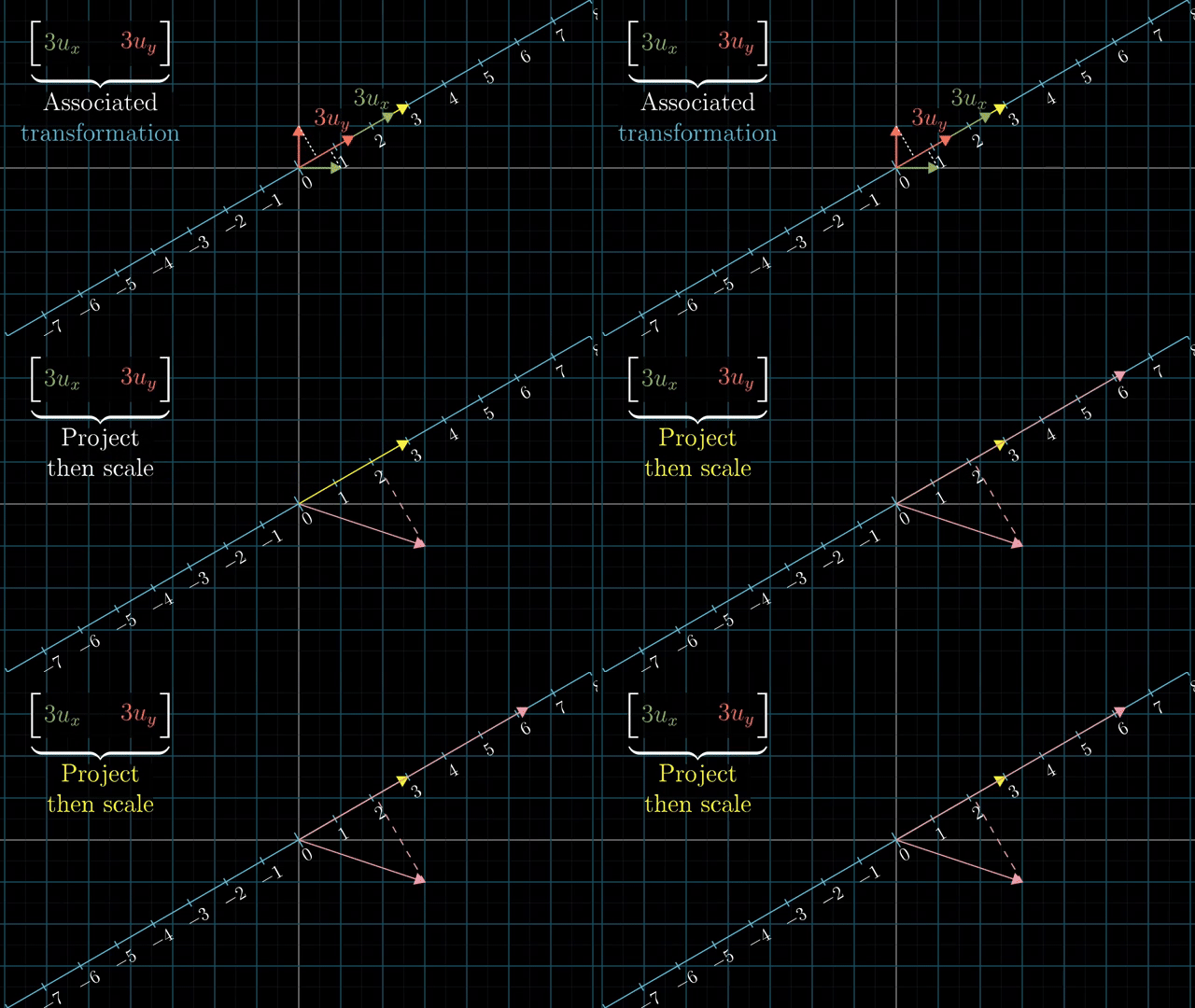
Useful identities to carry forward: for unit $\hat{\mathbf{u}}$, $\hat{\mathbf{u}}\cdot\mathbf{v}$ is the component of $\mathbf{v}$ along $\hat{\mathbf{u}}$. The polarization identity recovers the dot product from squared norms alone, showing how inner products and distances intertwine.
Symmetric positive definite $G$ defines an inner product $\langle u,v\rangle=u^T G v$. That generalization is how machine-learning metrics and Mahalanobis distances enter the same language as geometry class.
The dot product distributes over addition and respects scalar multiplication in each slot separately. These algebraic rules are the shadows of bilinearity you reuse whenever you define general inner products.
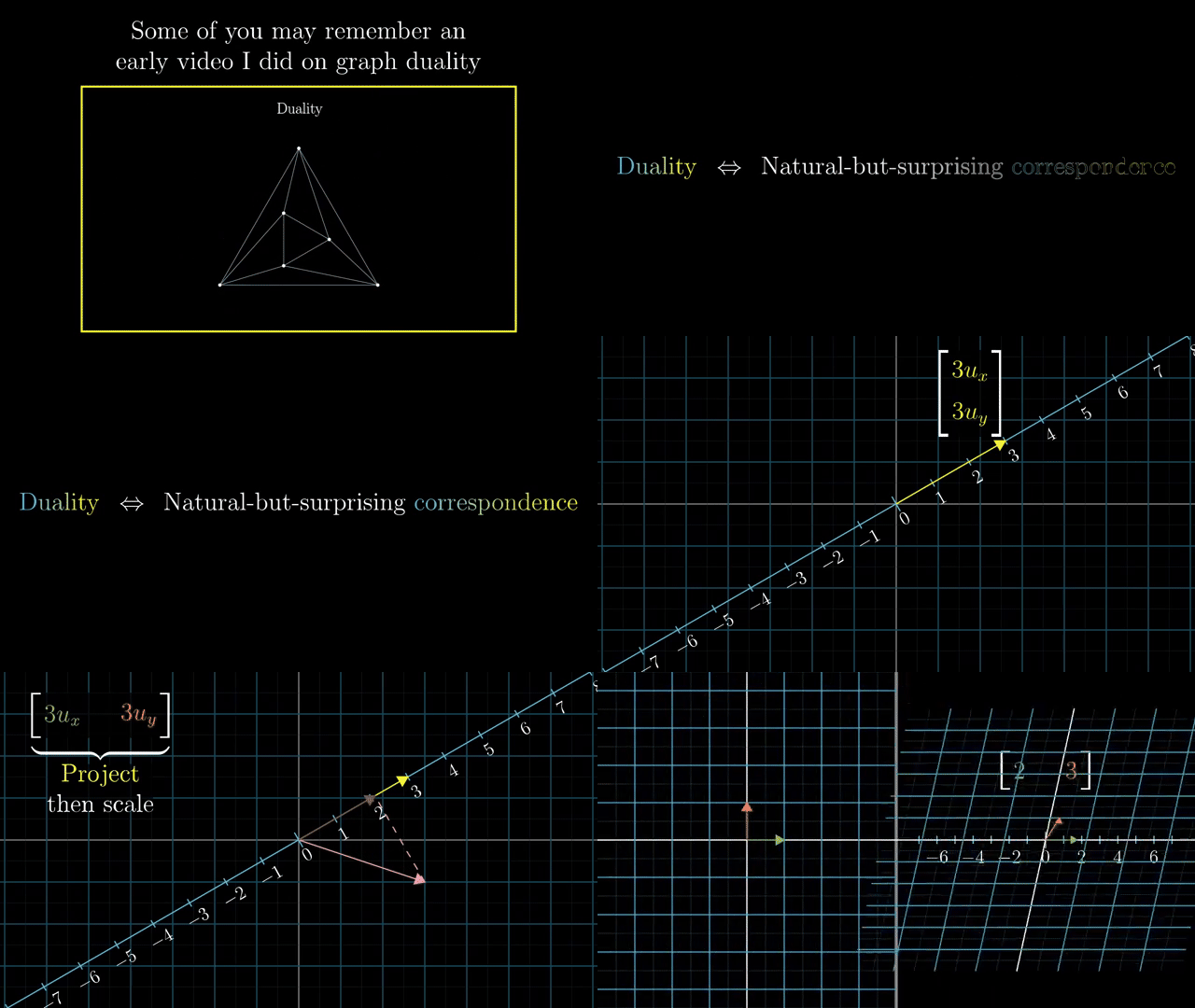
Cross product is special to three dimensions for the elementary geometric definition used in the next chapter. Higher dimensions need exterior algebra; for master dots as shadows and rows as measurement functionals.
Before moving on, you should be able to explain why $\mathbf{u}\cdot\mathbf{v}$ measures alignment while the upcoming cross product will measure perpendicular area and direction in $\mathbb{R}^3$.
Related cards
Video Content
Tasks
Card Info
- Topic: Mathematics
- Difficulty: Intermediate
- Completed: 0 users
Creator
