Rows as constraints in linear systems
Each row of $A\mathbf{x}=\mathbf{b}$ is a scalar constraint: $\mathbf{a}_i^T\mathbf{x}=b_i$. Geometrically, the set of $\mathbf{x}$ satisfying one such equation (when $b_i\neq 0$) is an affine hyperplane orthogonal to $\mathbf{a}_i$ . Intersecting many hyperplanes yields the solution set.
Left multiplication by an invertible matrix corresponds to reversible row operations on the equation system. Full row rank means the rows are linearly independent as covectors: the constraints are not redundant.
Two-equation example: $\begin{bmatrix}1&1\\2&2\end{bmatrix}\mathbf{x}=\begin{bmatrix}3\\6\end{bmatrix}$ gives parallel constraint rows. Row reduction on $[A\mid\mathbf{b}]$ reveals dependence immediately. Independent rows mean each equation cuts down the feasible set without repeating the same hyperplane.
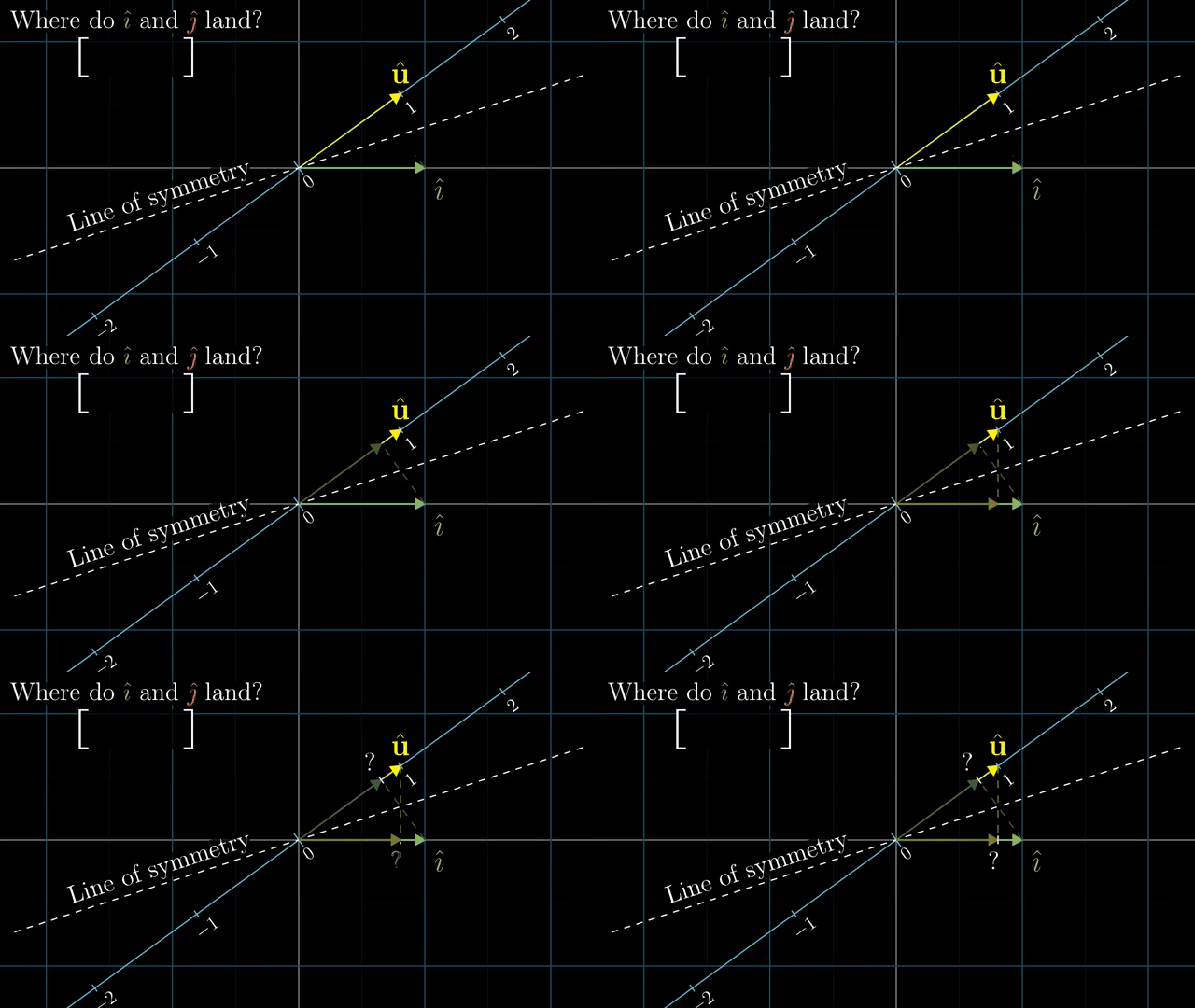
Inconsistent systems have $\mathbf{b}$ outside the column space of $A$: no linear combination of columns reaches $\mathbf{b}$. Row reduction on $[A\mid\mathbf{b}]$ surfaces compatibility constraints explicitly.
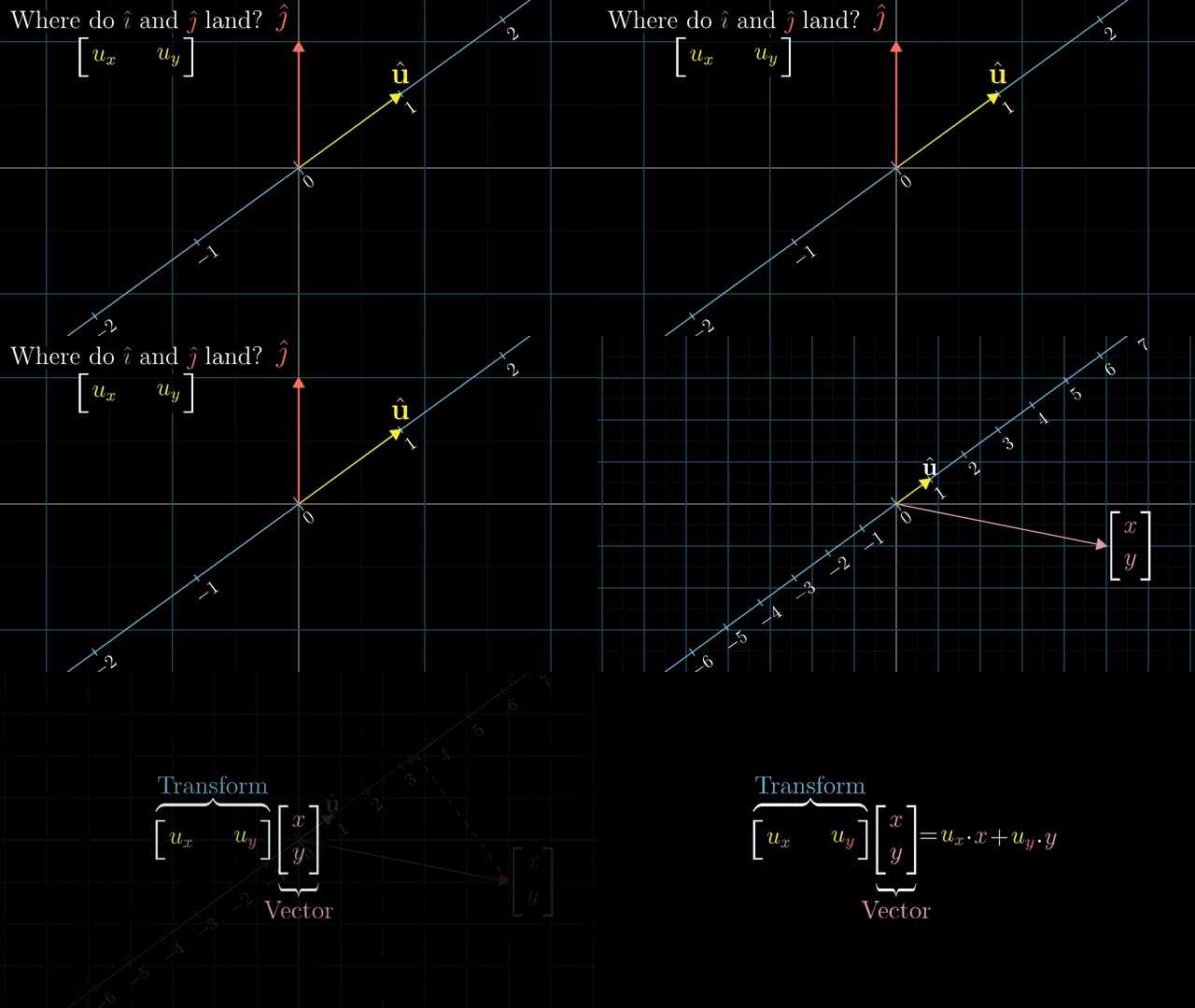
The row picture complements the column picture from earlier chapters. Columns tell you where basis vectors land; rows tell you what measurements you take of an input vector . Both views are the same matrix, read from different angles.
Compatibility is geometric: $\mathbf{b}$ must lie in the intersection of the affine hyperplanes defined by the rows. When that intersection is empty, the system is inconsistent even if each equation looks reasonable alone.
Related cards
Video Content
Tasks
Card Info
- Topic: Mathematics
- Difficulty: Intermediate
- Completed: 0 users
Creator
