Dual bases vs orthonormal trick
For a general (possibly non-orthonormal) basis $\{\mathbf{b}_1,\ldots,\mathbf{b}_n\}$, the dual basis $\{\mathbf{f}^1,\ldots,\mathbf{f}^n\}$ satisfies $\mathbf{f}^i(\mathbf{b}_j)=\delta_{ij}$. Coordinate extraction is $c_i=\mathbf{f}^i(\mathbf{v})$, not always a simple component-wise dot .
In a skewed plane basis, reading coordinates is not as simple as projecting onto coordinate axes. Dual covectors are chosen so each extracts one coefficient while annihilating the other basis directions. The Riesz map links inner products to dual vectors, but the formulas depend on the metric tensor.
In orthonormal standard coordinates, dual pairing collapses to the familiar $\sum_i u_i v_i$. That identification is convenient but hides the metric: changing the inner product changes which covectors are dual to which vectors.
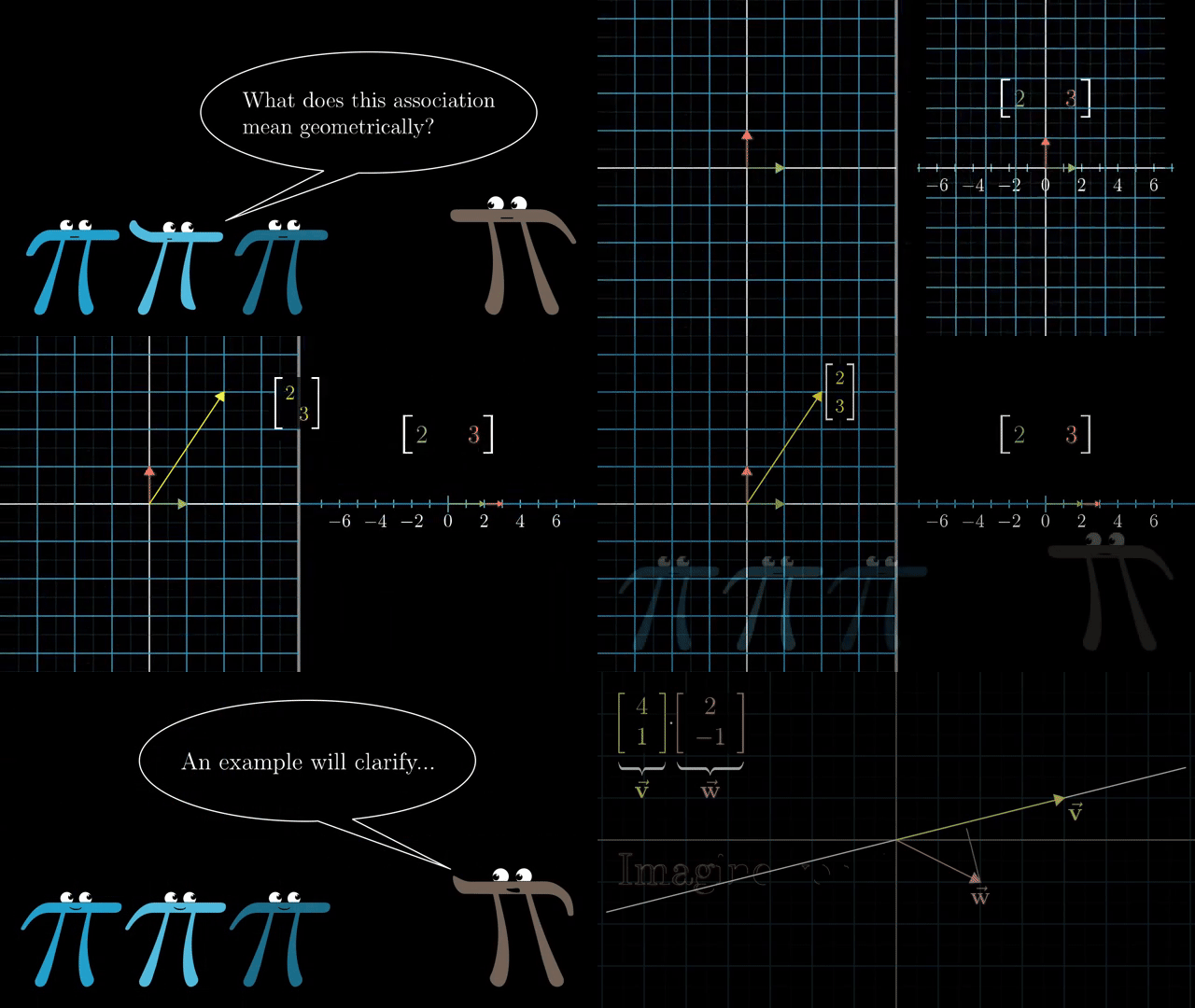
Cauchy-Schwarz for the standard dot product states $\lvert\mathbf{u}\cdot\mathbf{v}\rvert\le\|\mathbf{u}\|\|\mathbf{v}\|$, with equality when the vectors are parallel. The inequality controls how large a shadow can be relative to the lengths involved.
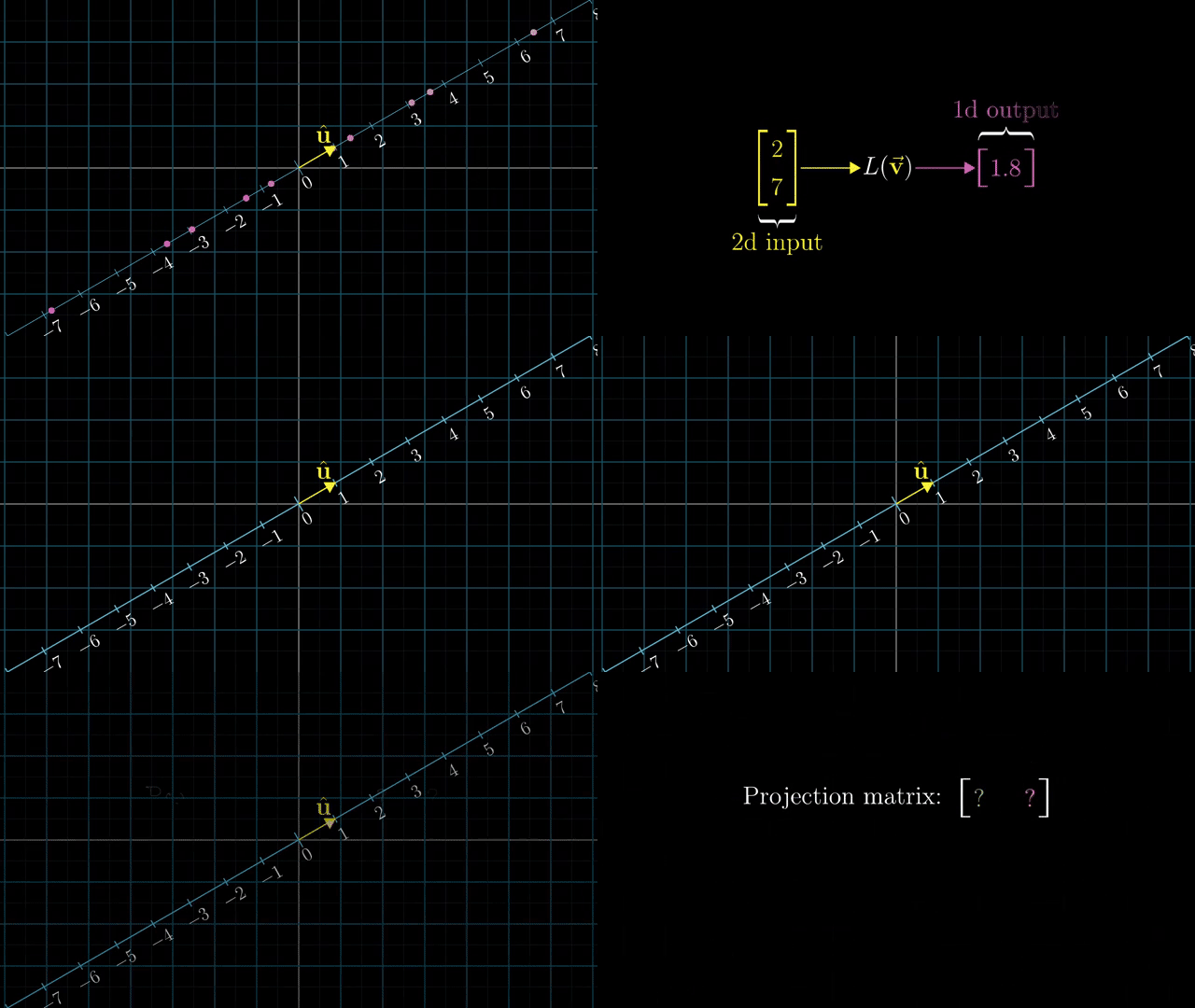
General relativity makes this bookkeeping explicit with index up/down conventions and metric tensors. Even in introductory linear algebra, remembering that orthogonality is metric-dependent prevents silent errors when a non-identity $G$ defines the geometry .
When students say two vectors look perpendicular on a skewed grid, ask which inner product they mean. The standard dot on column coordinates is one choice, not the only geometric definition.
Related cards
Video Content
Tasks
Card Info
- Topic: Mathematics
- Difficulty: Intermediate
- Completed: 0 users
Creator
