Dot product: length-times-shadow story
The standard dot product $\mathbf{u}\cdot\mathbf{v}$ measures how far $\mathbf{v}$ extends along $\mathbf{u}$, weighted by $\|\mathbf{u}\|$ unless you normalize $\mathbf{u}$ to unit length first . Geometrically, think of dropping a perpendicular from the tip of $\mathbf{v}$ onto the line through $\mathbf{u}$: the signed length of that shadow, times $\|\mathbf{u}\|$, is the dot product.
In components, $\mathbf{u}\cdot\mathbf{v}=\sum_i u_i v_i$. For $\mathbf{u},\mathbf{v}\in\mathbb{R}^2$ this is a single sum; in $\mathbb{R}^n$ the pattern is the same. Bilinearity means the dot is linear in $\mathbf{u}$ when $\mathbf{v}$ is fixed, and linear in $\mathbf{v}$ when $\mathbf{u}$ is fixed.
Example: if $\hat{\mathbf{u}}$ is unit length and $\mathbf{v}=(3,4)$, then $\hat{\mathbf{u}}\cdot\mathbf{v}$ is exactly the signed scalar projection of $\mathbf{v}$ onto $\hat{\mathbf{u}}$. If instead $\|\mathbf{u}\|=5$, multiply that projection by $5$ to recover $\mathbf{u}\cdot\mathbf{v}$.
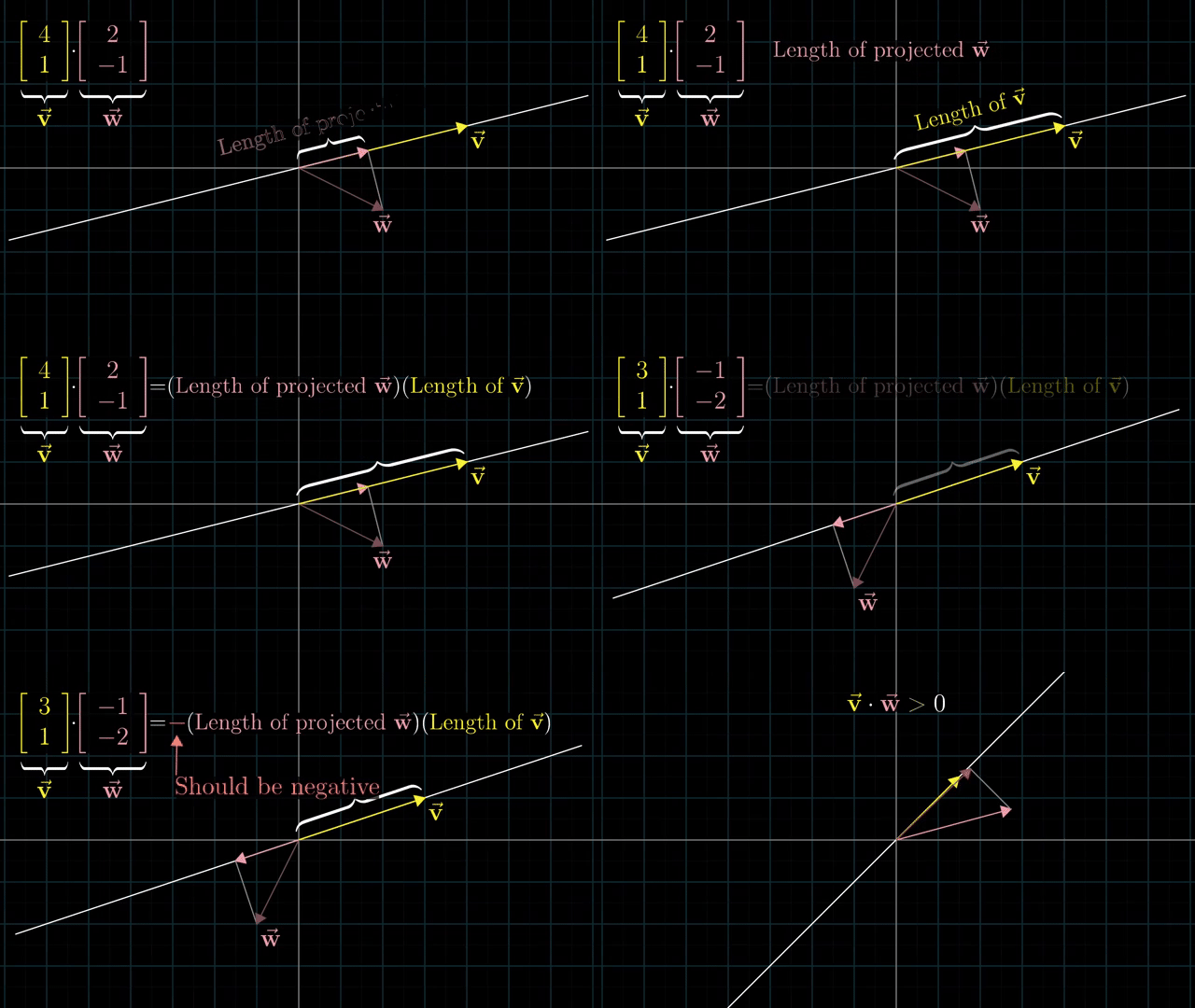
Zero dot need not mean either vector is zero. For nonzero vectors, $\mathbf{u}\cdot\mathbf{v}=0$ means orthogonality in the Euclidean inner product. The shadow picture comes before the coordinate formula so the sign and magnitude both have geometric meaning .
Related cards
Video Content
Tasks
Card Info
- Topic: Mathematics
- Difficulty: Intermediate
- Completed: 0 users
Creator
