Duality: row vectors eat column vectors
Matrix-vector multiplication $A\mathbf{x}$ has a column picture and a row picture. The row picture says: each row of $A$ defines a linear functional on inputs; $A\mathbf{x}$ stacks the resulting measurements . If rows are $\mathbf{r}_1^T,\ldots,\mathbf{r}_m^T$, then $(A\mathbf{x})_i=\mathbf{r}_i\cdot\mathbf{x}$.
In finite dimensions, covectors (linear maps to scalars) look like row vectors, but they live in a dual space conceptually distinct from column vectors. Transpose identities such as $\mathbf^T(A\mathbf{x})=(A^T\mathbf)^T\mathbf{x}$ package how pairings swap roles under adjoint transpose.

Worked example: for $A=\begin{bmatrix}1&2\\3&4\end{bmatrix}$ and $\mathbf{x}=\begin{bmatrix}x_1\\x_2\end{bmatrix}$, the first output is $1\cdot x_1+2\cdot x_2$. The second row gives $3x_1+4x_2$. Each row is a weighted sum dotting $\mathbf{x}$.
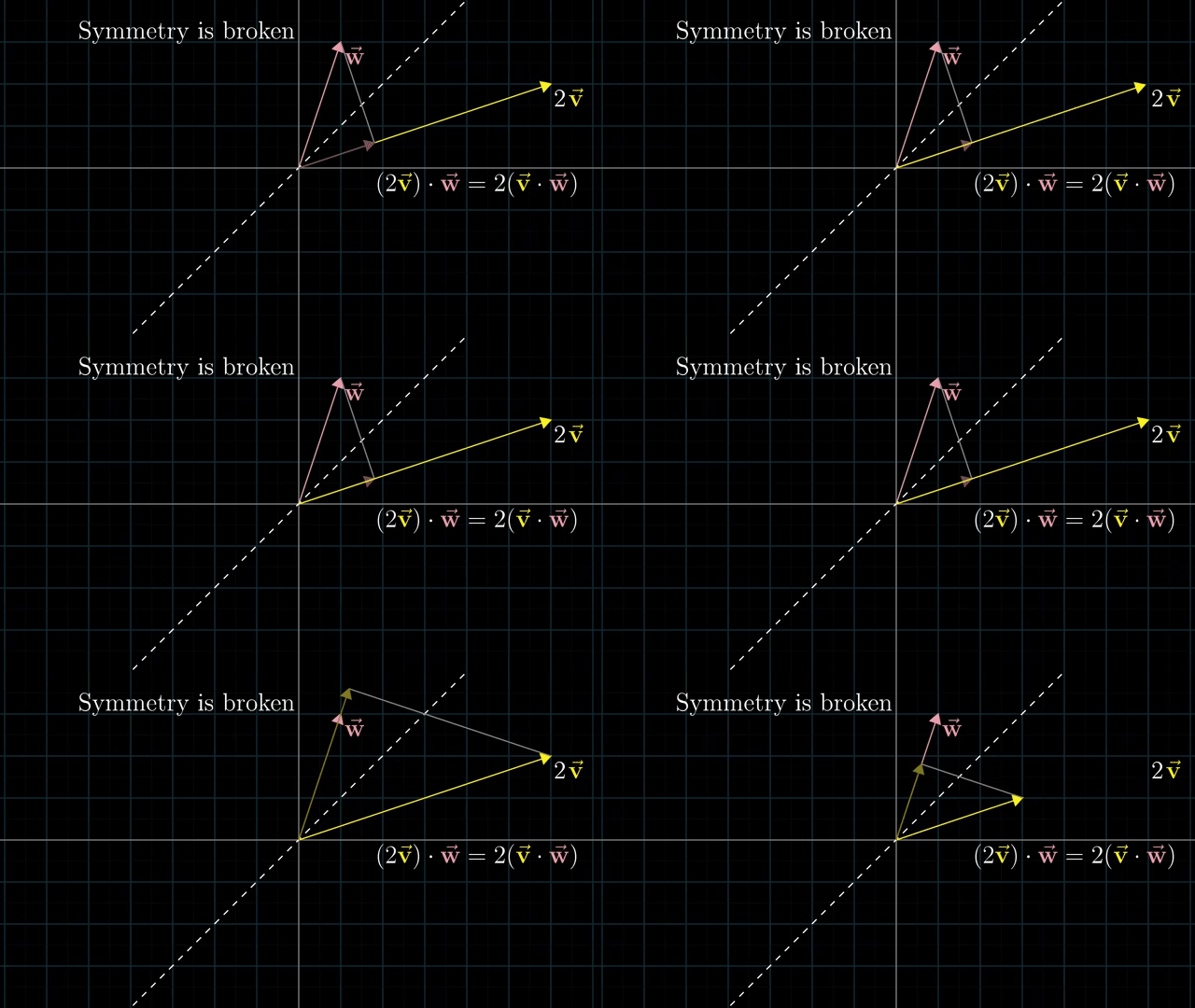
Orthogonality depends on the inner product you choose. The standard dot on $\mathbb{R}^n$ is the default in this playlist, but a symmetric positive definite matrix $G$ defines $\langle u,v\rangle=u^T G v$, changing which pairs count as perpendicular .
Related cards
Video Content
Tasks
Card Info
- Topic: Mathematics
- Difficulty: Intermediate
- Completed: 0 users
Creator
