Handoff to dot products and taller geometry
Later chapters revisit inner products to reinterpret rows geometrically and to build orthogonal projections . Nonsquare maps already showed why least squares and regularization appear: tall systems overdetermine; wide systems underdetermine.
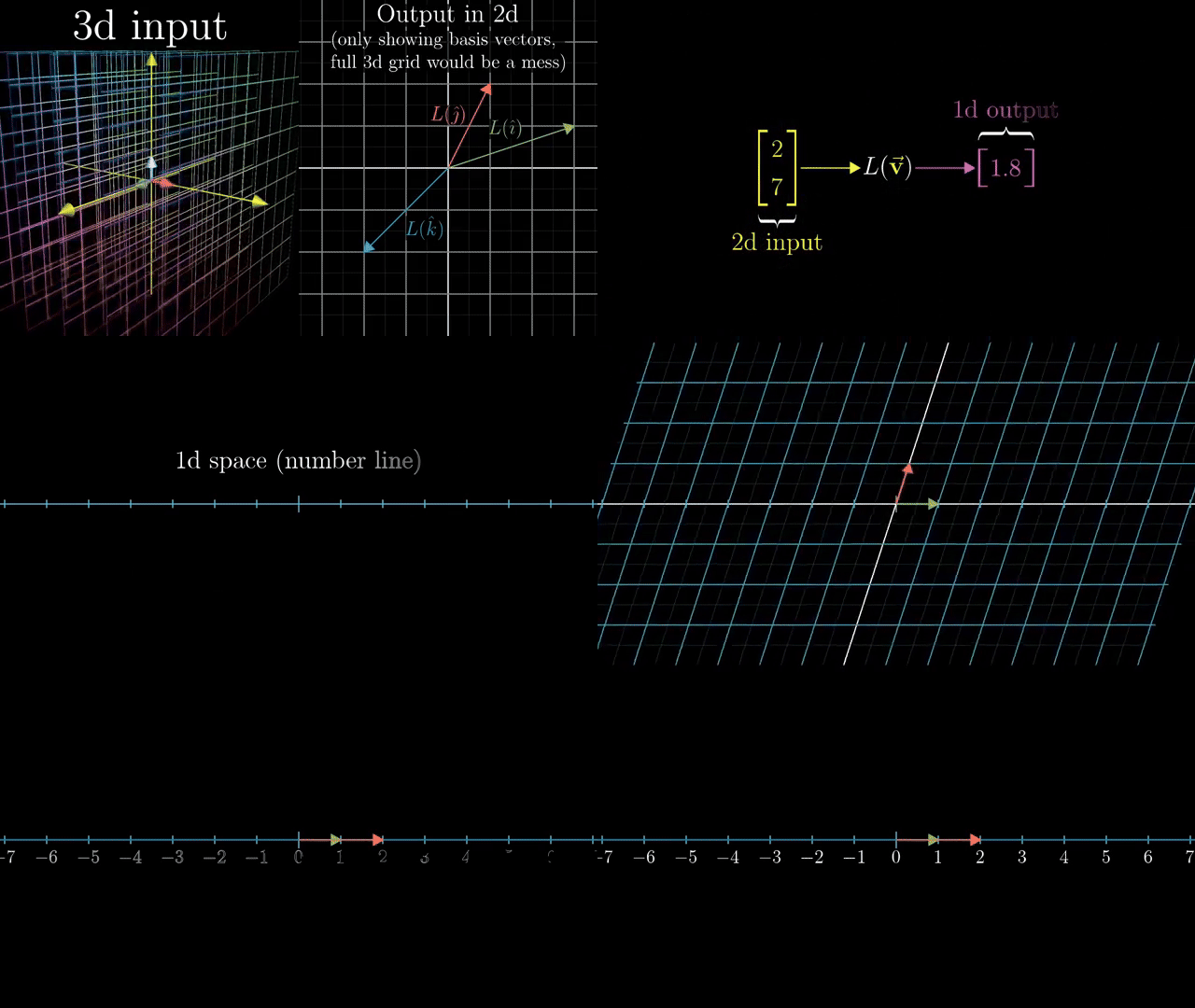
Embeddings $\mathbb{R}^2\to\mathbb{R}^3$ with independent columns have trivial kernel. Coordinate projections $\mathbb{R}^3\to\mathbb{R}^2$ are linear but not injective: forgetting a coordinate collapses a direction.
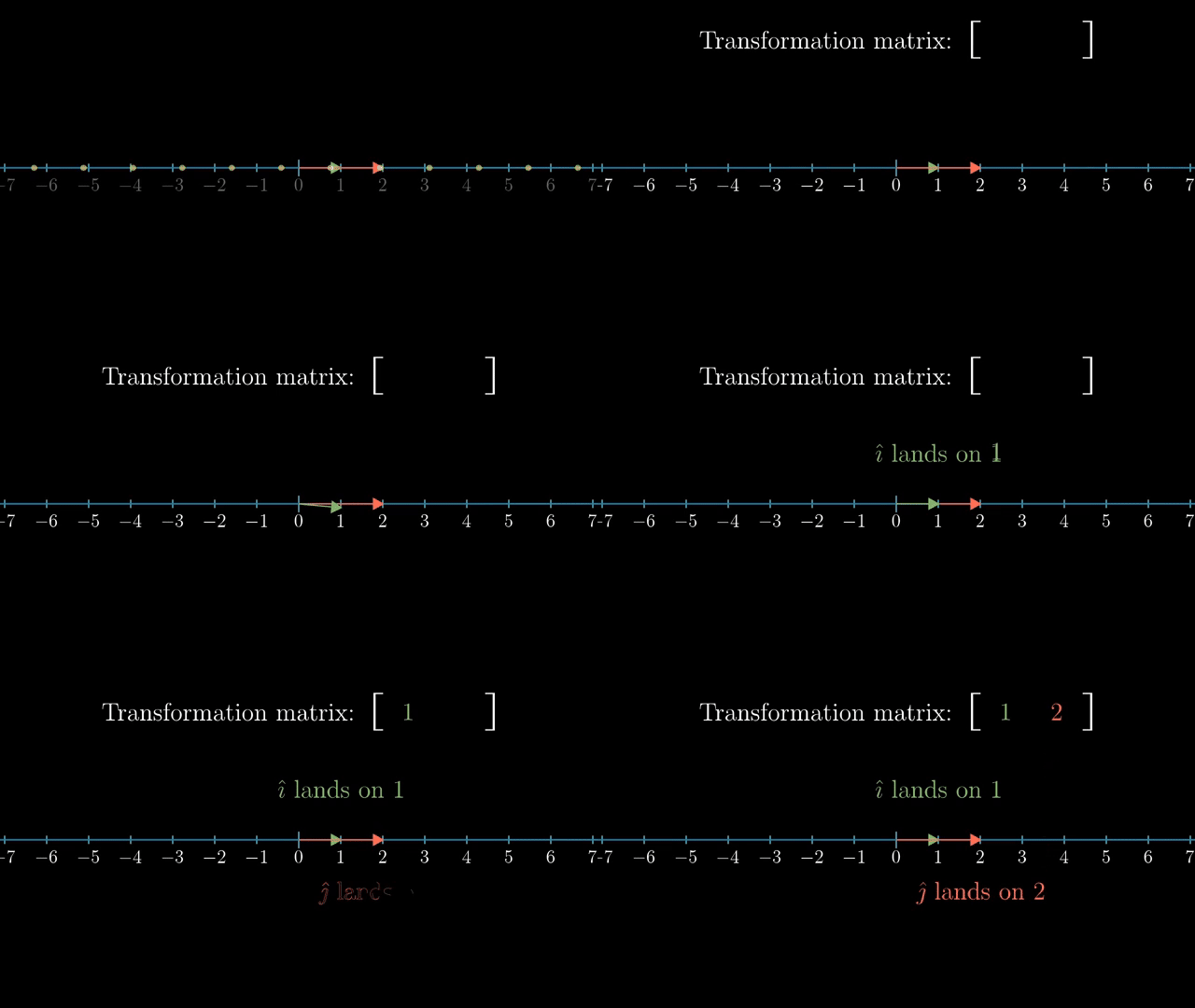
Practitioners often prefer SVD over raw rectangle shape because singular values separate dominant energy from noise subspaces. Frobenius norm $\|A\|_F$ treats $A$ as a vector in $\mathbb{R}^{mn}$ and is unchanged under orthogonal changes on left and right. Track which norm lives in $\mathbb{R}^n$ versus $\mathbb{R}^m$ as you move between domains. Dot products and orthogonal projections in the next chapter reinterpret rows as geometric measurements rather than mere lists of coefficients. Frobenius norm $\|A\|_F$ treats entries as coordinates in $\mathbb{R}^{mn}$ and is unchanged under orthogonal changes on left and right. SVD exposes dominant directions for data matrices practitioners actually analyze . Coordinate projection $\mathbb{R}^3\to\mathbb{R}^2$ is linear but not injective. Dot products arrive next to make row measurements geometric.
Related cards
Video Content
Tasks
Card Info
- Topic: Mathematics
- Difficulty: Intermediate
- Completed: 0 users
Creator
