Computing inverses conceptually with row operations
Augment $[A\mid I]$ and row-reduce. When $A$ is invertible, the reduced form becomes $[I\mid A^{-1}]$ . Each elementary row operation is multiplication on the left by an elementary matrix; chaining those operations builds $A^{-1}$.
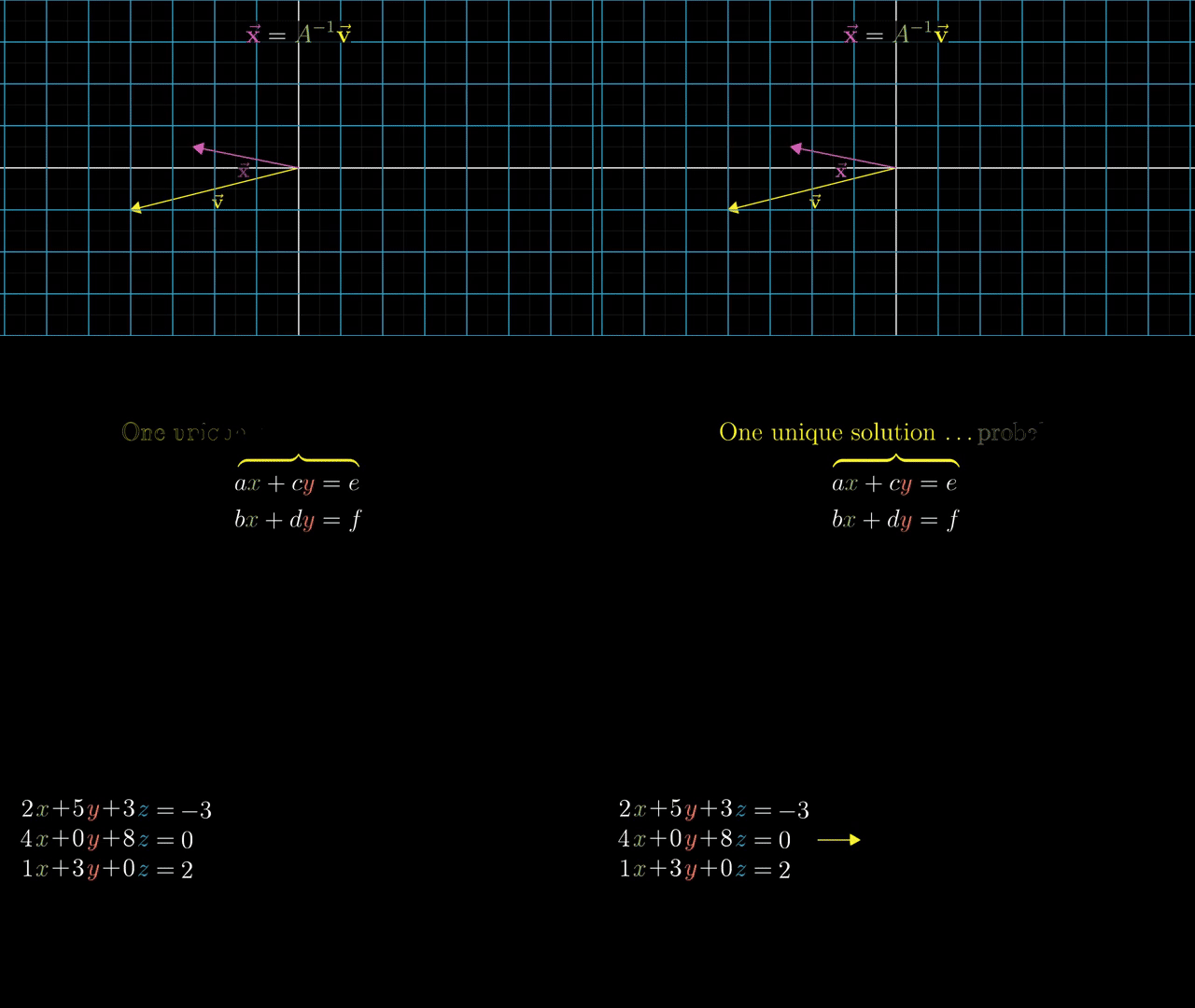
If RREF contains a zero row, $A$ is singular: some pivot column of the original matrix was dependent. Pivot columns mark independent columns of $A$, useful even when you do not need the full inverse.
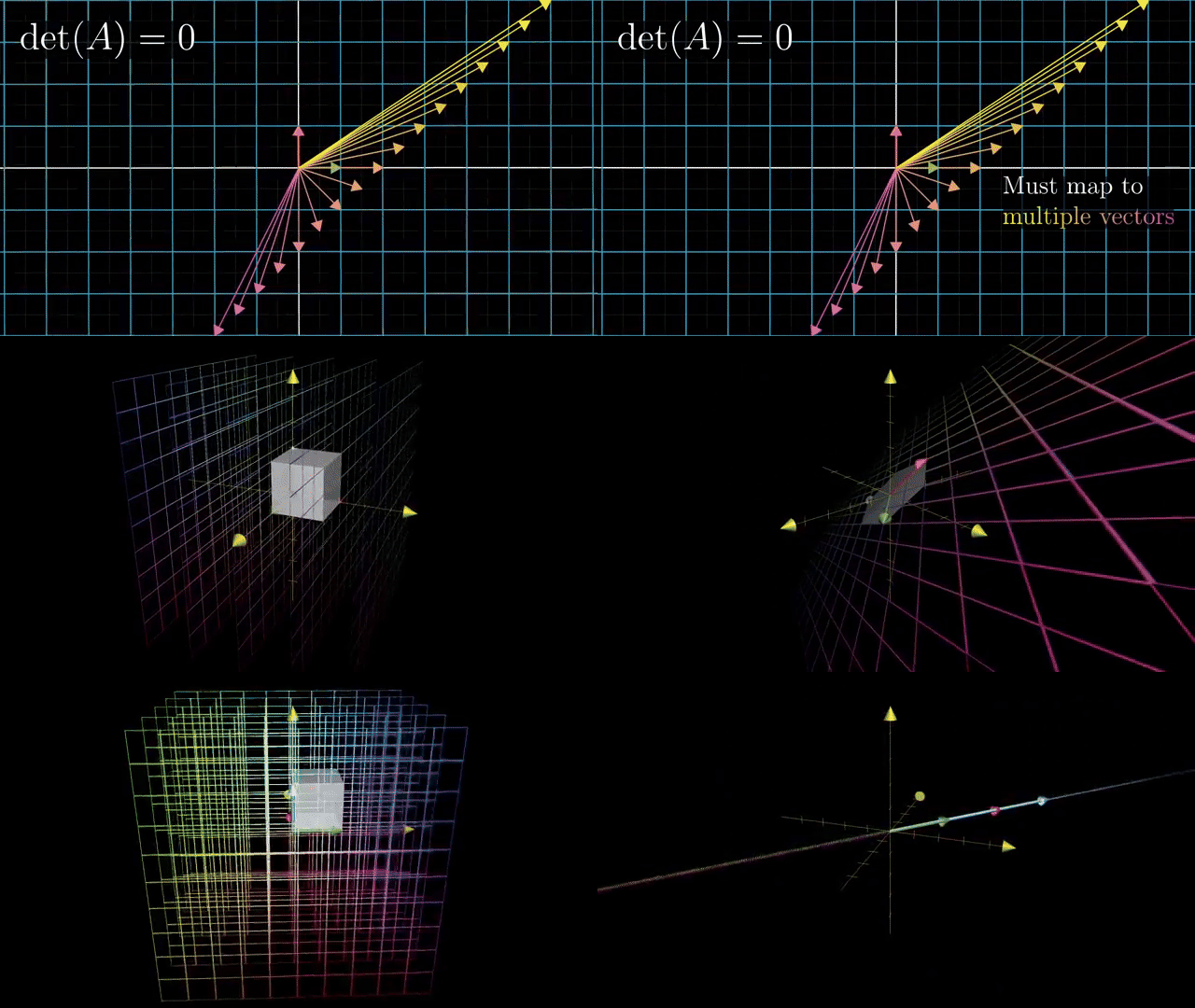
Partial pivoting swaps rows to avoid dividing by tiny pivots. Large-scale numerical linear algebra almost never forms $A^{-1}$ explicitly; it factors $A$ and solves systems with forward and back substitution because that is cheaper and stabler. Conceptually, $A^{-1}$ is the matrix that undoes $A$ on inputs; row reduction on $[A\mid I]$ is the algorithmic version of that undoing. Pivot columns mark which original columns are independent . Partial pivoting swaps rows to avoid dividing by near-zero entries during elimination. Libraries expose solve routines rather than inverse matrices for large systems. Conceptually $A^{-1}$ solves $A\mathbf{x}=\mathbf{b}$ via $\mathbf{x}=A^{-1}\mathbf{b}$ when $A$ is invertible. Zero rows in RREF signal singularity.
Related cards
Video Content
Tasks
Card Info
- Topic: Mathematics
- Difficulty: Intermediate
- Completed: 0 users
Creator
