Invertibility: two-sided when square and full rank
For square $A$, the following align: invertible, trivial null space, columns spanning $\mathbb{R}^n$, and $\det A\neq 0$ . The inverse $A^{-1}$ undoes the map on both sides: $A^{-1}A=AA^{-1}=I$.
Composition inverts swap order: $(AB)^{-1}=B^{-1}A^{-1}$ when both inverses exist. Non-square matrices cannot be bijections between different-dimensional spaces, so a genuine two-sided inverse between $\mathbb{R}^n$ and $\mathbb{R}^m$ with $m\neq n$ is impossible.
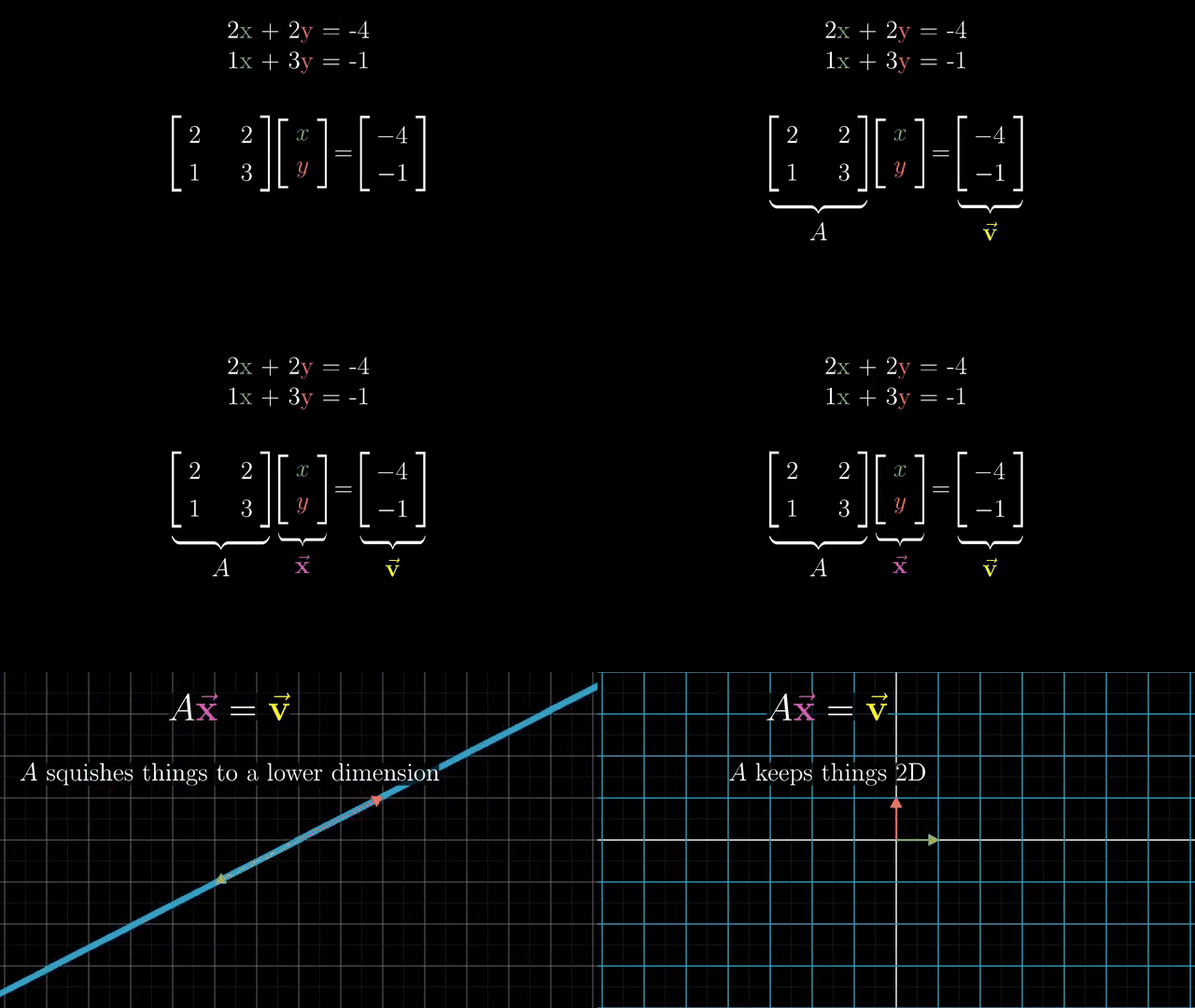
When a square inverse exists, it is unique. Left and right inverses cannot disagree in the finite-dimensional square case. Moore-Penrose pseudoinverses extend the idea for least squares and statistics, but they are not the same object as a true two-sided inverse.
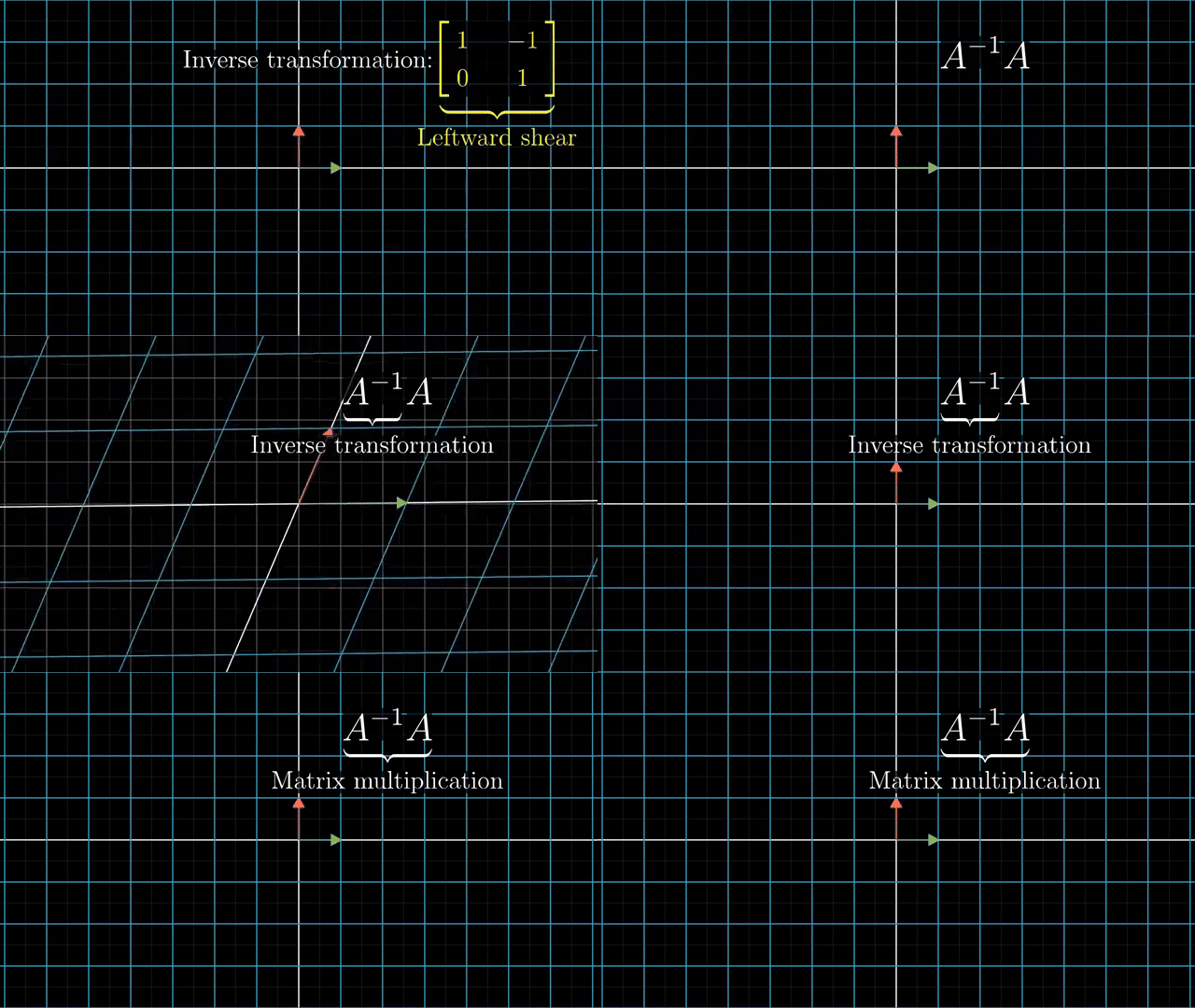
Injectivity means $T(\mathbf{u})=T(\mathbf{v})$ forces $\mathbf{u}=\mathbf{v}$: distinct inputs never share outputs. For linear $T$, that is equivalent to a trivial kernel. Surjectivity onto $\mathbb{R}^m$ means every $\mathbf{b}$ is reachable; for square matrices, injective plus surjective is bijective, matching $\det A\neq 0$. Moore-Penrose pseudoinverses generalize when $A$ is not square or not full rank . For square $A$, $\det A\neq 0$ is another equivalent invertibility test you already met.
Related cards
Video Content
Tasks
Card Info
- Topic: Mathematics
- Difficulty: Intermediate
- Completed: 0 users
Creator
