Null space: differences of solutions; invisible inputs
The null space (kernel) is all inputs $\mathbf{x}$ with $A\mathbf{x}=\mathbf{0}$ . It is a subspace because $A$ is linear: sums and scalings of kernel vectors stay in the kernel.
If $\mathbf{x}$ and $\mathbf{x}'$ both solve the same $\mathbf{b}$, then $\mathbf{x}-\mathbf{x}'$ lies in the null space. Uniqueness fails exactly when the null space contains more than $\mathbf{0}$. The null space collects invisible inputs: directions $\mathbf{n}$ with $A\mathbf{n}=\mathbf{0}$ that change nothing about the output .
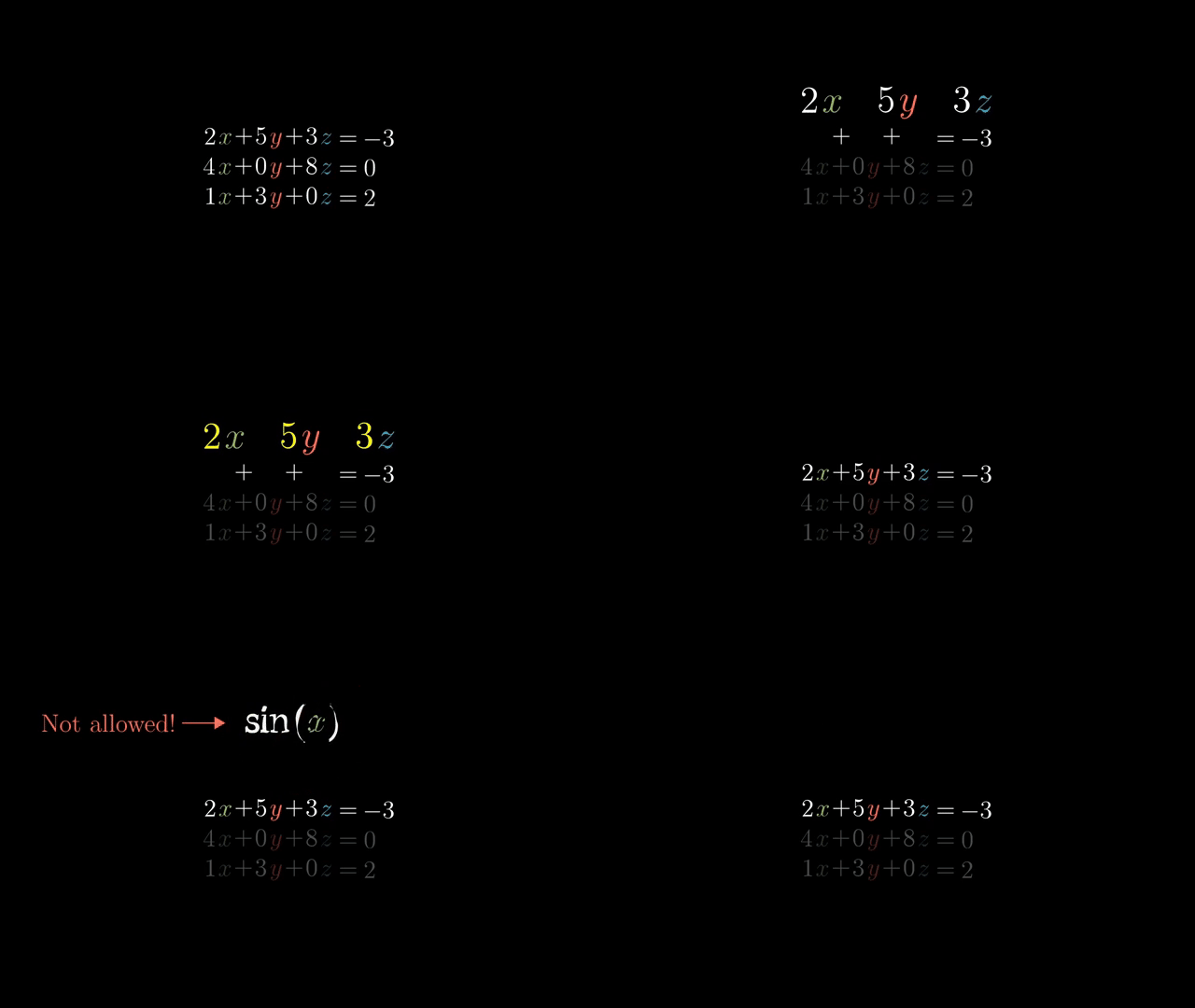
Square full-rank matrices have trivial null space: only the zero input maps to zero output. Wide matrices with more unknowns than equations typically have nontrivial null space even when many $\mathbf{b}$ are reachable.
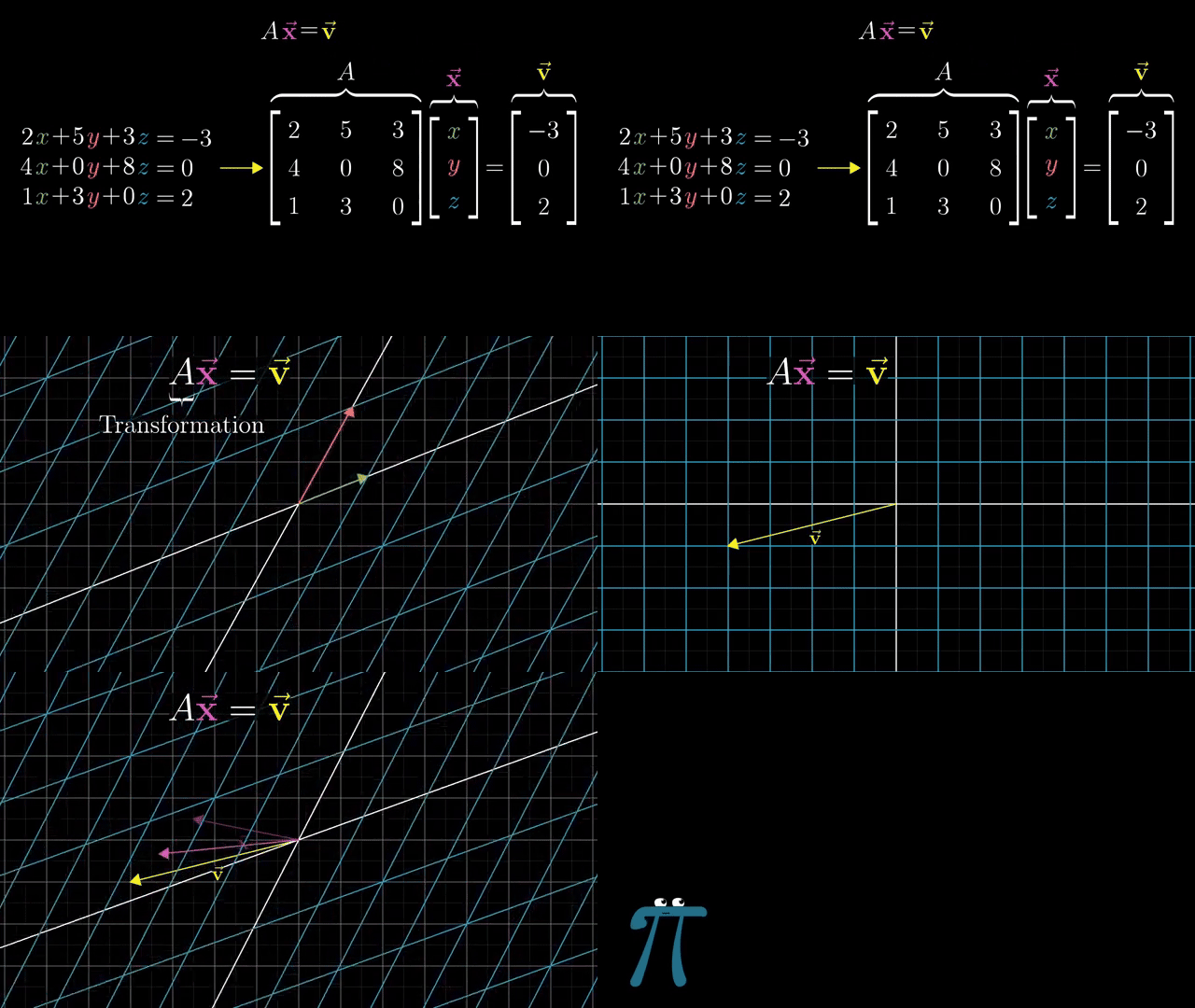
Adding any null vector to a particular solution leaves the output unchanged: $A(\mathbf{x}+\mathbf{n})=A\mathbf{x}+A\mathbf{n}=\mathbf{b}$ when $A\mathbf{n}=\mathbf{0}$. That is the affine picture of solution sets. Wide matrices with $m\lt n$ and full row rank can still admit infinitely many solutions when consistent because the kernel has dimension $n-m\ge 1$. Affine solution sets $\mathbf{x}_p+\ker A$ are the geometric picture to keep .
Related cards
Video Content
Tasks
Card Info
- Topic: Mathematics
- Difficulty: Intermediate
- Completed: 0 users
Creator
