Matrix-vector multiplication: combine columns with input coefficients
The product $A\mathbf{x}$ linearly mixes columns of $A$ using entries of $\mathbf{x}$ as weights. Outputs stay inside the column space, the span of columns .
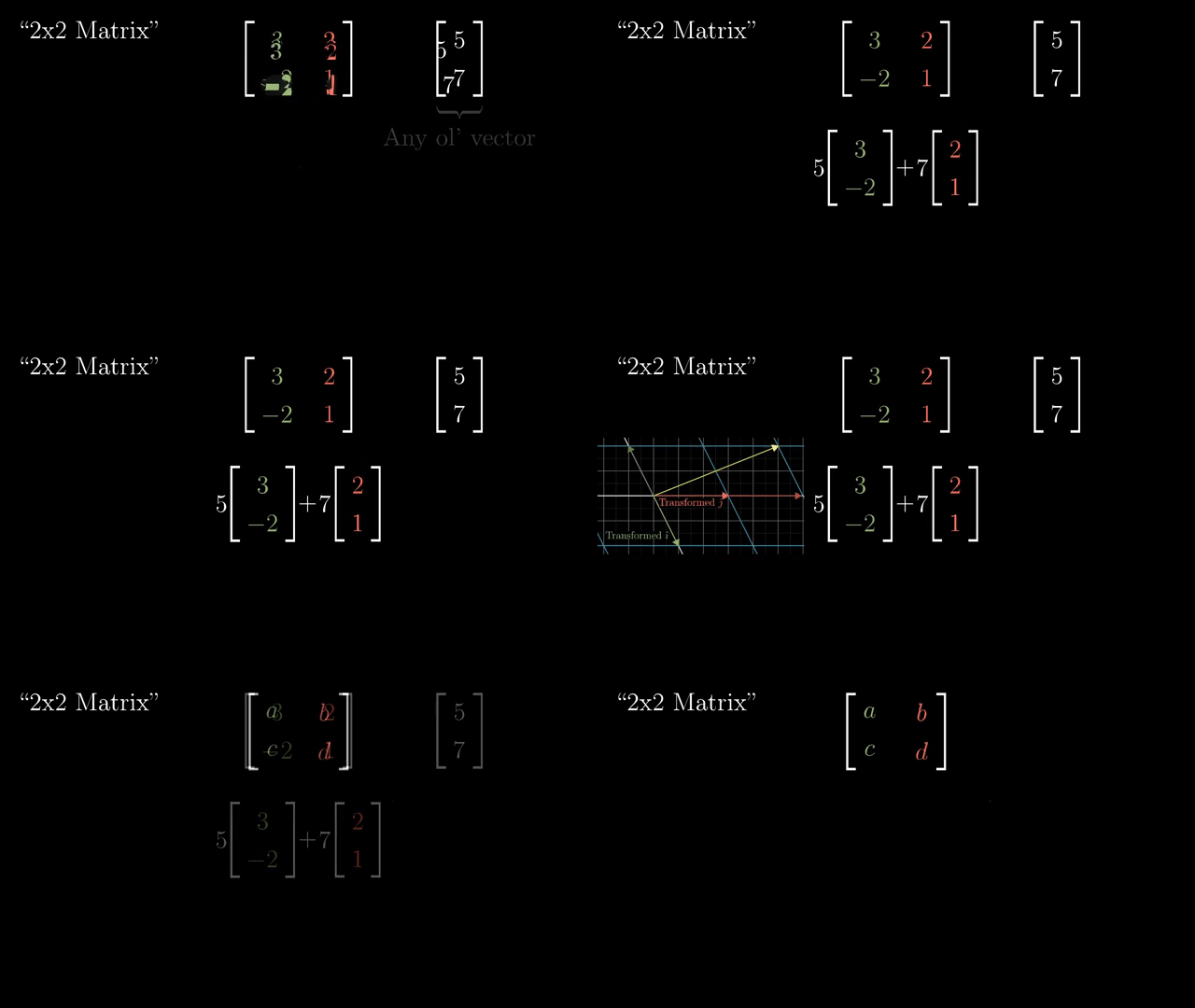
The column space is $\{A\mathbf{x}:\mathbf{x}\in\mathbb{R}^n\}$. Rank equals the dimension of that image. If columns are dependent, some nonzero $\mathbf{x}$ satisfies $A\mathbf{x}=\mathbf{0}$; dependence yields nontrivial kernel combinations.
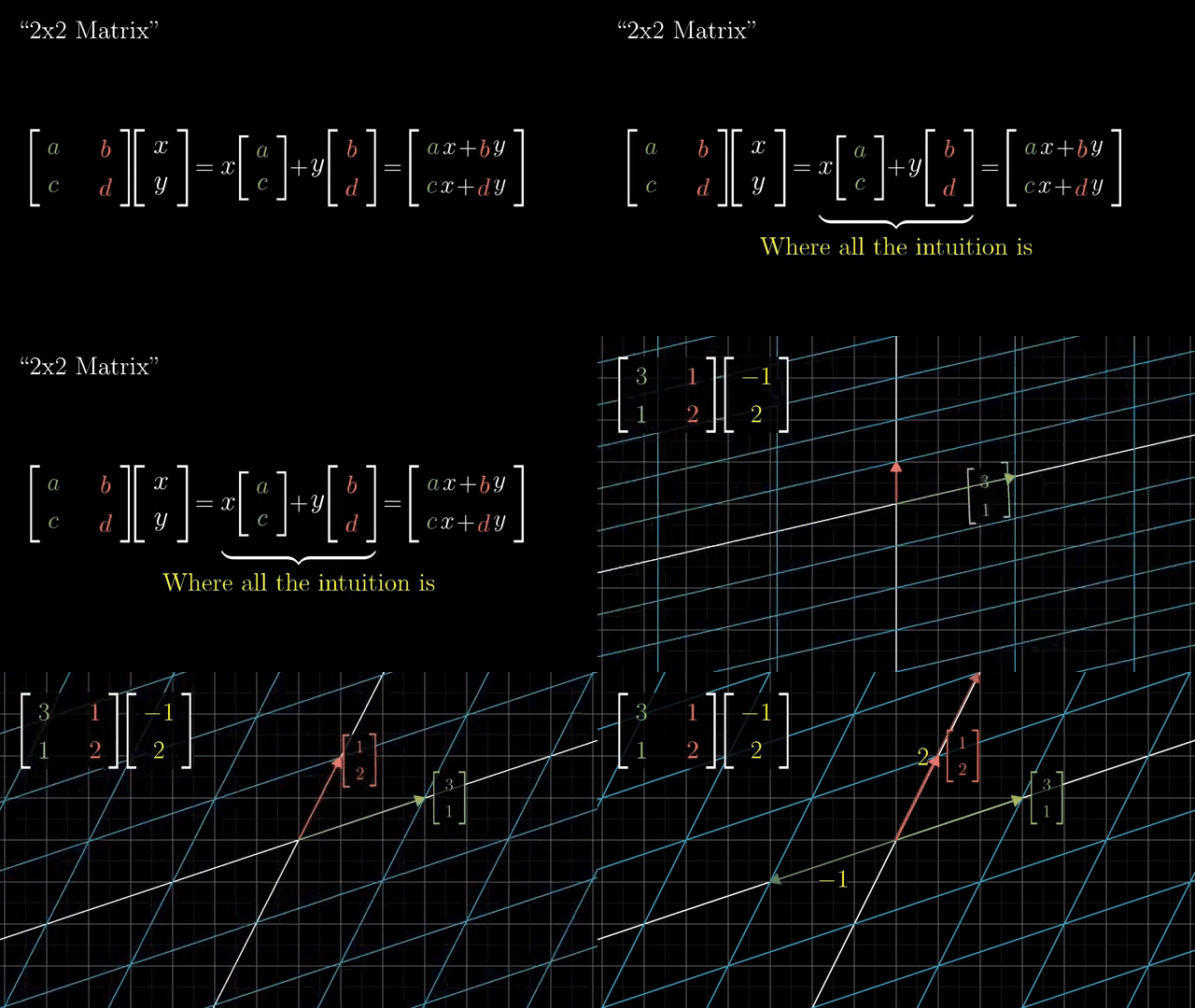
Nullspace directions collapse to $\mathbf{0}$ in output space. For a $3\times 2$ matrix with independent columns, the column space is a plane through the origin in $\mathbb{R}^3$ spanned by the two column vectors.
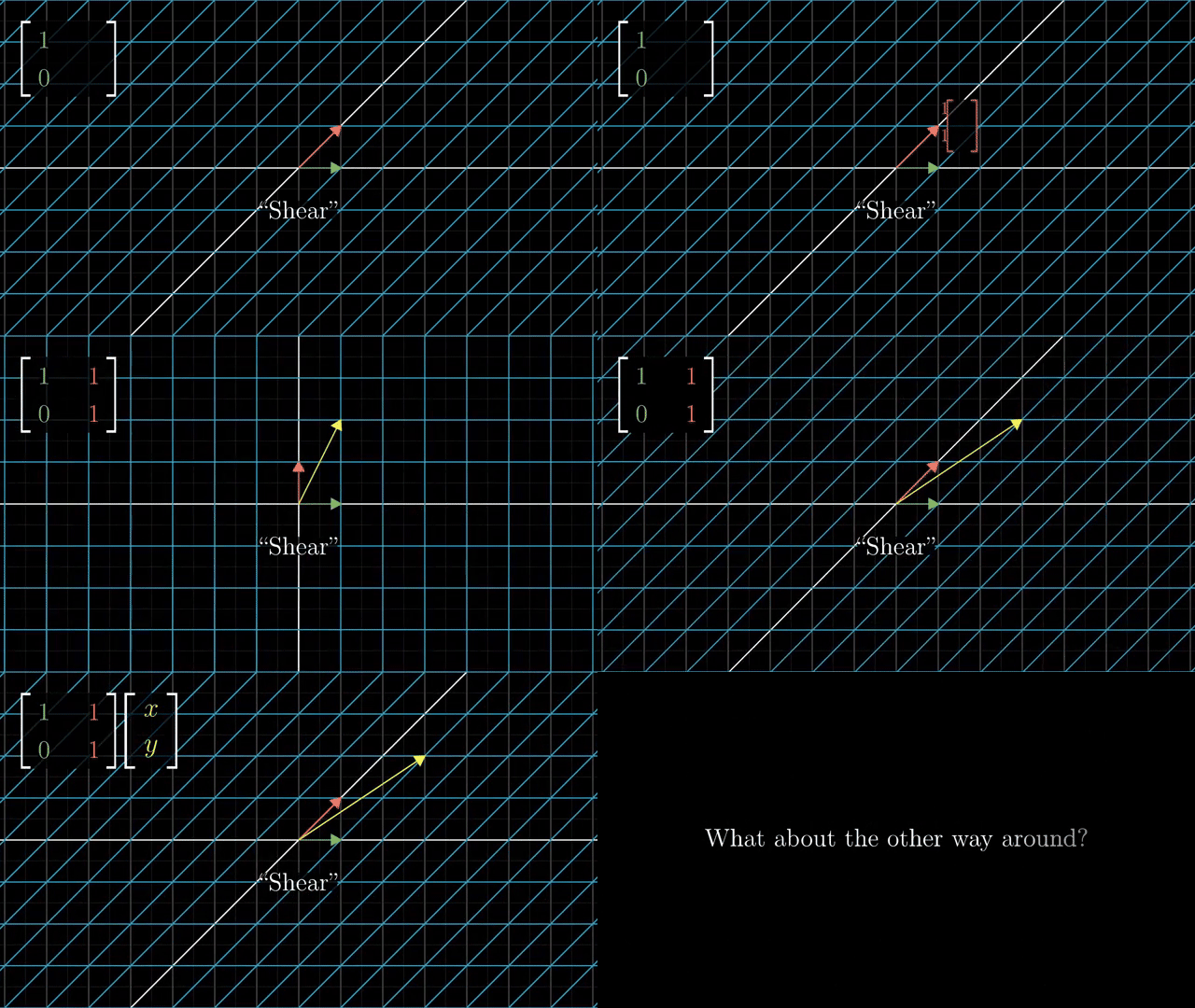
Column rank matches row rank in later theorems, but the column picture matches this chapter's geometry: read $A\mathbf{x}$ as "where do my input coefficients send me inside the span of columns?" .
Check your understanding. The tasks below rest on these ideas: Correct: every output is a combination of columns, so the image is exactly their span. Not quite: it is built from columns not rows, need not fill the codomain, and the inputs sent to $\mathbf{0}$ are the null space, not the column space. Correct: a dependence relation among columns is exactly a nonzero vector in the null space. Not quite: dependence breaks uniqueness and invertibility, and it does not require any column to be zero. Correct: rank is the count of independent column directions, i.e. the dimension of the image. Not quite: it is bounded by the row count but not equal to it in general, and it is unrelated to the trace or to zero entries. Correct: two independent columns span a two-dimensional subspace, a plane through $\mathbf{0}$. Not quite: two columns cannot fill three-space, and independent columns span more than a line or a point.
Related cards
Video Content
Tasks
Card Info
- Topic: Mathematics
- Difficulty: Beginner
- Completed: 0 users
Creator
