Matrices in the standard basis: columns are destination arrows
For $T:\mathbb{R}^n\to\mathbb{R}^m$ under standard bases, column $j$ of $A$ is $T(\mathbf{e}_j)$. That is the entire encoding: expand $\mathbf{x}$ in the input basis and linearly combine those columns .

Reading rows instead of columns swaps stories. Rows become stacks of dot products later in the series. Column $j$ records where the $j$-th standard basis vector lands. The product $A\mathbf{e}_2$ equals the second column of $A$ because $\mathbf{e}_2$ selects that column via linear combination with a single $1$ entry.
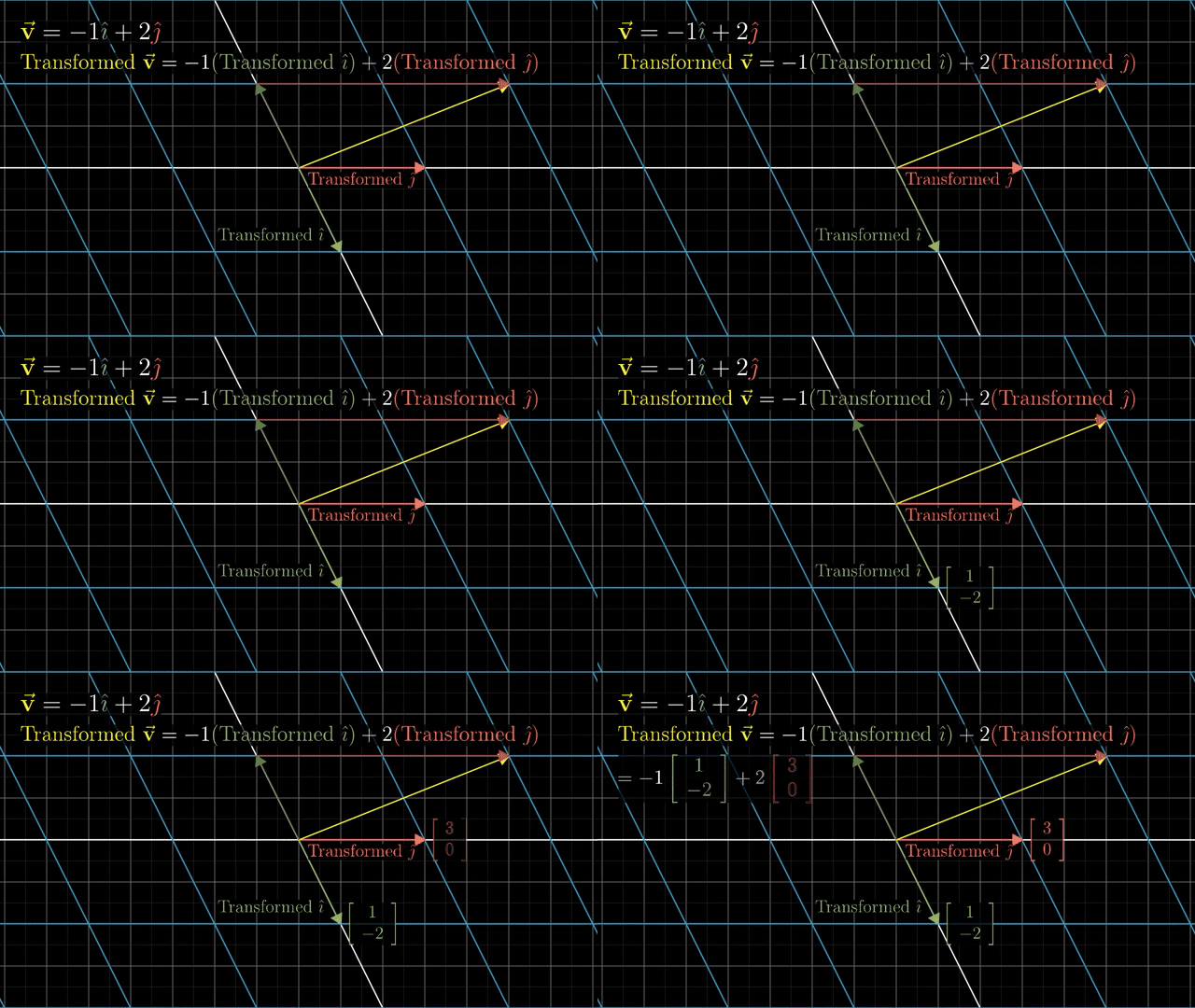
If two columns are identical, rank drops: duplicate columns waste a degree of freedom. At least one dependent column lowers rank below full. The matrix is a compact list of basis destinations in output space.
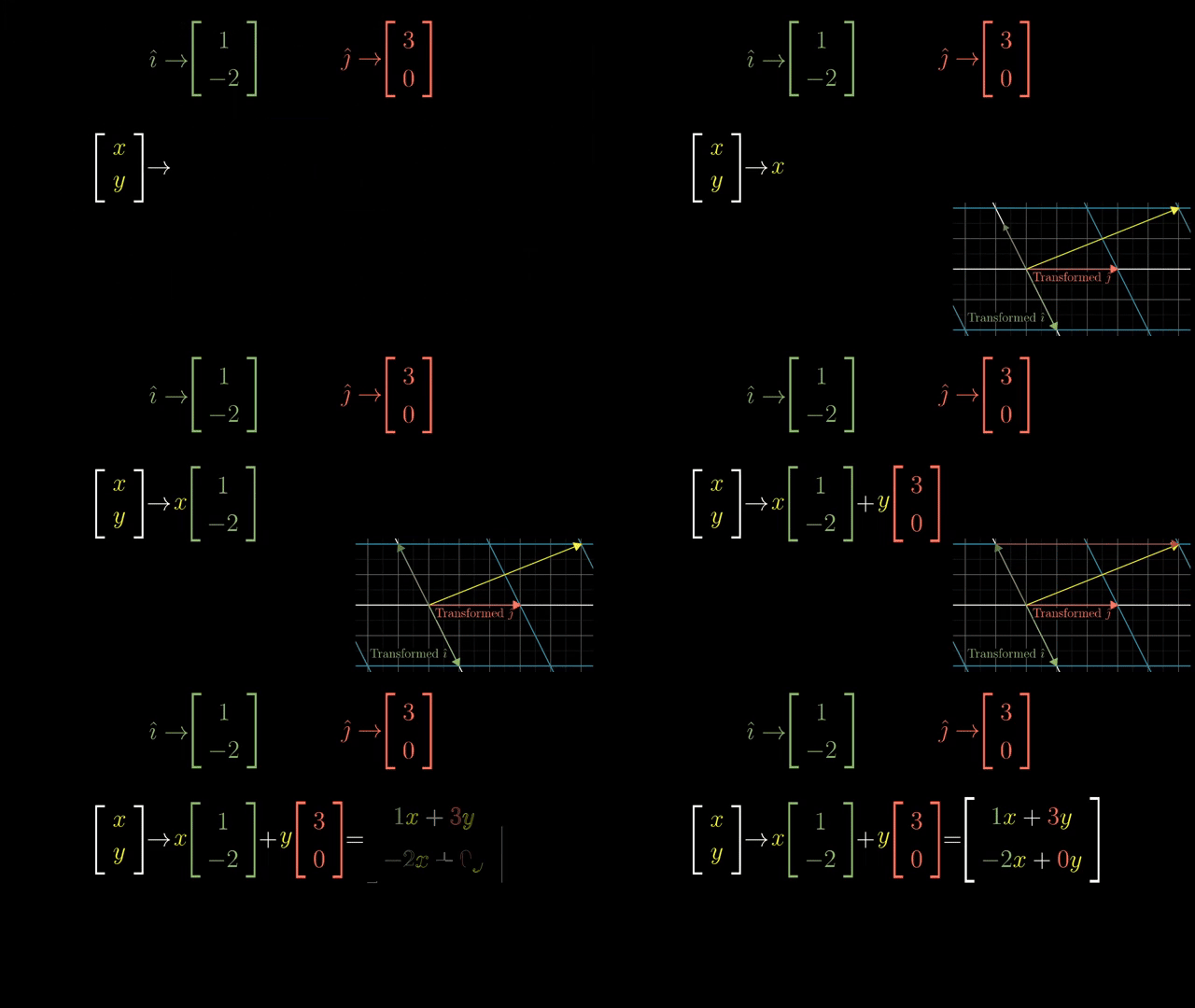
For $A=[\mathbf{c}_1\ \mathbf{c}_2]$ and $\mathbf{x}=(x_1,x_2)$, the product $A\mathbf{x}=x_1\mathbf{c}_1+x_2\mathbf{c}_2$. Inputs weight columns; outputs stay in the column space .
Check your understanding. The tasks below rest on these ideas: Correct: under the standard basis, the $j$-th column is exactly $A\mathbf{e}_j$, the image of that basis vector. Not quite: it is not an output component, a flipped row, or a length. Correct: a repeated column is a dependent direction, which lowers the rank below the number of columns. Not quite: duplicated columns prevent full rank and invertibility, but the rank need not collapse all the way to $0$. Correct: $\mathbf{e}_2$ selects the second column via a single $1$ in its second slot. Not quite: it is not a row, not necessarily zero, and not a single entry. Correct: each input entry weights its matching column, and the weighted columns add. Not quite: swapping which entry scales which column, taking a dot product, or lumping the sums together all change the result.
Related cards
Video Content
Tasks
Card Info
- Topic: Mathematics
- Difficulty: Beginner
- Completed: 0 users
Creator
