Linearity: additivity and scaling, no translation of space
A map $T$ is linear if $T(\mathbf{u}+\mathbf{v})=T(\mathbf{u})+T(\mathbf{v})$ and $T(c\mathbf{u})=cT(\mathbf{u})$. Consequence: $T(\mathbf{0})=\mathbf{0}$, so rigid translations of the plane are not linear maps in the vector-space sense .
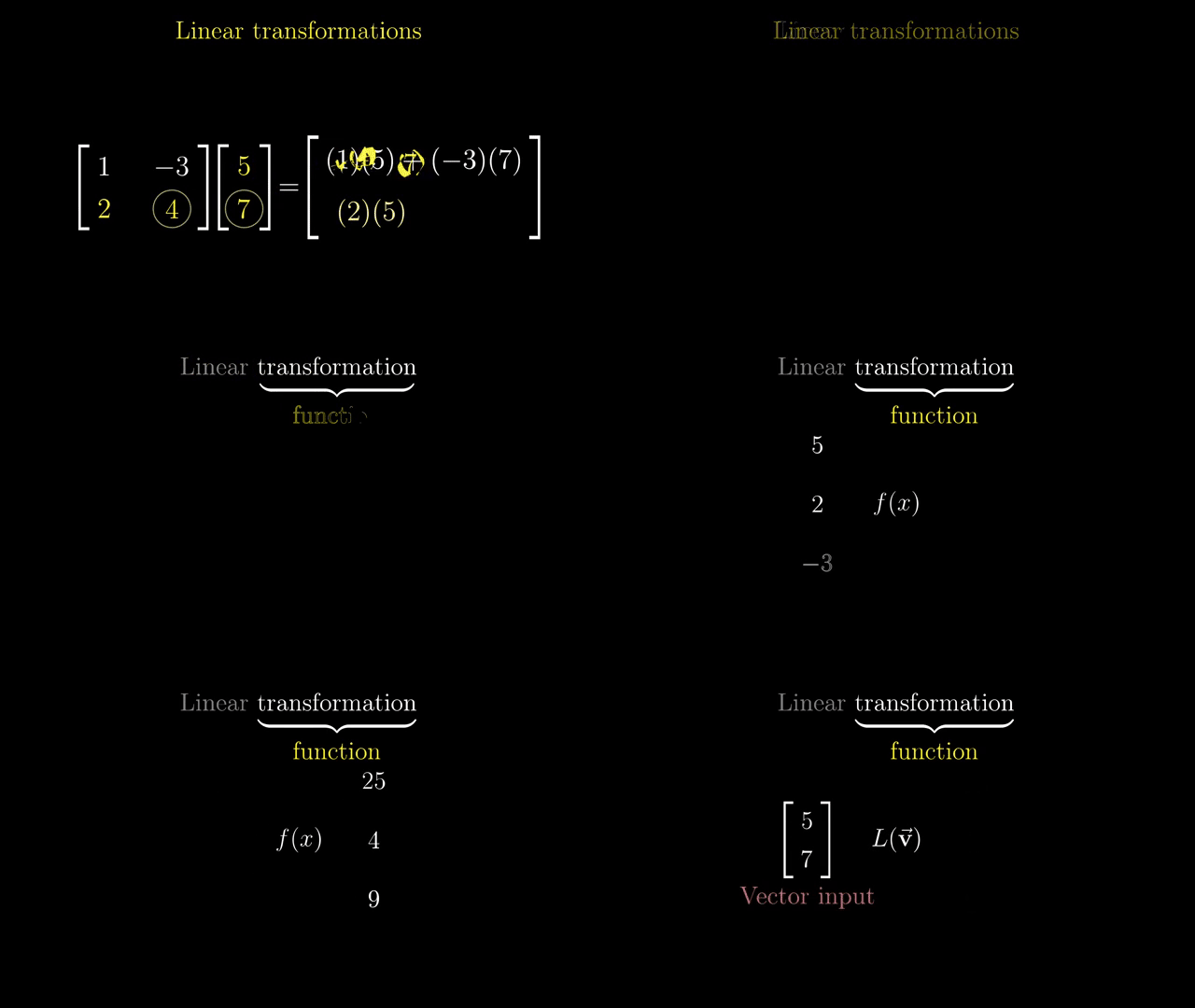
Affine maps allow a constant offset; linear maps keep the origin nailed down. Translation by nonzero $\mathbf{a}$ fails because $T(\mathbf{0})\neq\mathbf{0}$. Knowing images of basis vectors determines $T$ on all inputs because every input is a unique linear combination of basis vectors and linearity extends from generators.
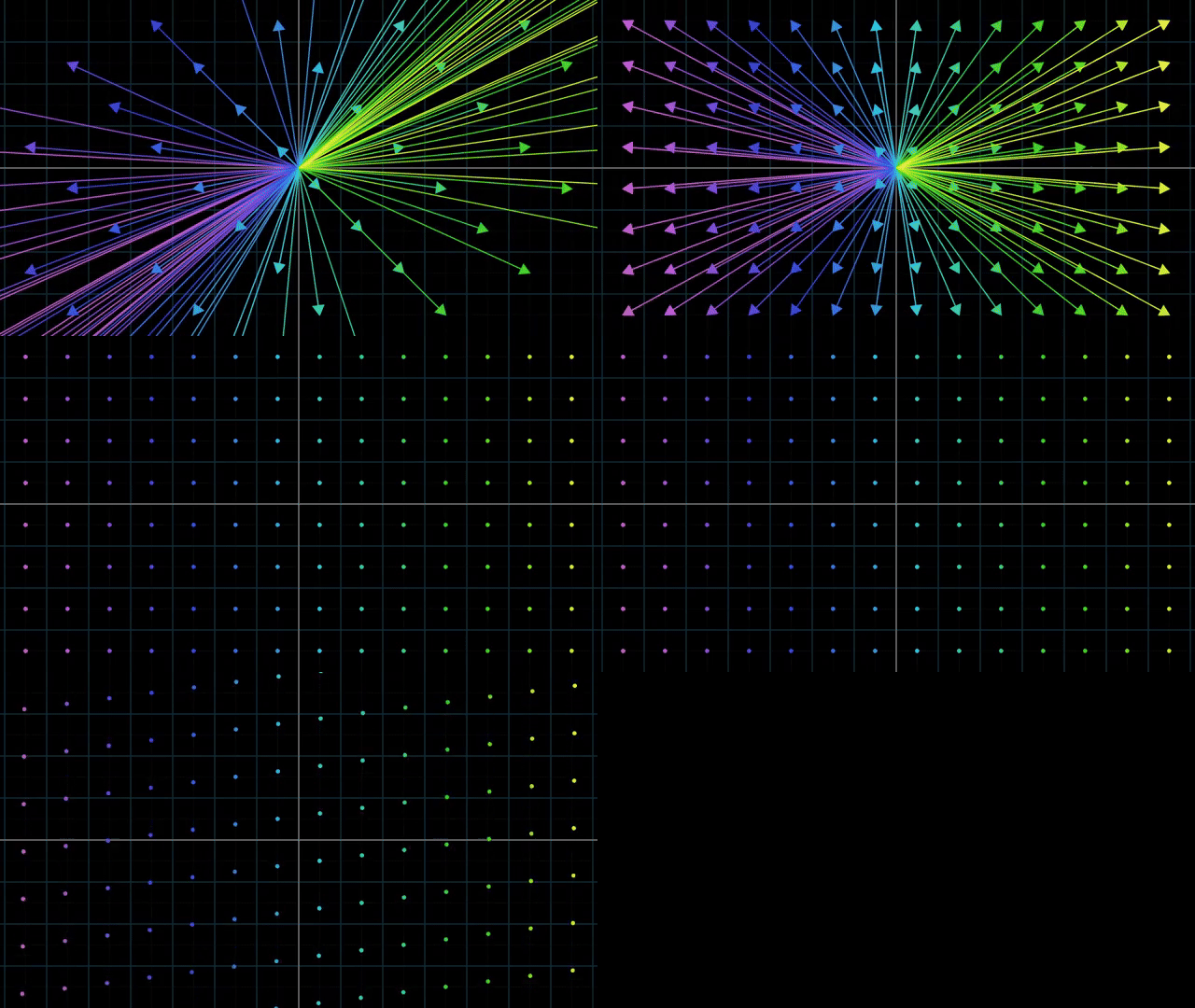
Parallel equally spaced lines map to parallel equally spaced lines as a family. That grid preservation is the geometric signature of linearity. Reflection through a line through the origin, projection onto a coordinate axis, and shear fixing a line are familiar linear examples besides rotation.
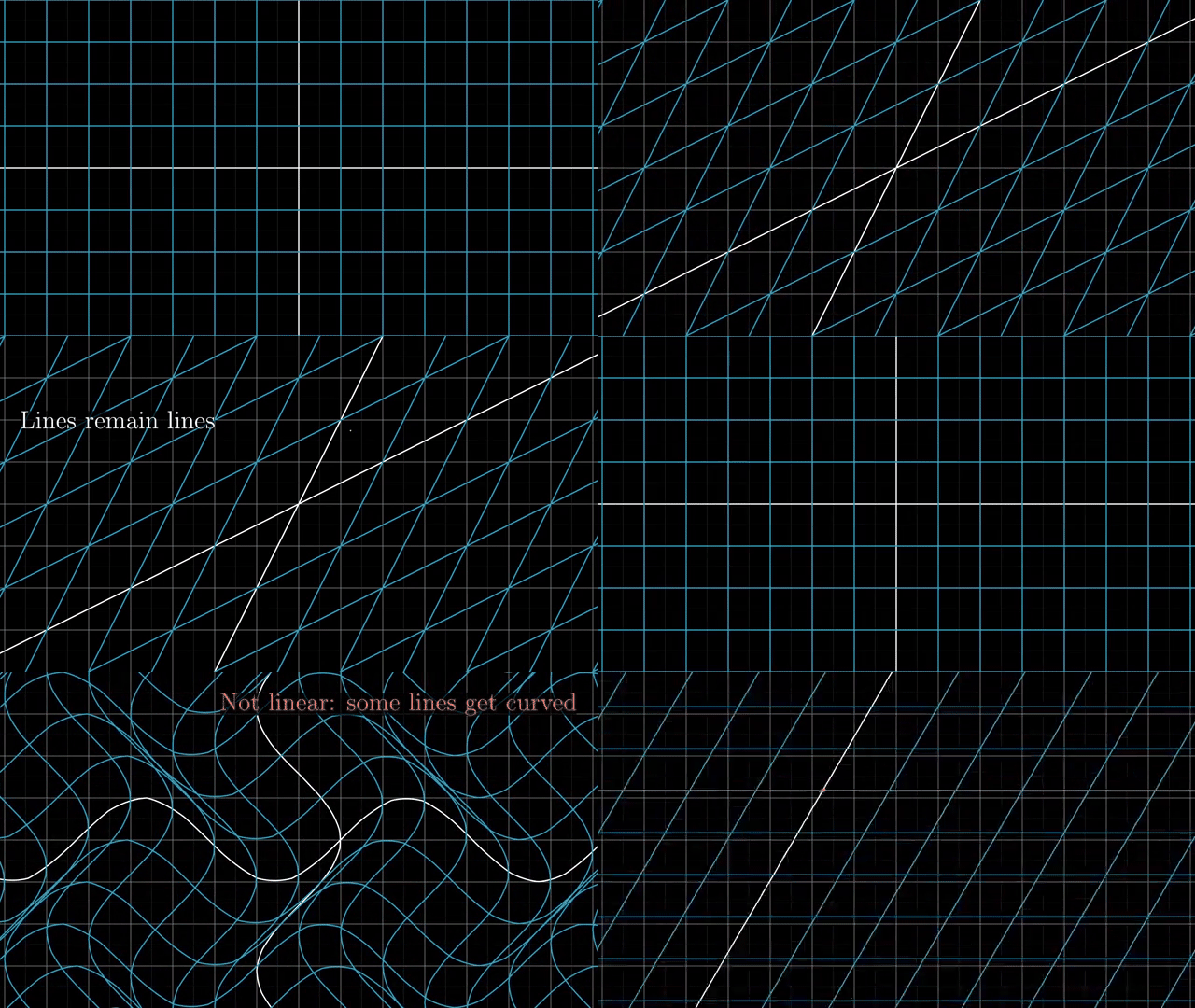
Polar coordinates break vector-space structure globally, so the coordinate map is not linear on the underlying vector operations. Linearity is about respecting addition and scaling of displacements, not about every convenient coordinate chart .
Check your understanding. The tasks below rest on these ideas: Correct: linearity forces $T(\mathbf{0})=\mathbf{0}$, which a nonzero shift violates. Not quite: preserving distances and being differentiable are true of translation but do not bear on linearity, and translation keeps the dimension. Correct: write any $\mathbf{x}$ in the basis and push the combination through $T$ term by term. Not quite: this needs no orthonormality or squareness, and a linear map generally treats different inputs differently. Correct: preserving sums and scalings keeps grid lines straight, parallel, and evenly spaced. Not quite: linear maps never curve lines into circles or arcs, and they need not collapse the family to a point. Correct: a reflection through a line through the origin fixes $\mathbf{0}$ and preserves sums and scalings, so it is linear. Not quite: the other three move the origin (a translation, a shift, or a constant map), so none can be linear.
Related cards
Video Content
Tasks
Card Info
- Topic: Mathematics
- Difficulty: Beginner
- Completed: 0 users
Creator
