Linear combinations: scale, then add, same recipe in every dimension
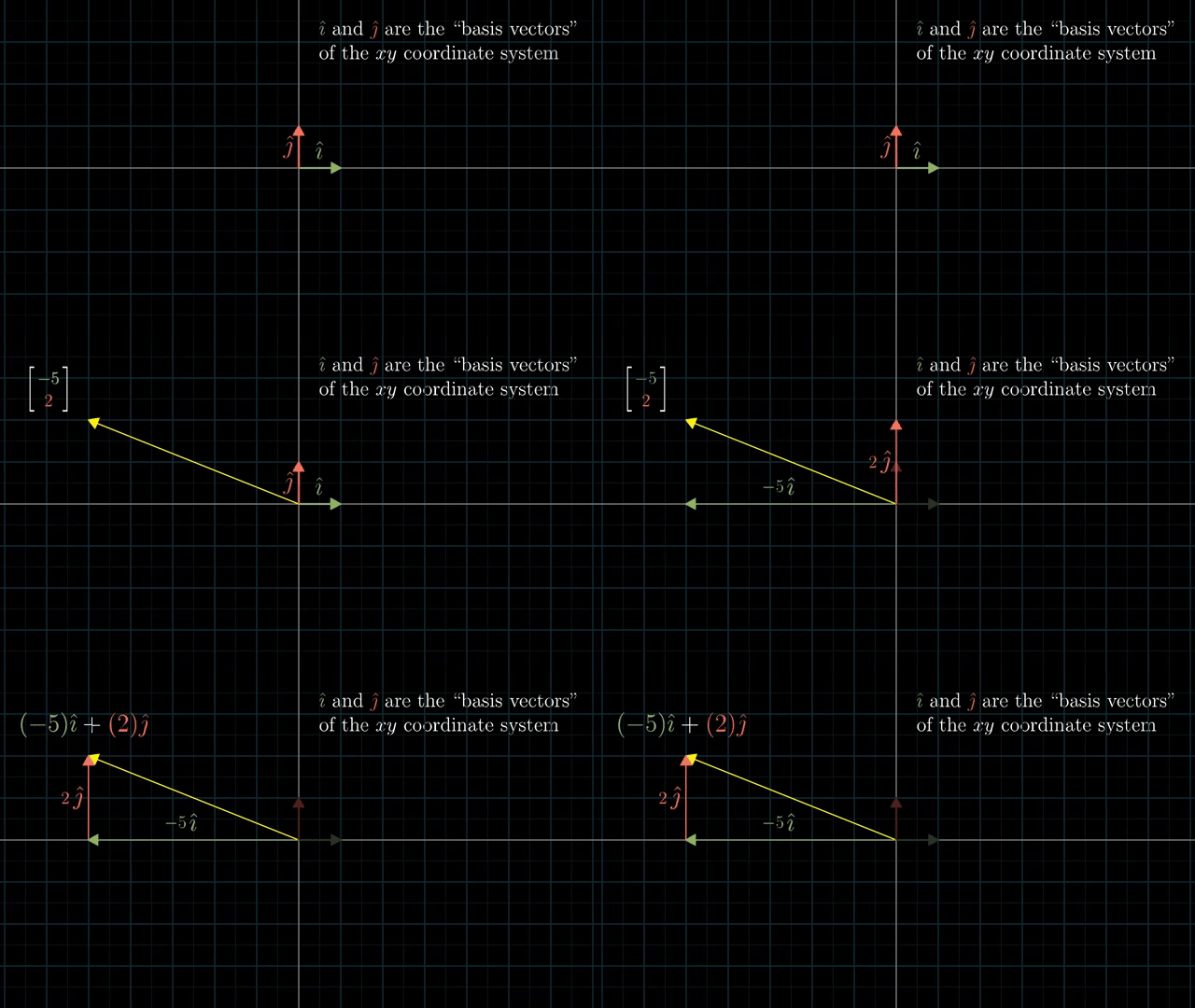
A linear combination of vectors $\mathbf{v}_1,\ldots,\mathbf{v}_k$ is any sum $c_1\mathbf{v}_1+\cdots+c_k\mathbf{v}_k$ with real scalars $c_i$. The exposition stresses that coordinates you have been writing all along are exactly the coefficients in front of a chosen basis .
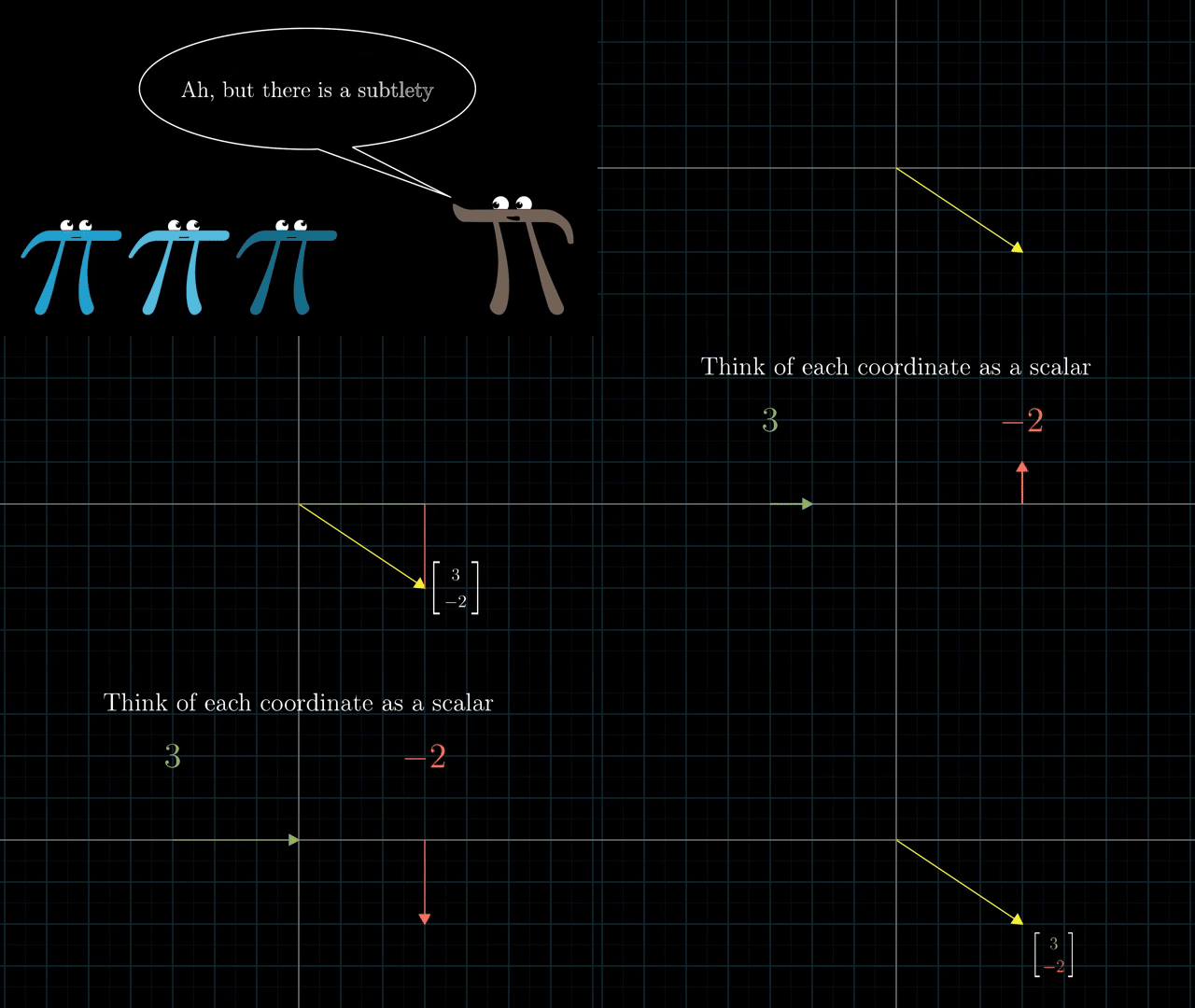
The common slip is treating "linear combination" as "pairwise products." Only one sum overall appears, built from every generator at once. Coefficients may be zero, negative, or fractional; each scalar scales one generator before everything adds.
The zero vector is always a linear combination of any nonempty list because all coefficients can be chosen zero. That trivial combination does not make $\mathbf{0}$ "depend" on the list in the independence sense, but it confirms that spans always contain the origin.
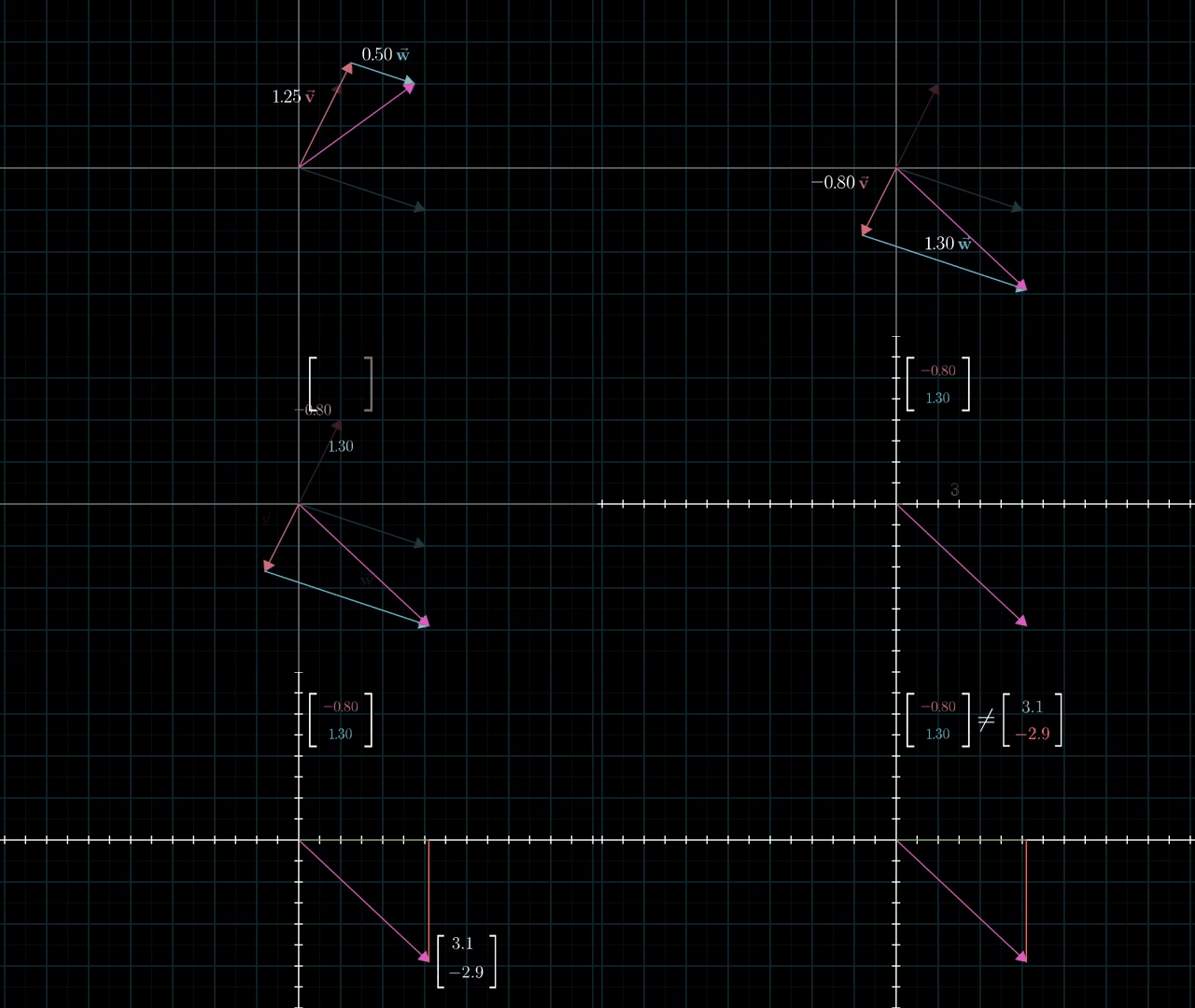
Adding generators does not always enlarge reach: a new vector already inside the old span adds notation but not new destinations. Dependent additions are geometrically redundant .
Check your understanding. The tasks below rest on these ideas: Correct: a linear combination scales each vector and adds, giving $c_1\mathbf{u}+c_2\mathbf{v}$. Not quite: the dot product returns a number, and length-scaling or entrywise products are different operations that are not what 'combination' means. Correct: the trivial combination $0\mathbf{v}_1+\cdots+0\mathbf{v}_k$ equals $\mathbf{0}$, so every span contains the origin. Not quite: spans always include $\mathbf{0}$, the rule about bases is unrelated, and orthogonality does not make something a combination. Correct: a generator already reachable from the others adds notation but no new destinations. Not quite: scalars range over all reals, spans are always subspaces, and adding a vector can only keep or enlarge the span, never shrink it. Correct: each coordinate is the coefficient on the matching basis vector, so $(4,-1)$ is $4\hat{\mathbf{i}}-\hat{\mathbf{j}}$. Not quite: swapping the slots or flipping the sign changes the vector, and a coordinate pair is a combination, not a single dot-product number.
Related cards
Video Content
Tasks
Card Info
- Topic: Mathematics
- Difficulty: Beginner
- Completed: 0 users
Creator
