Numeric coordinates: bookkeeping layered on top of geometry
Once an origin and perpendicular axes are fixed, every displacement acquires a pair of numbers $(x,y)$ recording how far you walked along each axis to realize the same trip. The exposition emphasizes that the list is notation for a geometric object, not the object itself. Swap basis later and the numbers scramble while the arrow stays put .
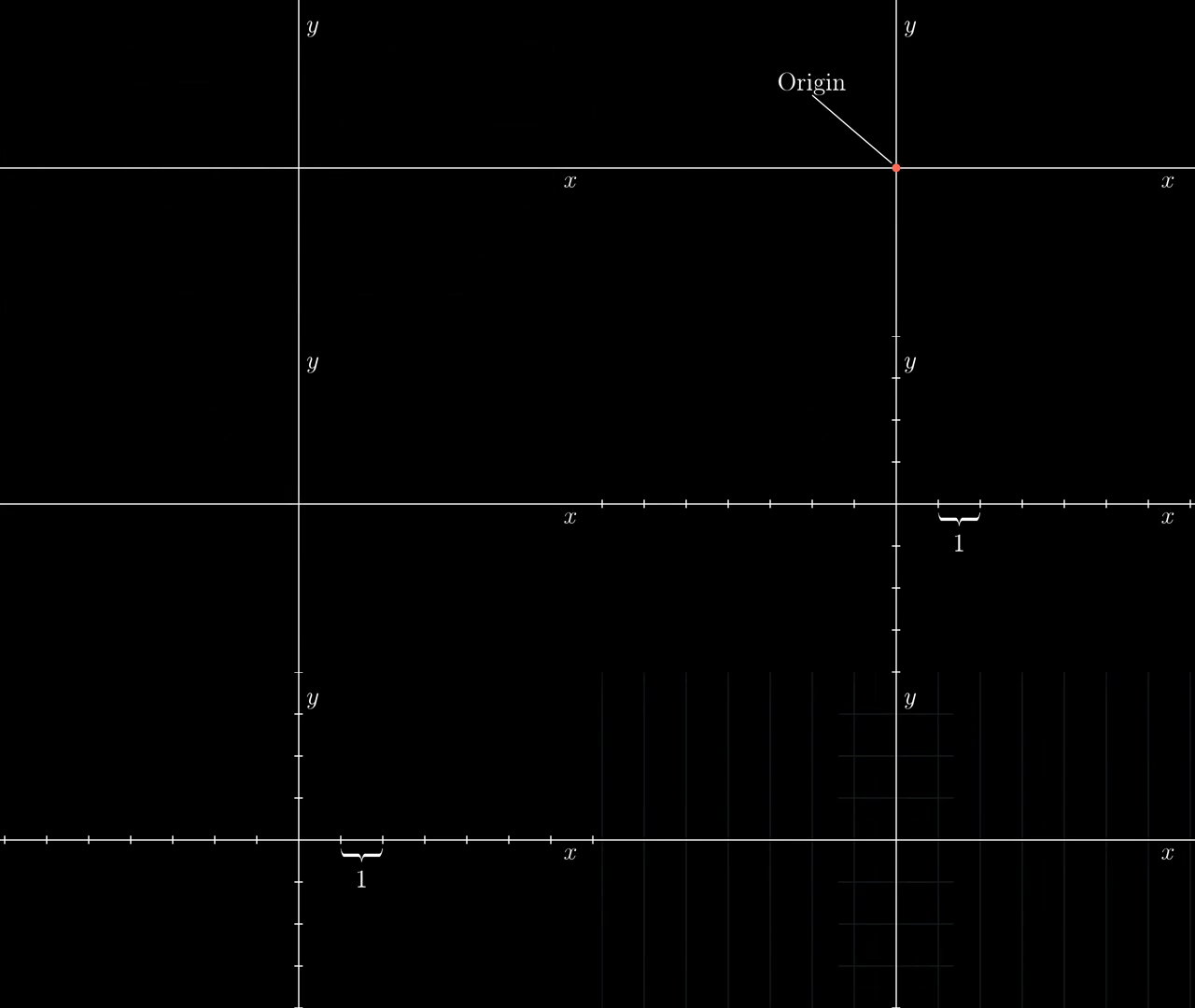
Professional habit: read coordinate tuples as instructions to combine basis vectors with those coefficients. That habit pays off when matrices arrive as "where do basis vectors land?" The standard basis $\hat{\mathbf{i}},\hat{\mathbf{j}}$ is convenient, not mandatory.
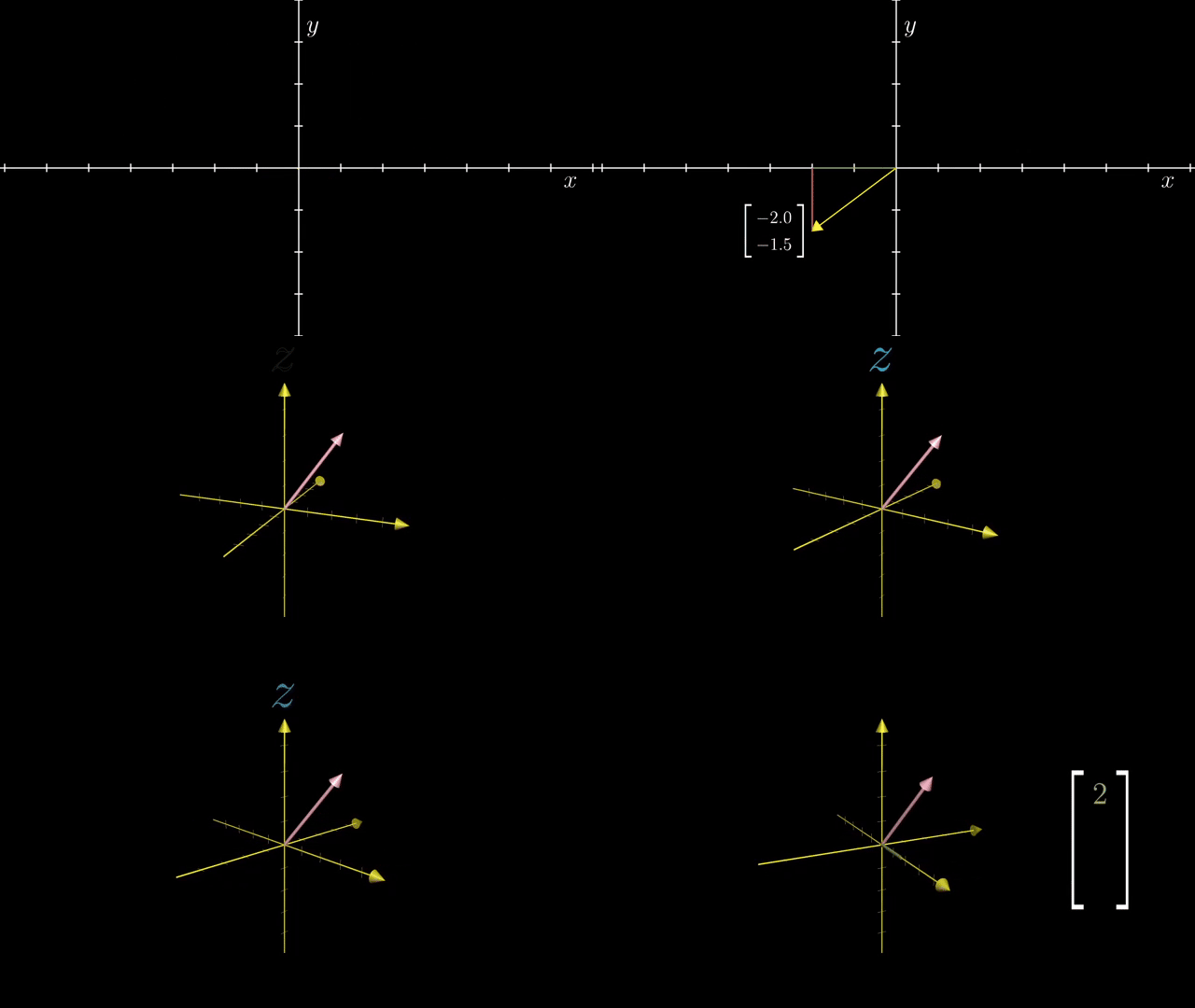
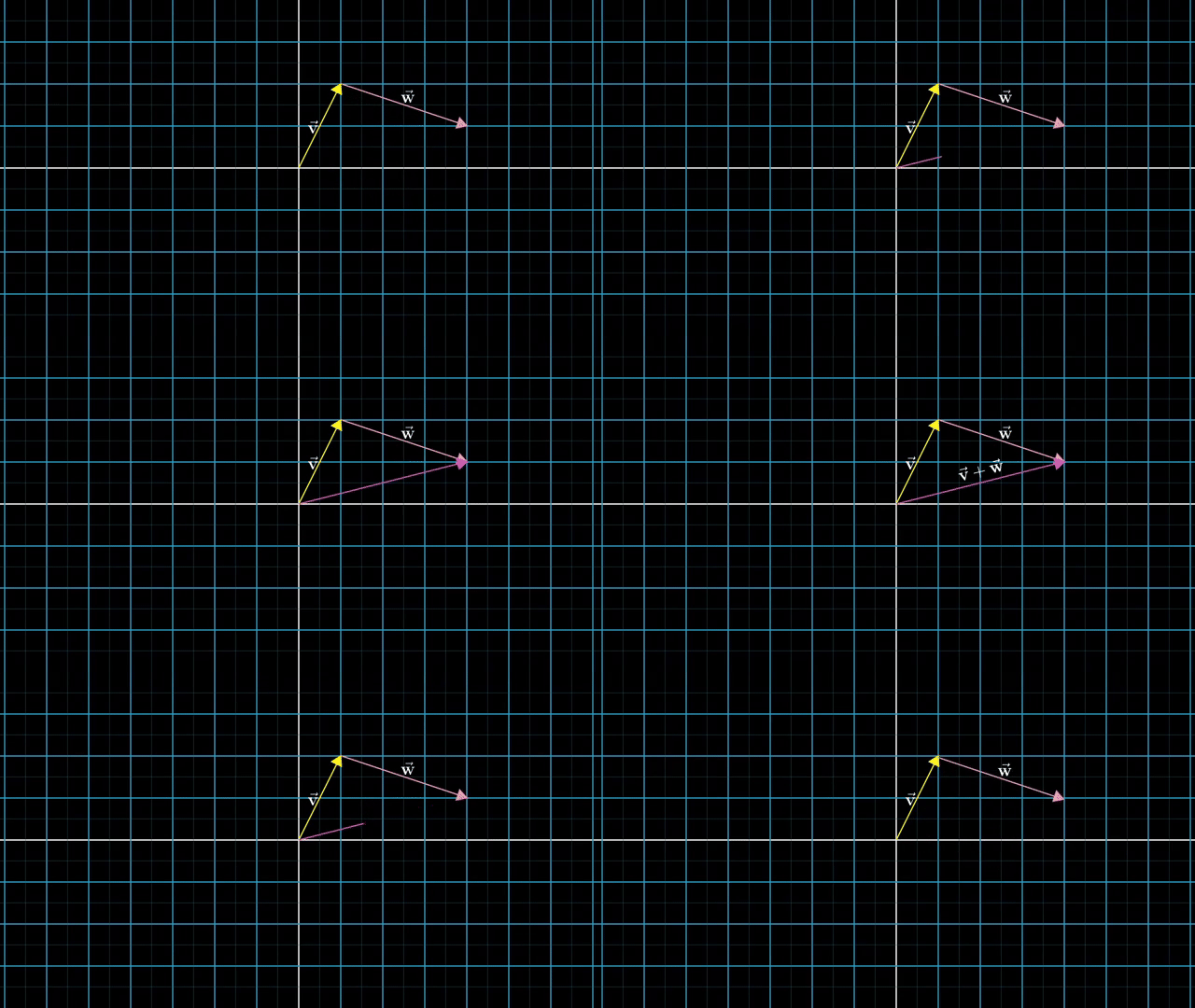
Negating every coordinate reflects through the origin along the line spanned by the vector: $-\mathbf{v}$ points opposite with the same magnitude. Componentwise addition matches head-to-tail geometry because each axis measures an independent piece of the combined displacement .
Edge case: students sometimes treat $(3,-2)$ as "the point $(3,-2)$" rather than $3\hat{\mathbf{i}}-2\hat{\mathbf{j}}$. Keeping the linear-combination reading prevents category errors once linear maps enter the story.
Check your understanding. The tasks below rest on these ideas: Correct: coordinates are the coefficients on a chosen ordered basis, so the basis and its ordering fix the numbers. Not quite: length alone cannot give two coordinates, drawing style is cosmetic, and the same vector gets different coordinates in different bases, so there is no single true pair. Correct: multiplying all coordinates by $-1$ is scaling by $-1$, which flips direction and preserves magnitude. Not quite: a $90^\circ$ rotation is a different operation, negation does not collapse a nonzero vector to $\mathbf{0}$, and the length $|-1|\,\|\mathbf{v}\|$ is unchanged, not doubled. Correct: the axes are independent directions, so the total trip along each axis is just the sum of the parts along that axis. Not quite: the triangle need not be right-angled, ordering of letters is irrelevant, and head-to-tail addition works for any two vectors, not only perpendicular ones. Correct: the first coordinate scales $\hat{\mathbf{i}}$ and the second scales $\hat{\mathbf{j}}$, giving $3\hat{\mathbf{i}}-2\hat{\mathbf{j}}$. Not quite: swapping the slots or flipping the sign of the second coefficient changes the vector, and treating it as merely a point misses that coordinates are exactly the combining coefficients.
Related cards
Video Content
Tasks
Card Info
- Topic: Mathematics
- Difficulty: Beginner
- Completed: 1 users
Creator
