Vector addition: head-to-tail choreography
To add $\mathbf{u}$ and $\mathbf{v}$, draw $\mathbf{u}$, place the tail of $\mathbf{v}$ at the tip of $\mathbf{u}$, and the closing arrow from start to finish is the sum. This matches the parallelogram law because rigid translation identifies opposite sides of the parallelogram .
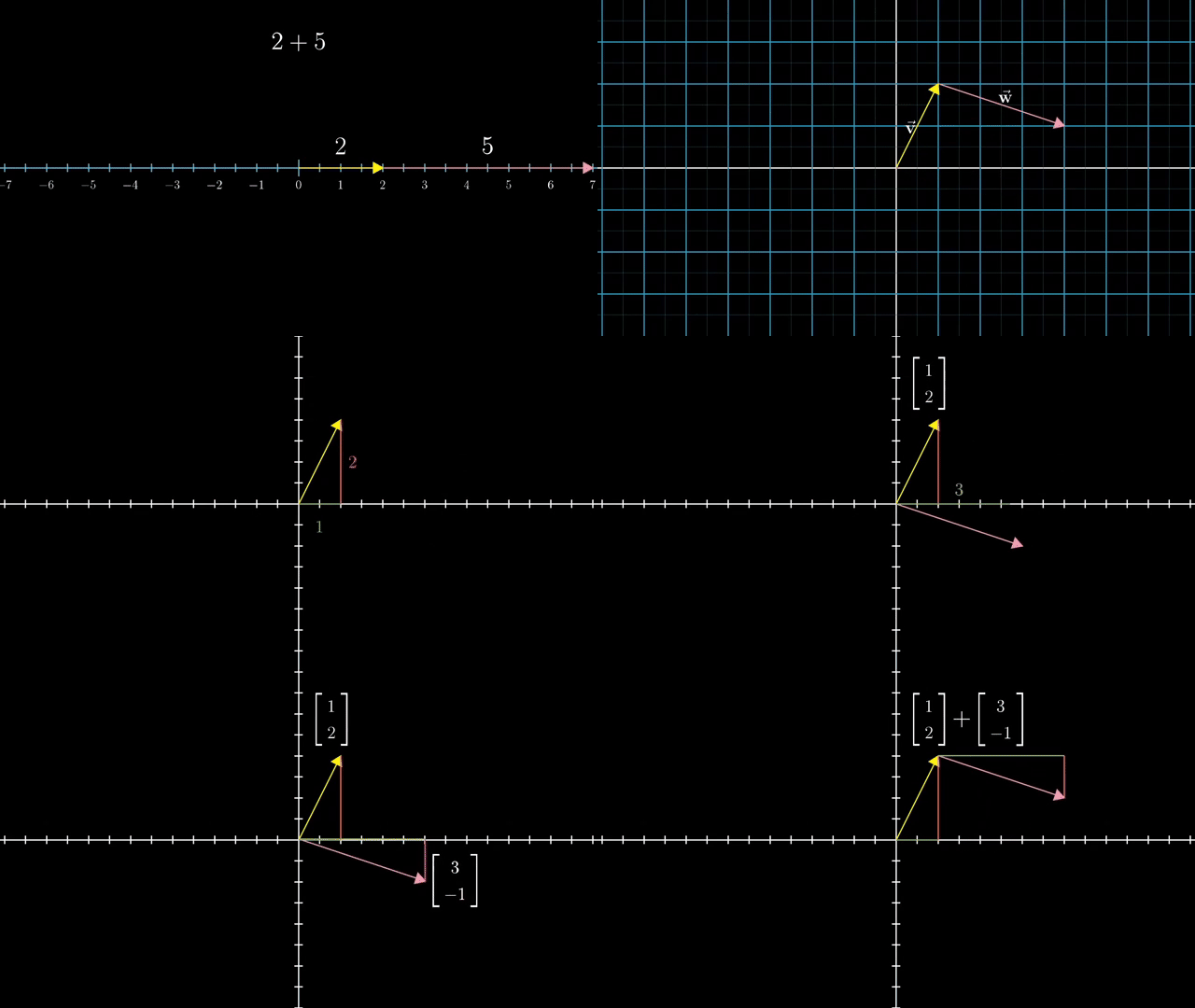
The pedagogical pitfall is drawing the second vector from the origin out of habit. The sum is still well defined, but you lose the immediate visual that addition is composition of movements. Commutativity follows from the parallelogram: $\mathbf{u}+\mathbf{v}$ and $\mathbf{v}+\mathbf{u}$ share the same diagonal.
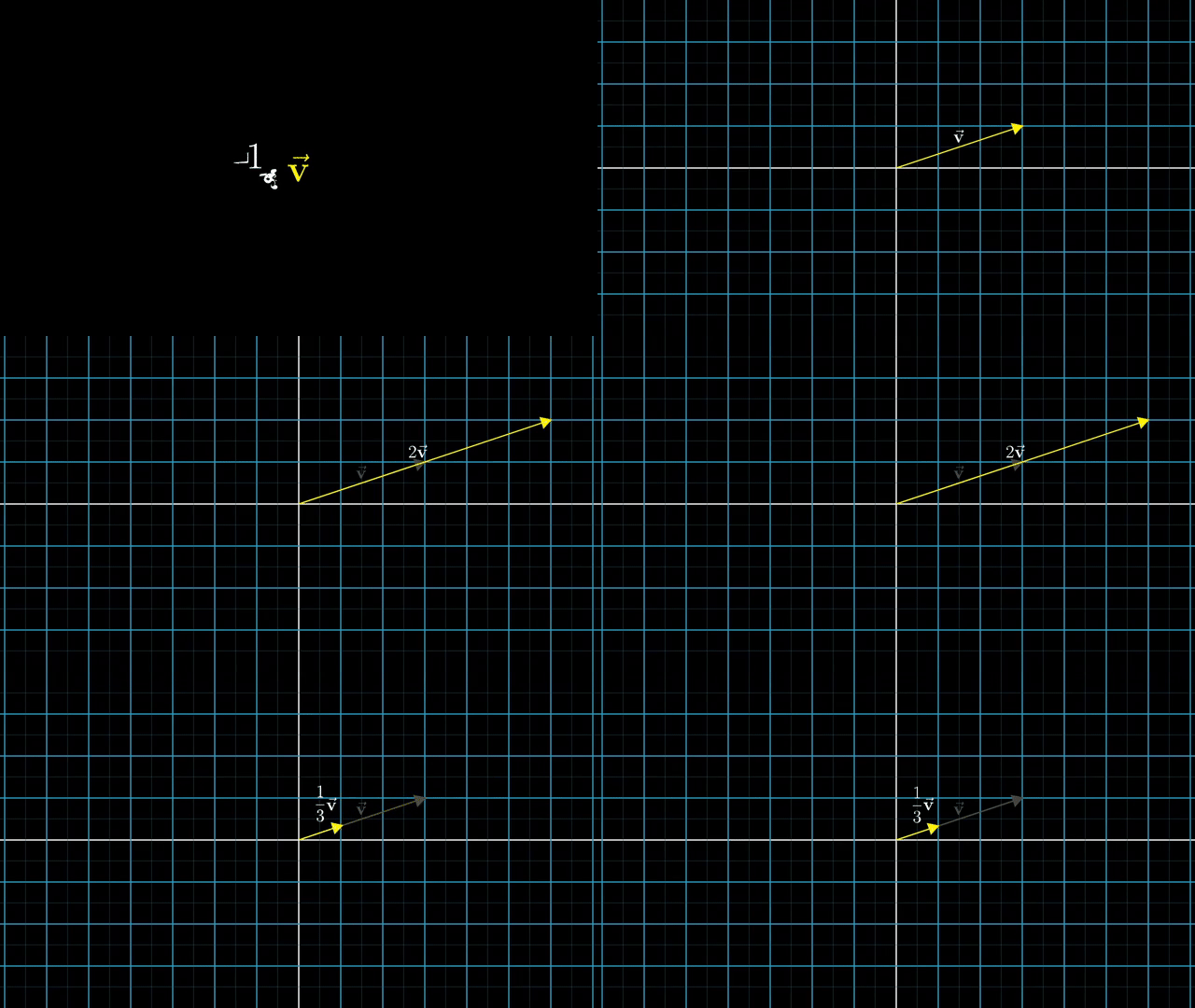
Subtraction means add $-\mathbf{v}$ head-to-tail. Associativity in $\mathbb{R}^n$ lifts from real addition in each coordinate: $(\mathbf{u}+\mathbf{v})+\mathbf{w}=\mathbf{u}+(\mathbf{v}+\mathbf{w})$ because every component associates independently .
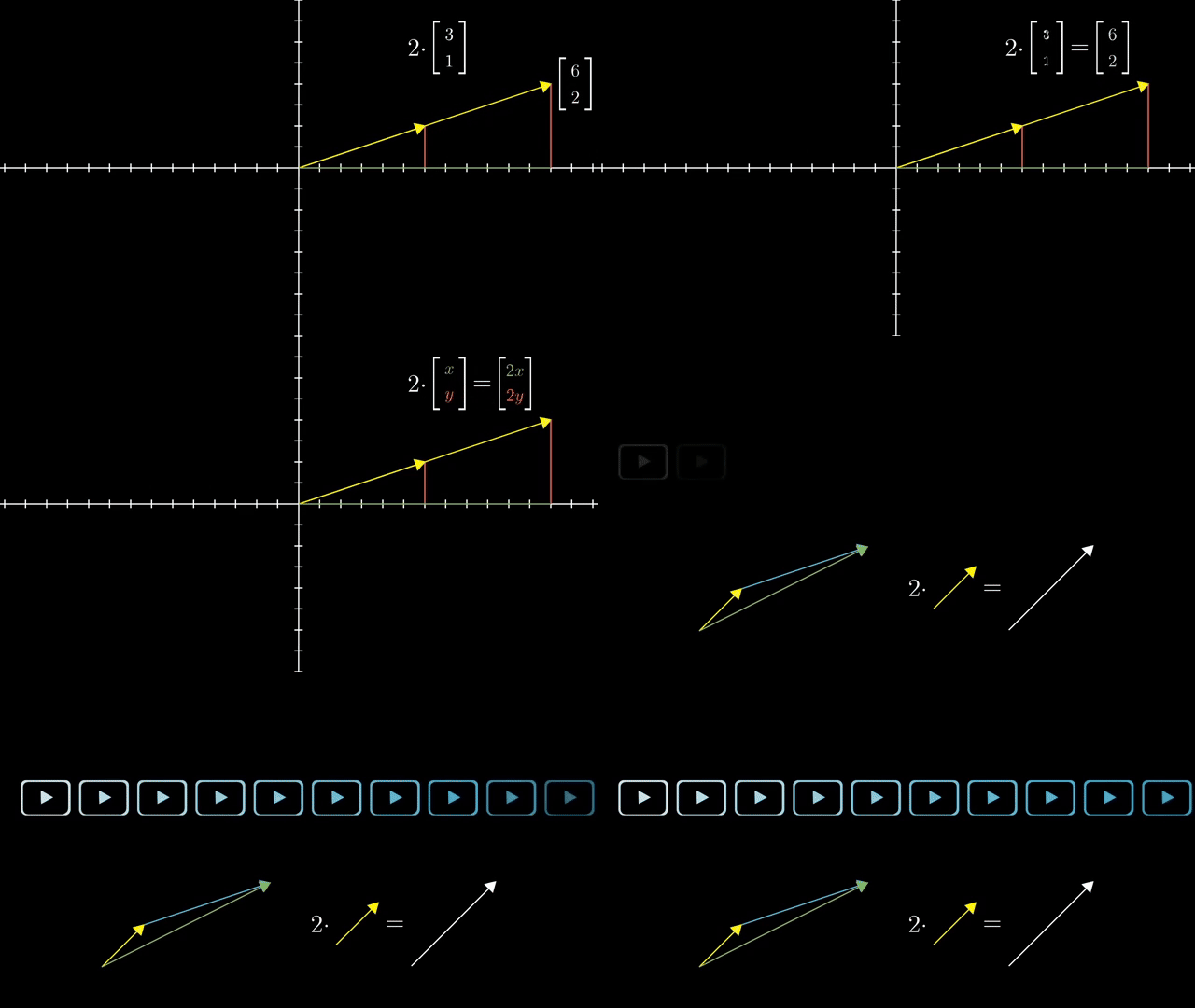
Three or more vectors concatenate the same way: walk along $\mathbf{u}$, then $\mathbf{v}$, then $\mathbf{w}$; the closing arrow is the total displacement regardless of bracketing.
Check your understanding. The tasks below rest on these ideas: Correct: both orders of head-to-tail walking trace the two routes around one parallelogram and reach the same diagonal. Not quite: commutativity holds in every $\mathbb{R}^n$, addition is not multiplication, and it does not require perpendicular vectors. Correct: subtraction is addition of the additive inverse, so you flip $\mathbf{v}$ and add it head to tail. Not quite: projection and the dot product are unrelated operations, and halving $\mathbf{v}$ scales rather than subtracts. Correct: addition acts coordinate by coordinate, so the associativity of real addition lifts directly to vectors. Not quite: determinants, independence, and orthonormality are unrelated to why bracketing does not matter for a sum. Correct: chaining the arrows composes the displacements, and associativity means the bracketing is irrelevant. Not quite: drawing from the origin loses the composition picture, the result is the sum for any three vectors (not only closed triangles), and it is a sum, not an average.
Related cards
Video Content
Tasks
Card Info
- Topic: Mathematics
- Difficulty: Beginner
- Completed: 0 users
Creator
