Educational Cards
Learn from video content, text, and interactive tasks
Filters
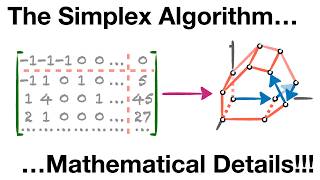
One pivot: entering column, ratio test, and row reduction
A single move of the algorithm has two decisions and one calculation. First, choose which variable...
Building the simplex tableau
With every equation in the same format, you load the coefficients and the right-hand totals into a...
Slack variables turn inequalities into equalities
The next step converts each less-than-or-equal constraint into an exact equality by adding a slack...
Standard form: making every constraint a less-than-or-equal
The simplex algorithm is written to expect every constraint in the same direction, using the...
Scaling the idea: the three-mix example
To see the idea work on something bigger, add a third product. Now the goal is to choose amounts of...
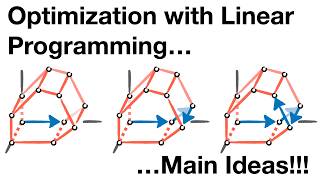
The simplex idea: walk from vertex to vertex, uphill
The simplex algorithm avoids checking every vertex. Take two mixes with three constraints on flour,...
Constraints and the feasible region
A constraint turns a resource limit into an inequality. The factory has only 10 kg of flour. Each...
Reading JSON and the many faces of missing
Most web data arrives as JSON , a text format of nested objects and arrays that maps cleanly onto...
Choosing charts and headless plotting
Four charts do most of the everyday work, and each answers a different question: - a histogram...
Why look first, and the figure/axes model
Exploratory data analysis (EDA) is the habit of plotting before modelling, because a picture...
groupby, merge, and counting carefully
The workhorse is groupby — the "split by key, then reduce" sentence from the aggregation topic, now...
Broadcasting and boolean masks
Broadcasting is NumPy's rule for combining arrays of different shapes. When the shapes are...