Collisions: Chaining
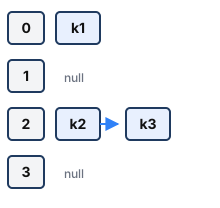
Chaining stores colliding entries in a list (or a tree) per bucket. Insertion depends on the structure of the bucket.
Advantage: simple deletion logic. Disadvantage: additional pointers and poor cache locality with long chains.
| Strategy | Where the entry sits | Deletion |
|---|---|---|
| Chaining | inside the bucket structure | local in the chain |
| Open addressing | later slot in the table | needs a tombstone |
| ## Where used |
Classic HashMap buckets (historically lists, today often trees beyond a threshold). Understanding chaining explains worst-case behavior and attacks with colliding keys.
Depth
In chaining, each table slot points to a collection of all entries that land there. Searching, inserting, and deleting first handle the index and only then work on this local collection. Lists are simple, but for long chains, other structures can also be sensible.
If the distribution is adequate, the average chain length is controlled by the load factor. In the worst case, however, many keys accumulate at one location, and the search approaches a linear examination. Chaining tolerates an occupancy above the table length because buckets can hold multiple entries.
Difficulty levels
- Handle a collision by inserting into a bucket list.
- Relate expected chain length to the load factor.
- Analyze the degenerate case of a poor hash function.
Pitfalls
When updating, an already equal key must not be blindly appended as a second entry. Another mistake is to only check the hash value and not the key equality.
Tasks
Card Info
- Topic: Algorithms and Data Structures
- Difficulty: Intermediate
- Completed: 0 users
Creator
