Same words, new habitats: eigenfunctions, inner products
Eigenvectors become eigenfunctions when the vector space is a function space. Dots become inner products that encode geometry of functions .
On nice domains, the $L^2$ inner product $\int f(x) g(x)\, dx$ replaces the finite-dimensional dot product. Orthogonal polynomials have zero inner product pairwise within the family. Gram, Schmidt generalizes to abstract inner product spaces.
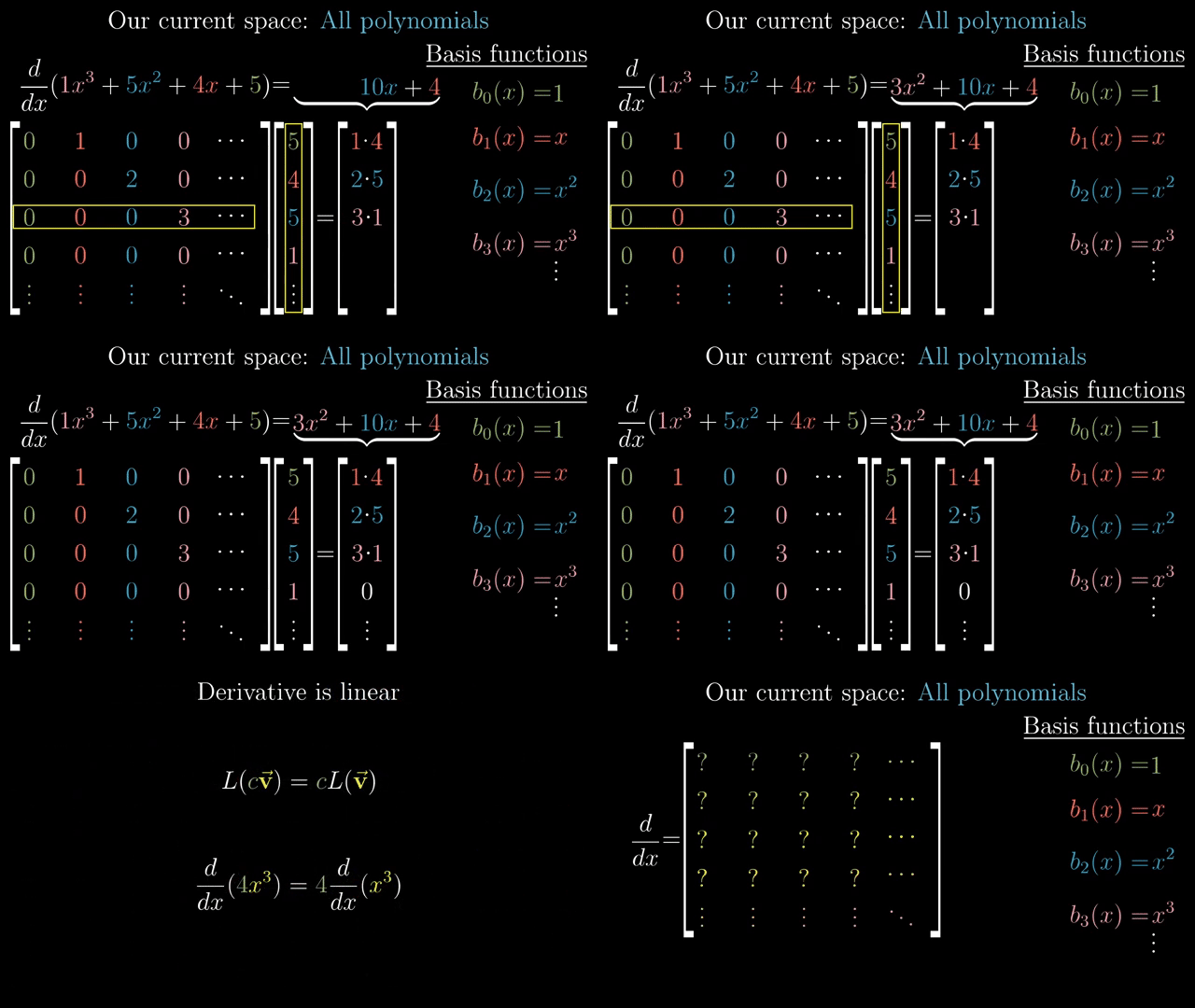
The time-independent Schrödinger equation is an eigenfunction equation: Hamiltonian eigenfunctions are stationary states. Same vocabulary, new habitat.
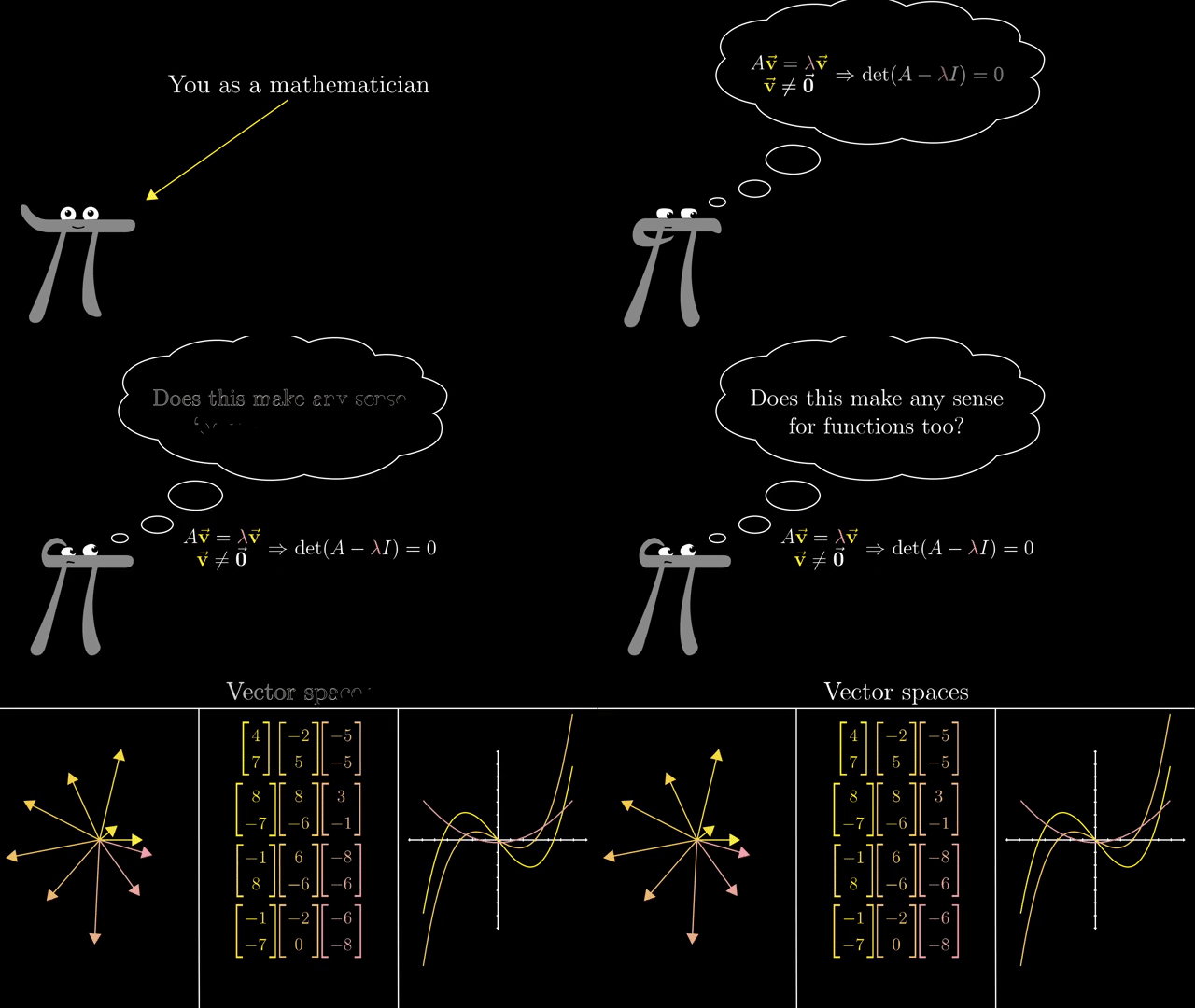
Analysis prerequisites matter once integrals define geometry, but the linear-algebra skeleton is unchanged.
Orthogonality in function space is the same idea as perpendicular arrows: inner product zero. Gram, Schmidt is the same algorithm, now with integrals instead of finite sums.
Check your understanding. The tasks below rest on these ideas: Correct: the $L^2$ inner product integrates the product of the functions, generalizing the dot product. Not quite: a single point value, a max, or a difference are not inner products. Correct: orthogonality means distinct members pair to zero under the inner product. Not quite: they are not parallel, equal, or about determinants. Correct: with an inner product defined, Gram-Schmidt builds orthonormal bases in general spaces. Not quite: it is not limited to $\mathbb{R}^2$, matrices, or finite dimension. Correct: the Schrodinger equation $\hat{H}\psi = E\psi$ is an eigenvalue problem for an operator on a function space. Not quite: the Pythagorean theorem, quadratic formula, and $F=ma$ are not eigenvalue equations.
Related cards
Video Content
Tasks
Card Info
- Topic: Mathematics
- Difficulty: Advanced
- Completed: 0 users
Creator
