Many things are "vectorish"
Arrows in the plane, tuples of numbers, polynomials, and signals can all reuse linear algebra language once addition and scalar multiplication behave sensibly . The concrete Euclidean picture remains the pedagogical on-ramp, but it is not the final definition.
Vector space axioms pin down rules for $+$ and scalar multiplication: closure, associativity, commutativity of addition, distributive laws, compatibility of scaling, existence of a unique zero vector, and additive inverses. Functions can be added pointwise by $(f+g)(x) = f(x) + g(x)$.
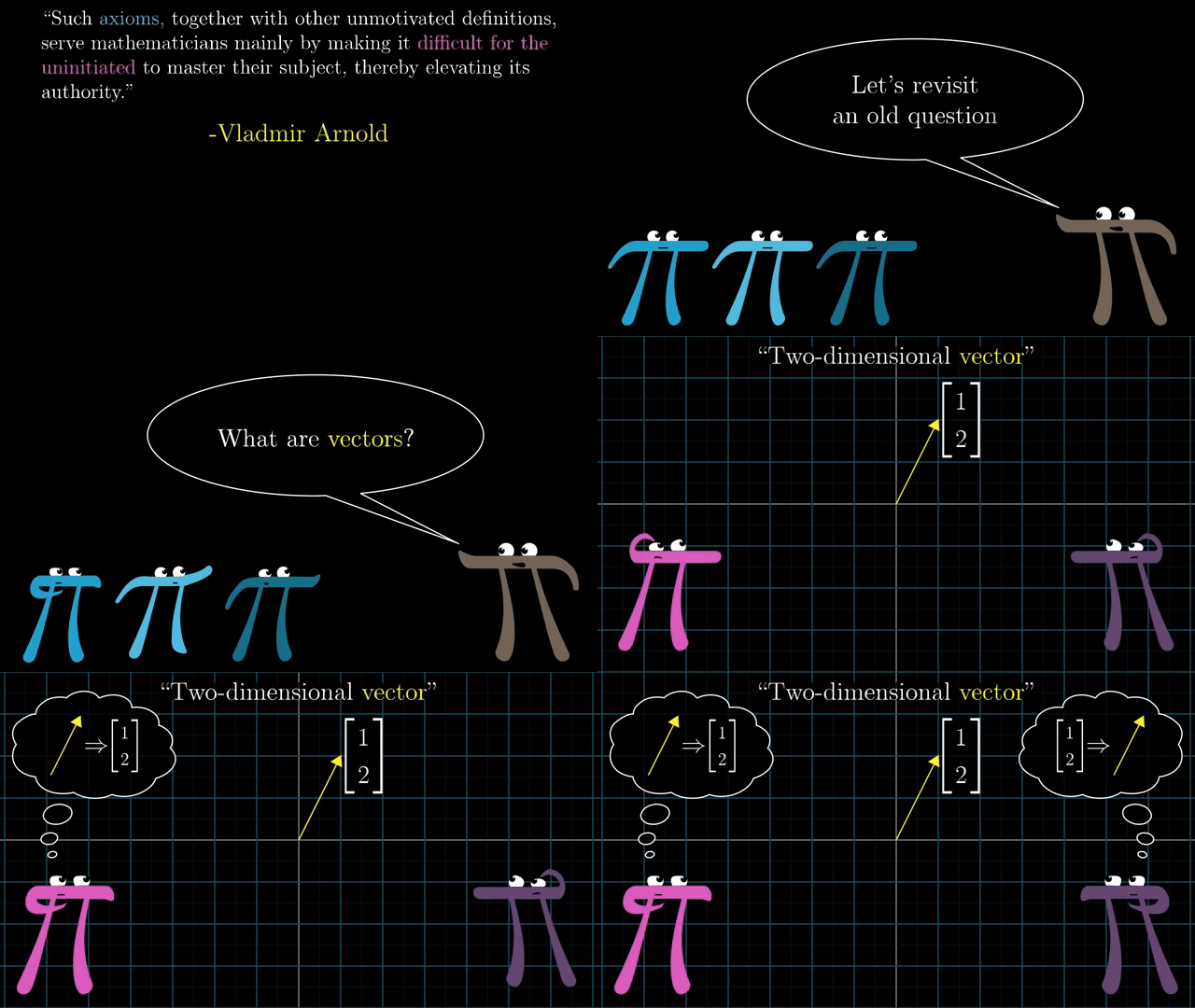
Example beyond arrows: polynomials of bounded degree with real coefficients form a vector space under usual addition and scaling. So do square-integrable functions on an interval with the standard operations.
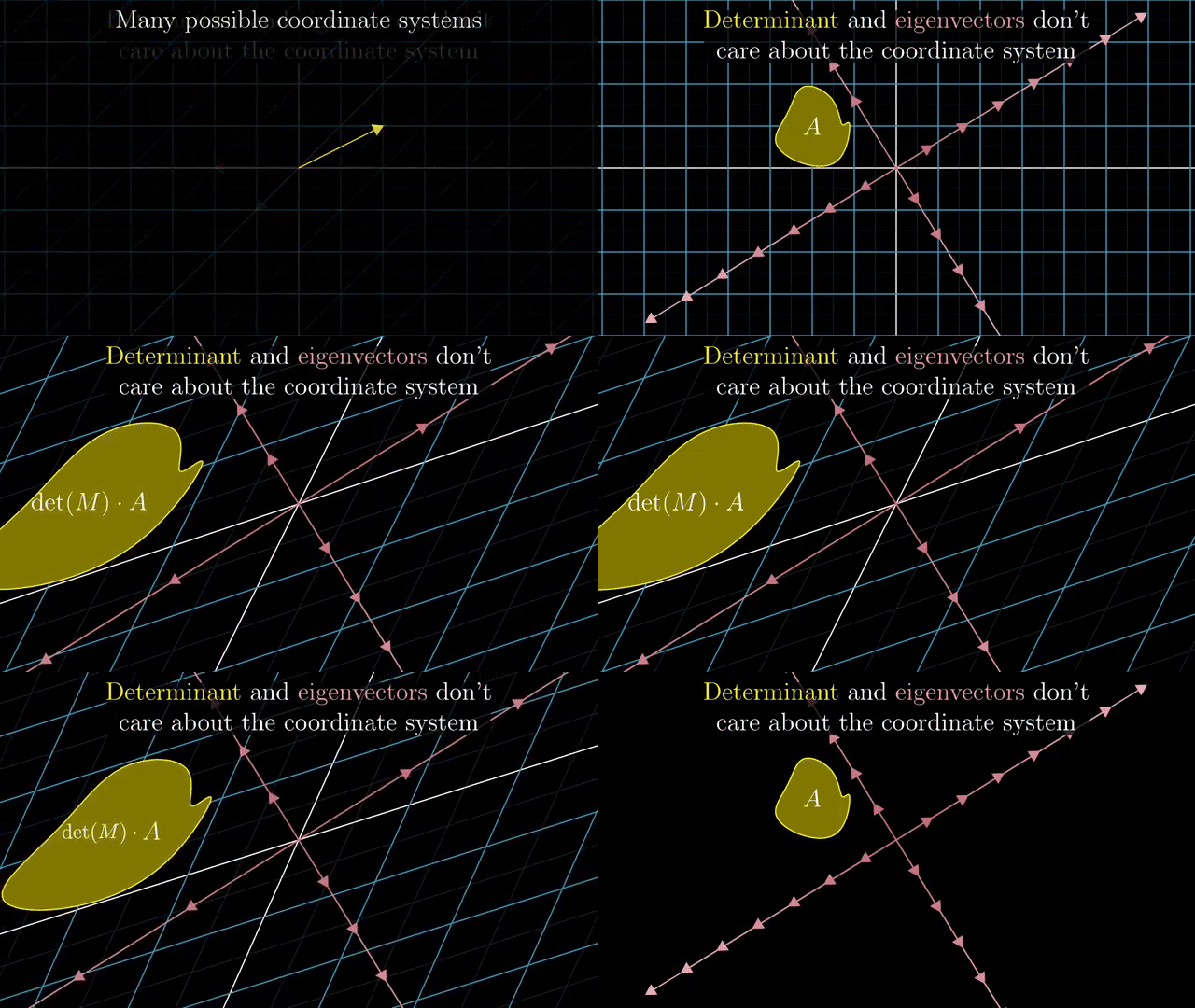
The mathematician's question shifts from "what shape is a vector?" to "does this set satisfy the axioms?"
Check your understanding. The tasks below rest on these ideas: Correct: a vector space is a set with well-behaved $+$ and scalar multiplication satisfying the axioms. Not quite: dot products, determinants, and inversion are extra structure, not the defining axioms. Correct: existence of a unique $\mathbf{0}$ and of additive inverses are axioms. Not quite: a zero vector must exist, vectors need not be unit length, and there is no vector multiplication in a bare vector space. Correct: pointwise addition (and scaling) satisfies the axioms, making functions vectors. Not quite: composition, multiplication, and concatenation are not the vector addition. Correct: degree-$\leq d$ polynomials are closed under addition and scaling and contain a zero, so they form a vector space. Not quite: unit vectors are not closed under addition, invertible matrices are not closed under addition (and lack a zero), and the positive reals have no additive inverses.
Related cards
Video Content
Tasks
Card Info
- Topic: Mathematics
- Difficulty: Advanced
- Completed: 0 users
Creator
