Limitations beyond $2\times 2$
The shortcut is deliberately narrow: it is for $2\times 2$ eigenvalues you want quickly on paper . For $3\times 3$ and larger, the characteristic polynomial degree grows; there is no equally short universal mnemonic.

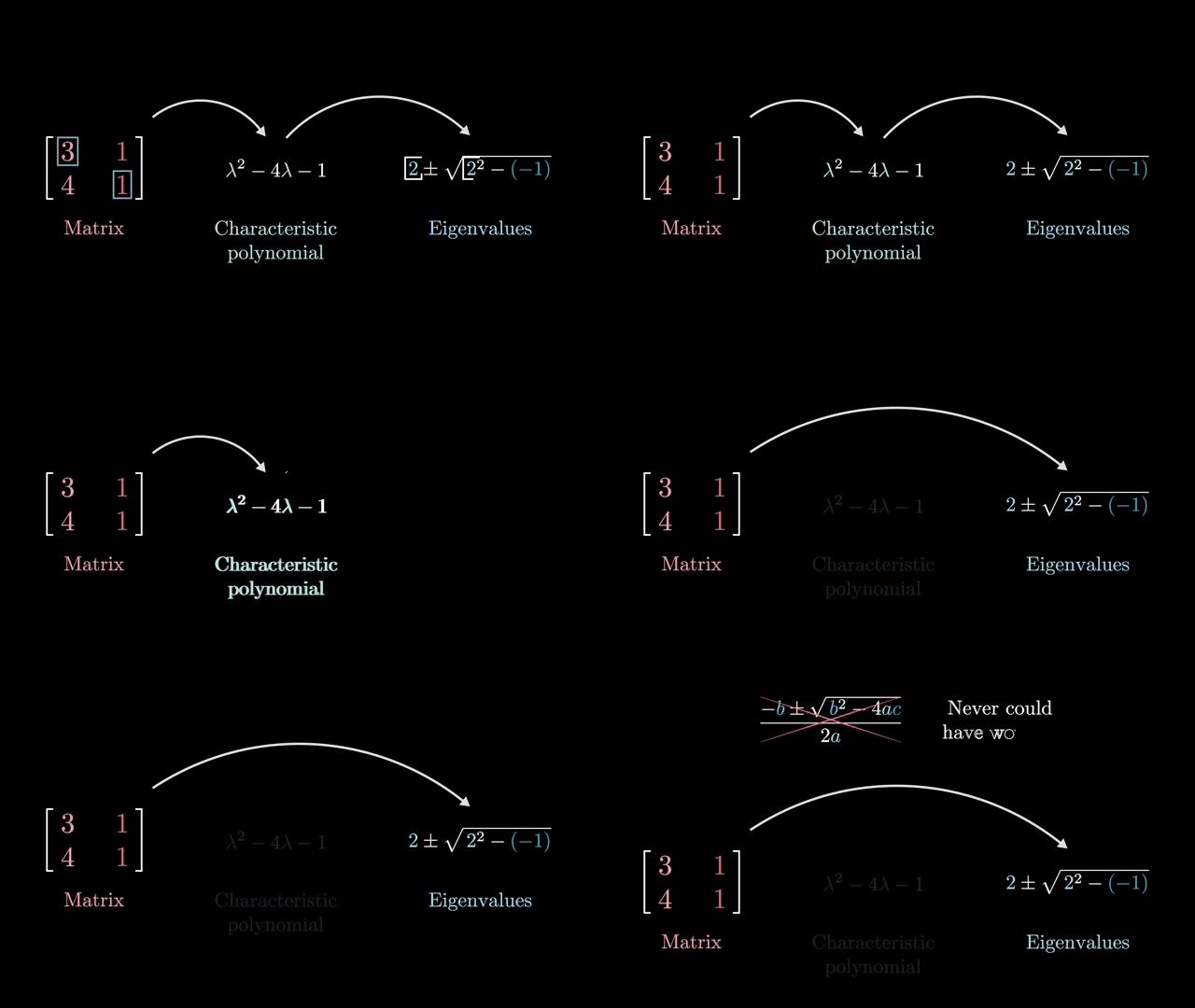
Numerical software uses iterative methods (QR and relatives) rather than explicit polynomial root finding for large matrices. Defective matrices (geometric multiplicity below algebraic) still require Jordan-style reasoning even when you know the eigenvalues.
Treat this trick as a paper shortcut that reinforces trace and determinant meaning, not as a replacement for the full theory.
When a matrix is defective or dimension is three or higher, return to $\det(A-\lambda I)$ or numerical eigen-solvers; the shortcut is a deliberate specialization, not a universal tool.
Check your understanding. The tasks below rest on these ideas: Correct: an $n\times n$ matrix gives a degree-$n$ polynomial, so $3$ here. Not quite: it is not $2$, $9$, or $6$. Correct: practical eigenvalue computation uses iterative algorithms like QR. Not quite: Cramer, guessing, and the $2\times 2$ shortcut do not scale. Correct: too few independent eigenvectors for a repeated eigenvalue makes it defective. Not quite: symmetric matrices are always diagonalizable, and zero trace or unit determinant do not cause defectiveness. Correct: the shortcut is a $2\times 2$ specialization, so larger or defective cases need the full approach. Not quite: it is the larger and trickier cases, not the $2\times 2$ or symmetric ones, that require it.
Related cards
Video Content
Tasks
Card Info
- Topic: Mathematics
- Difficulty: Intermediate
- Completed: 0 users
Creator
