Example walkthrough without carrying minors
The workflow is recite, then compute: read $t=a+d$ and $p=\det A$, set $m=t/2$, then write $\lambda=m\pm\sqrt{m^2-p}$ . Minors never appear on the scratch paper.
Trace $0$, determinant $-5$: mean $m=0$, $m^2-p=5$, roots $\pm\sqrt{5}$ (real and distinct). Trace $10$, determinant $25$: mean $m=5$, $m^2-p=0$, so $\lambda=5$ twice.
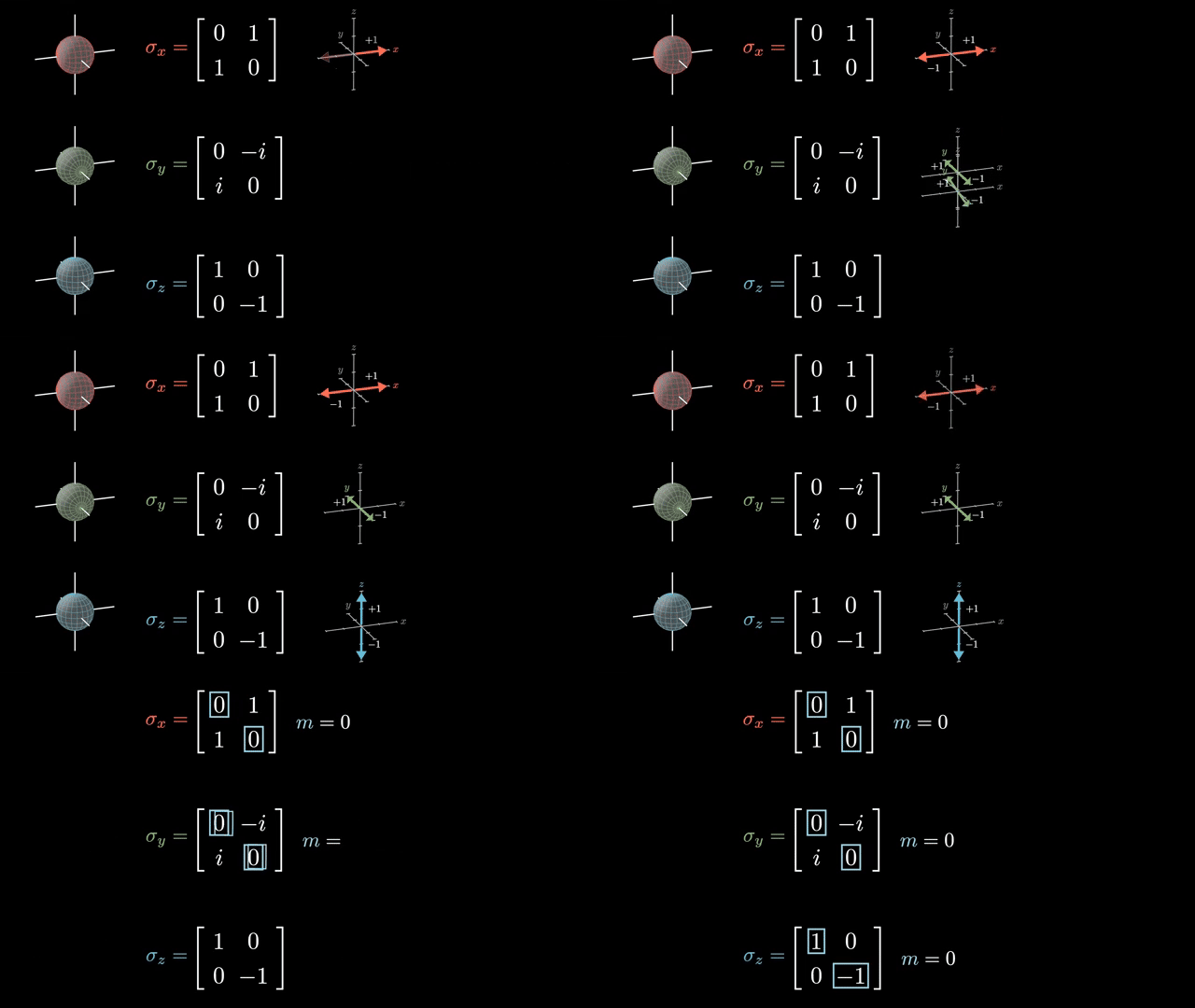
Reflection matrix $\begin{bmatrix}0&1\\1&0\end{bmatrix}$: $t=0$, $p=-1$, hence $\lambda=0\pm\sqrt{0-(-1)}=\pm 1$. Negative determinant with real entries forces eigenvalues of opposite sign.
Practice the rhythm: read $t$ and $p$, halve the trace for $m$, then one square root finishes the eigenvalues. The reflection example is a good check that negative determinant forces opposite-signed real roots when entries are real.
Check your understanding. The tasks below rest on these ideas: Correct: $0^2 - 4(-5) = 20 \gt 0$, giving two distinct real roots. Not quite: it is positive, not negative or zero, and not $-20$. Correct: the discriminant is zero, so both roots equal the mean $5$. Not quite: the trace and determinant themselves are not the roots, and $0,0$ or $5,20$ do not match. Correct: a negative product means one positive and one negative eigenvalue. Not quite: same-sign pairs give a positive product, and the roots are real here, not imaginary. Correct: trace $0$, determinant $-1$, so $\lambda = 0 \pm \sqrt{0 - (-1)} = \pm 1$. Not quite: the other pairs do not match a trace of $0$ and determinant of $-1$.
Related cards
Video Content
Tasks
Card Info
- Topic: Mathematics
- Difficulty: Intermediate
- Completed: 0 users
Creator
