Mean, square-root mnemonic
If two numbers share mean $m$ and product $p$, they sit symmetrically about $m$: write them as $m\pm d$ for some offset $d$. Expanding the product gives
$$p=(m+d)(m-d)=m^2-d^2,$$
so $d^2=m^2-p$ and the pair is $m\pm\sqrt{m^2-p}$ . That is the difference-of-squares identity in a form worth memorizing.
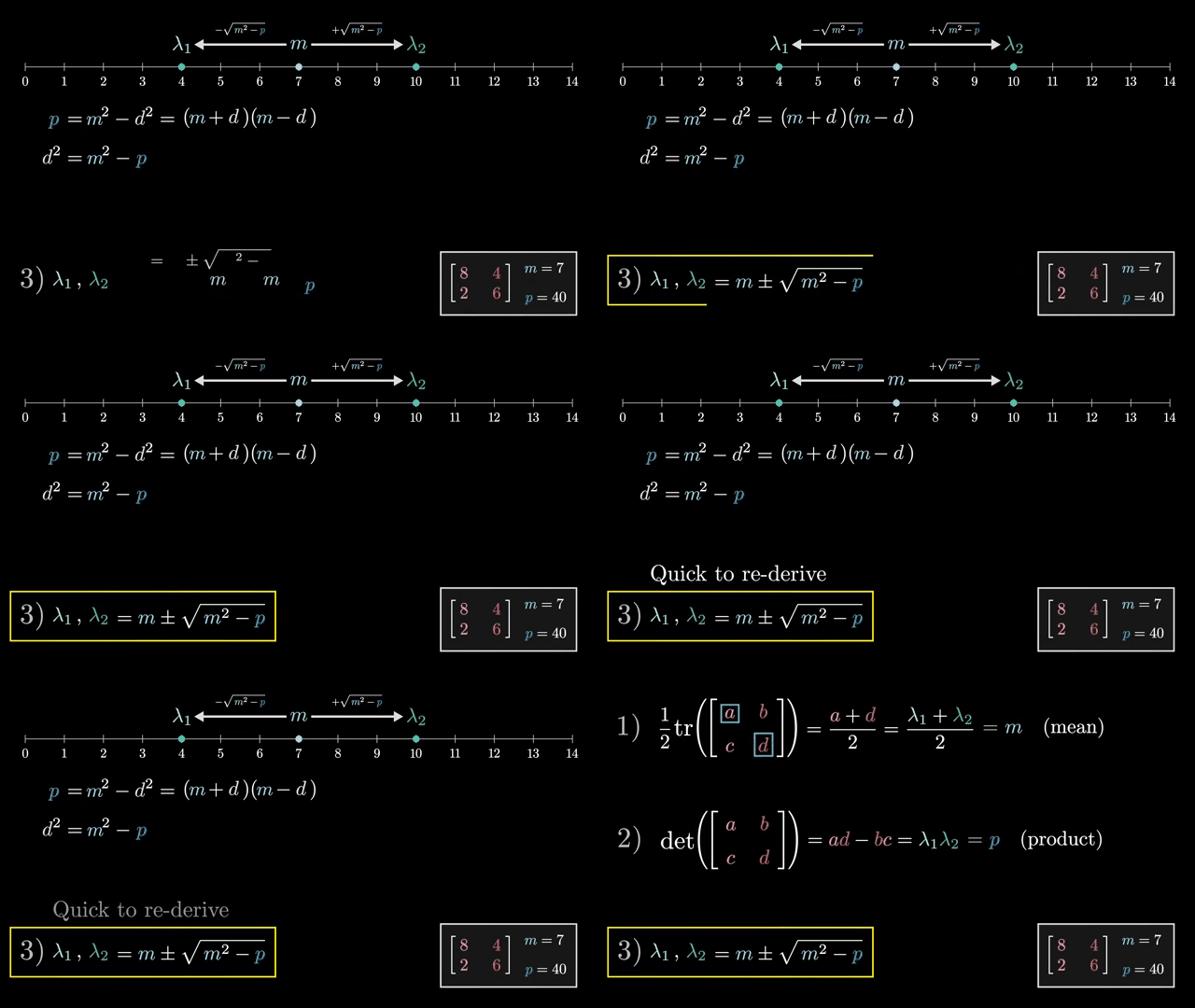
Warm-up with plain numbers: mean $m=7$, product $p=40$. Then $d^2=49-40=9$, so $d=3$ and the two values are $4$ and $10$. You never wrote a quadratic; you read off mean and product, then took one square root.

Eigenvalues of a $2\times 2$ matrix are just such a pair. Their sum is the trace and their product is the determinant, so set $m=\tfrac{\mathrm{tr}(A)}{2}$ and $p=\det(A)$, then $\lambda=m\pm\sqrt{m^2-p}$.
Take $A=\begin{bmatrix}3&1\\4&1\end{bmatrix}$. Trace $3+1=4$ gives $m=2$; determinant $3\cdot 1-1\cdot 4=-1$ gives $p=-1$. Therefore
$$\lambda = 2 \pm \sqrt{4-(-1)} = 2\pm\sqrt{5}.$$
The square root step is the only algebra after reading $m$ and $p$ from the matrix. When $m^2-p\lt 0$, the roots are complex conjugates; when $m^2-p=0$, you get a repeated eigenvalue.
Related cards
Video Content
Tasks
Card Info
- Topic: Mathematics
- Difficulty: Intermediate
- Completed: 0 users
Creator
