Lead-in: eigenbasis is the ultimate friendly coordinate change
When enough eigenvectors span the space, a matrix $B$ built from them diagonalizes $M = B D B^{-1}$ with diagonal $D$ listing eigenvalues . That is the coordinate change where the map acts by independent scalings along each axis.
Shear in the plane lacks a second independent eigenvector, so diagonalization fails there. Still, the eigenvalue language names what went wrong: not enough eigen-directions to form a full basis.
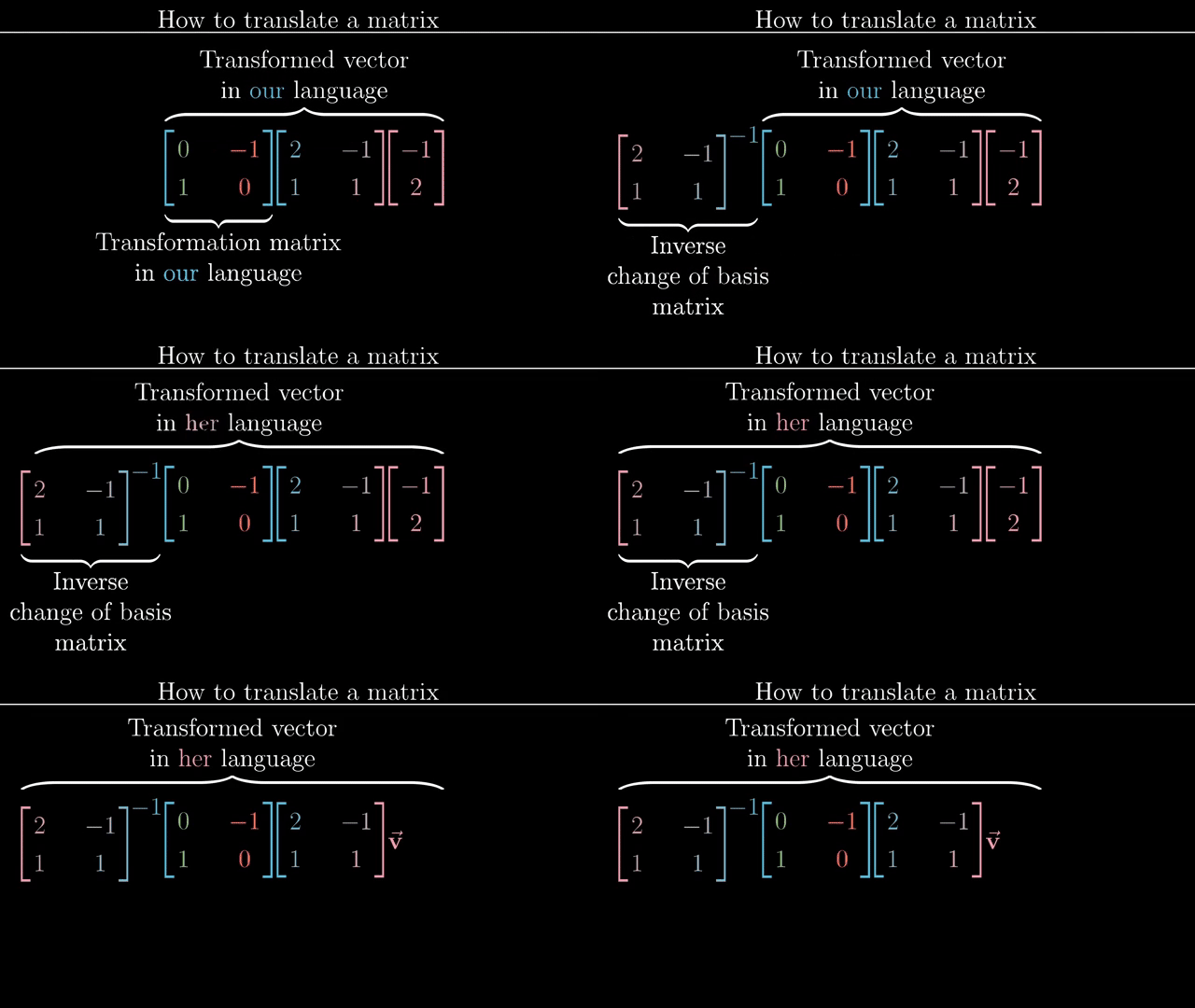
Matrix powers become cheap in eigen-coordinates: $M^k = B D^k B^{-1}$ when the splitting exists. Chapter 14 studies vectors that stay on their own span under $M$.
When diagonalization fails, similarity still explains why the same map can look simple in one basis and entangled in another. Eigenvectors are exactly the directions where entanglement collapses to independent scalings.
Check your understanding. The tasks below rest on these ideas: Correct: 'diagonal' means every off-diagonal entry is $0$. Not quite: they are not all one, not copies of the diagonal, and are well defined. Correct: diagonalization uses an eigenbasis, so $B$'s columns are eigenvectors. Not quite: they are not the standard basis, random, or rows of $M$. Correct: cheap powers require the eigen-decomposition to exist. Not quite: it does not hold for every matrix (defective ones fail), nor is it never valid or identity-only. Correct: an eigenvector keeps its direction under the map, scaling by its eigenvalue. Not quite: null vectors map to $\mathbf{0}$, and unit/row vectors are unrelated notions.
Related cards
Video Content
Tasks
Card Info
- Topic: Mathematics
- Difficulty: Intermediate
- Completed: 0 users
Creator
