Worked mental checklist for change of basis
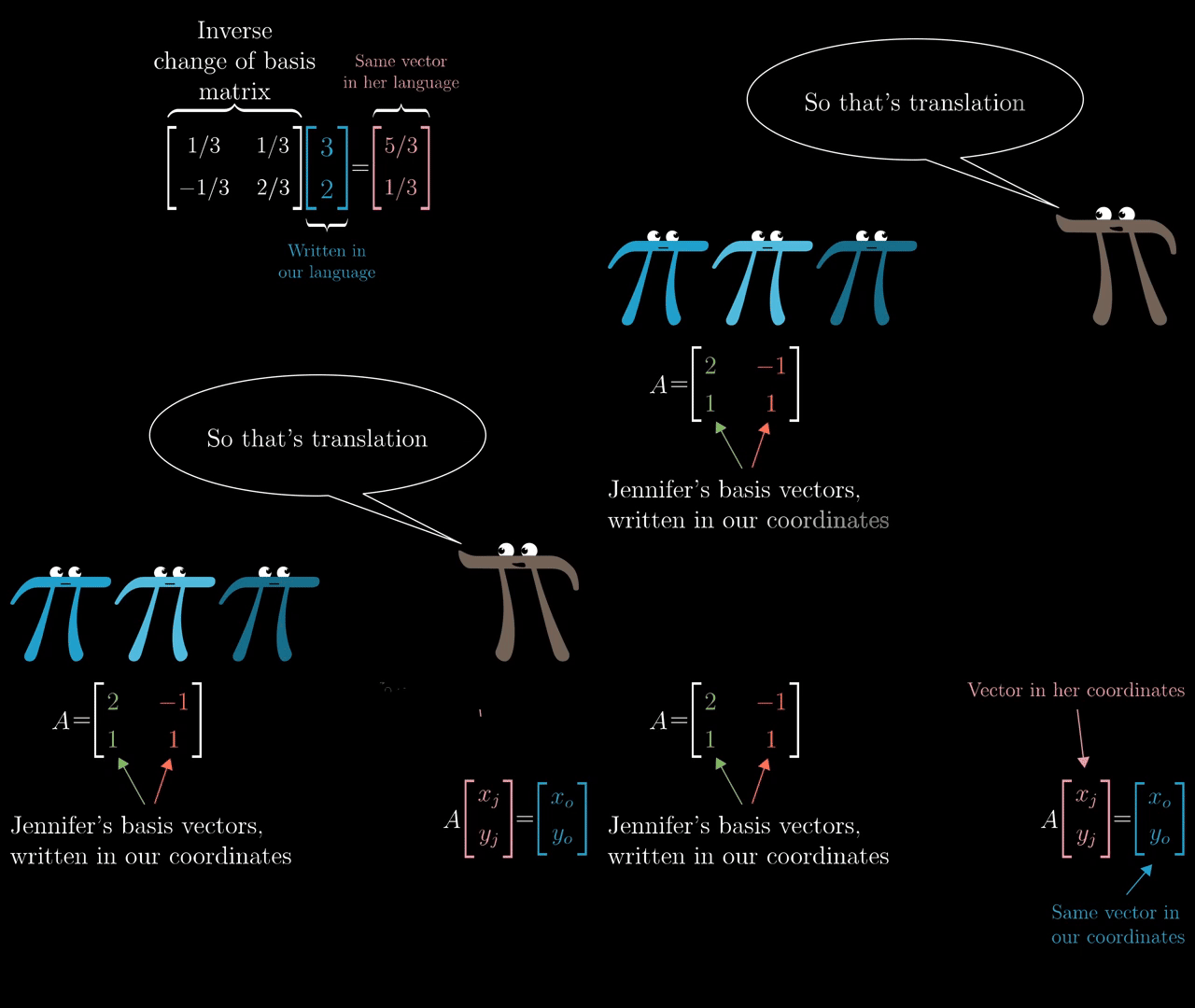
A reliable workflow: identify columns of $B$, confirm invertibility, then multiply or sandwich as the story demands . Vector translation uses $B$ and $B^{-1}$; transformation rewriting uses $B^{-1}MB$.
Singular $B$ means the proposed set of directions is not actually a basis. Numerically, prefer stable factorizations (LU or QR) over Cramer's rule for moderate or large $n$. Physical units on entries of $B$ must match the coordinate definitions you chose.
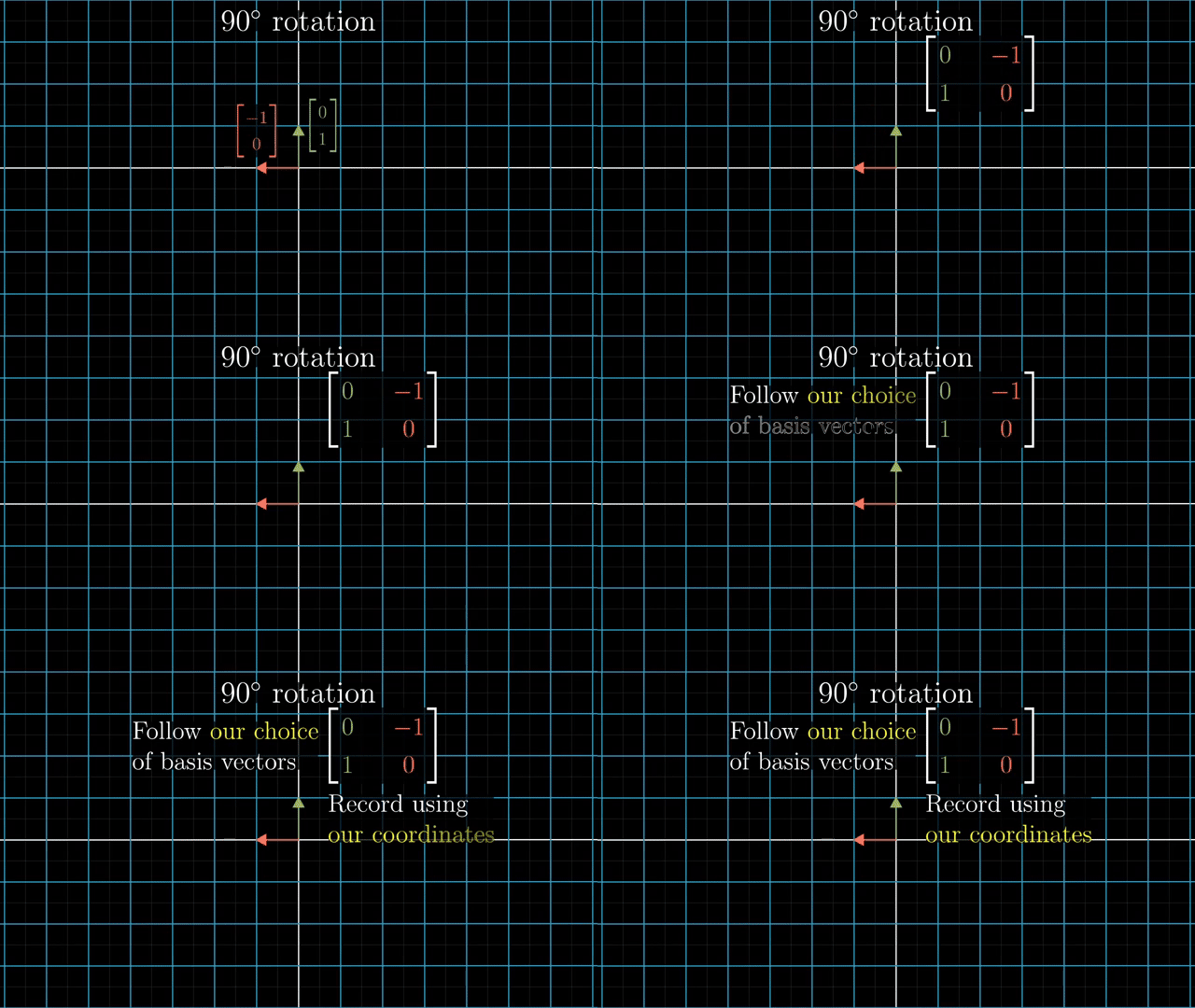
Engineering repeats this weekly: aircraft body axes versus north-east-down inertial frames differ by orthogonal rotation matrices, often products of yaw, pitch, and roll.
Navigation example: converting a body-frame velocity to an inertial-frame velocity is the same pattern as Jennifer-to-you translation, with orthonormal frames when directions are unit vectors.
Check your understanding. The tasks below rest on these ideas: Correct: a singular $B$ has dependent columns, so its 'basis' fails to span. Not quite: singular is the opposite of orthogonal or determinant $1$, and the identity is invertible. Correct: factorization-based methods are far faster and more stable. Not quite: Cramer, random search, and cofactor expansion are impractical at that size. Correct: a change-of-basis matrix carries the units implied by its coordinate definitions. Not quite: the entries need not be dimensionless or integers, and units do not 'cancel the trace'. Correct: orthonormal navigation frames differ by a rotation, an orthogonal matrix. Not quite: a projection or singular scaling would lose information, and the zero matrix is meaningless here.
Related cards
Video Content
Tasks
Card Info
- Topic: Mathematics
- Difficulty: Intermediate
- Completed: 0 users
Creator
