Trace and determinant stay similar
Similarity $B^{-1}MB$ preserves trace and determinant even when individual entries scramble . That invariance is why spectrum and volume-scaling data survive a coordinate rewrite.
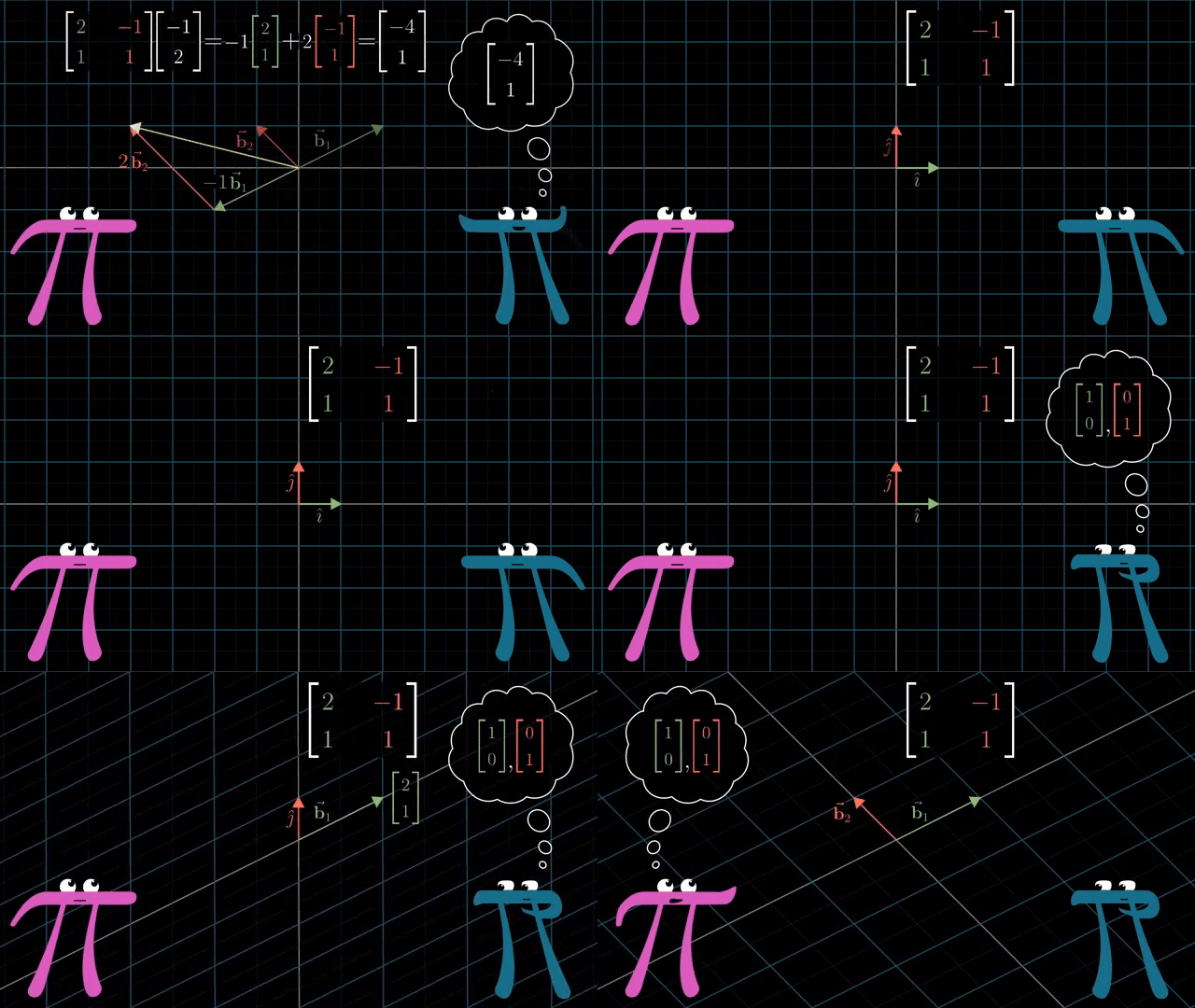
Cyclic trace gives $\mathrm{tr}(B^{-1}MB) = \mathrm{tr}(M)$. Multiplicativity of determinant gives $\det(B^{-1}MB) = \det(M)$ when $B$ is square invertible. The characteristic polynomial is unchanged, so eigenvalues and algebraic multiplicities match.
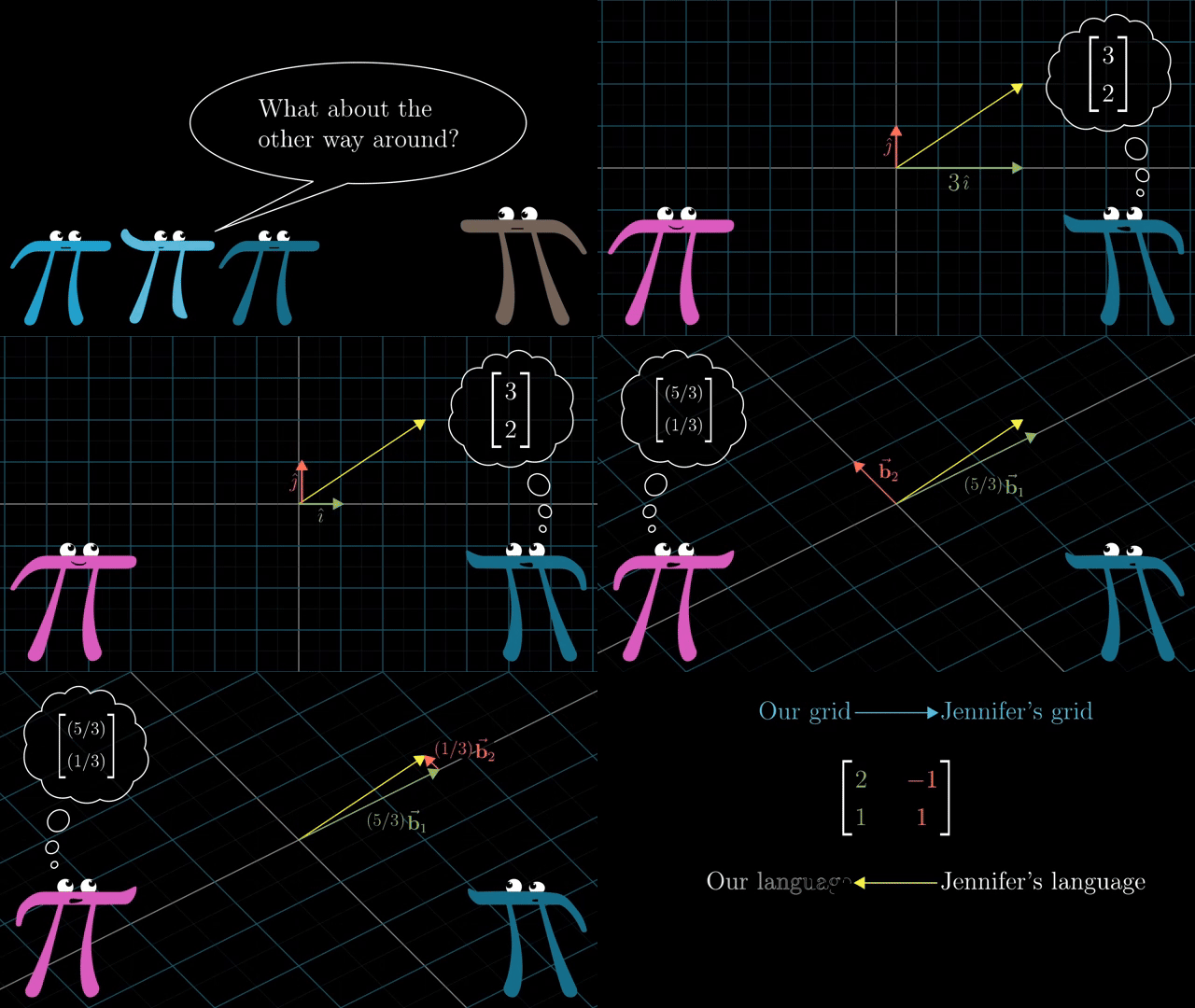
Diagonalization preview: when enough eigenvectors span the space, a basis built from them can make $M$ look diagonal in new coordinates. That is the ultimate friendly coordinate change, developed fully in Chapter 14.
Sanity check: recompute $\mathrm{tr}(M)$ and $\det(M)$ before and after forming $B^{-1}MB$. If either invariant changes, the similarity was assembled with the wrong order of factors or a non-invertible $B$.
Check your understanding. The tasks below rest on these ideas: Correct: the trace is a similarity invariant (by the cyclic property of trace). Not quite: it is not $\mathrm{tr}(B)$, zero, or scaled by $\det(B)$. Correct: the $\det(B)$ factors cancel, leaving $\det(M)$. Not quite: it is not zero, $\det(B)^2$, or divided by $\det(B)$. Correct: similar matrices have the same characteristic polynomial, hence the same eigenvalues and multiplicities. Not quite: it does not change with basis, is invariant in all sizes, and is not zero. Correct: a general change of basis scrambles a diagonal matrix unless the new basis is also an eigenbasis. Not quite: it is generally not diagonal, and orthogonality of $B$ alone does not fix this.
Related cards
Video Content
Tasks
Card Info
- Topic: Mathematics
- Difficulty: Intermediate
- Completed: 0 users
Creator
