Transition to change of basis formulas
Coordinate remapping reinterprets the same geometry in new language. Chapter 13 develops change of basis: if $A$ represents $T$ in standard coordinates, another basis uses conjugation $B^{-1}AB$ .
Determinant and trace are similarity invariants: $\det(B^{-1}MB)=\det(M)$ and $\mathrm{tr}(B^{-1}MB)=\mathrm{tr}(M)$ for invertible $B$. Cramer ratios echo in formulas for inverse change-of-basis matrices.
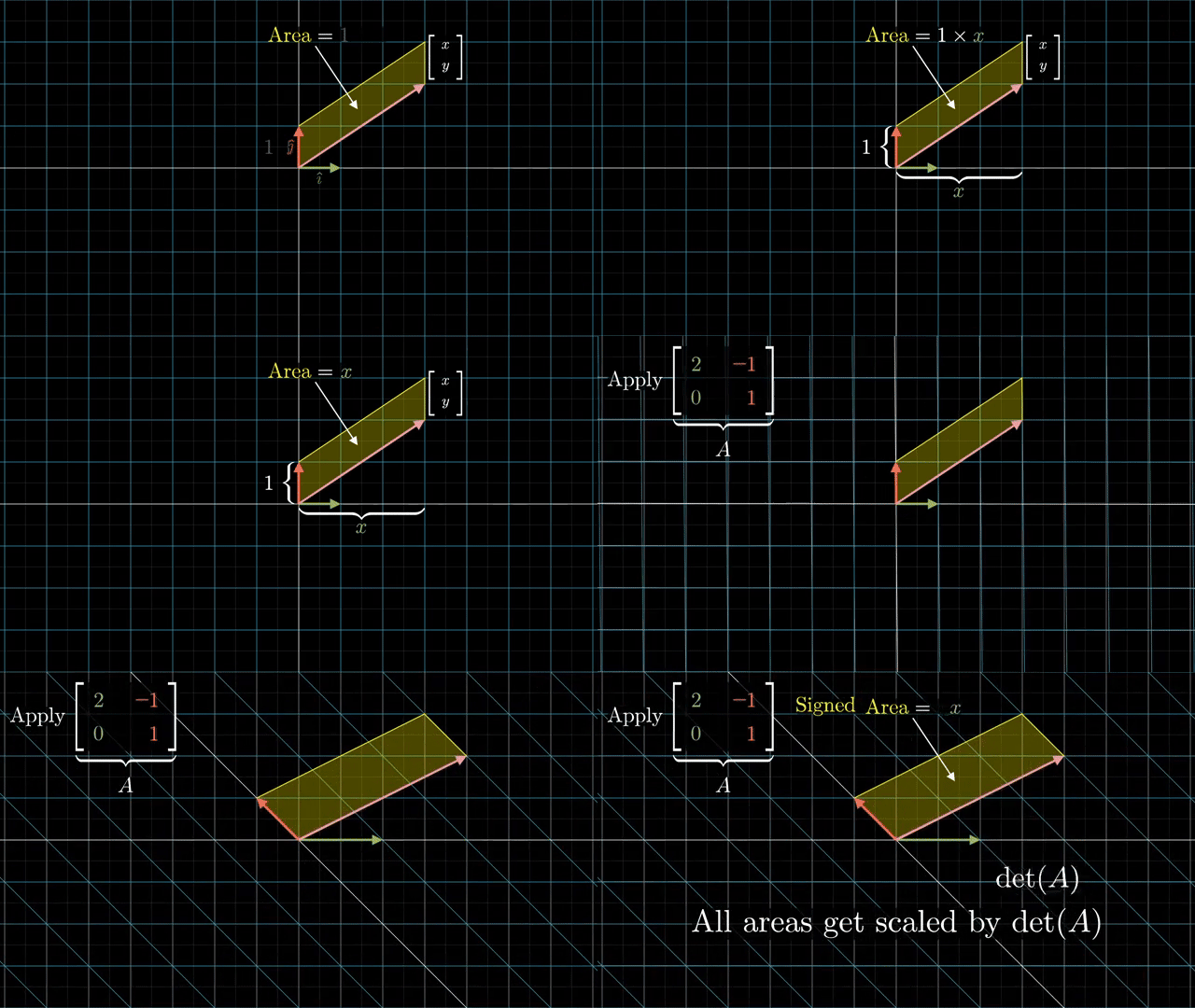
After Cramer, Chapter 13 reuses inverse matrices for translating coordinates between observers who label the same arrows with different numeric addresses.
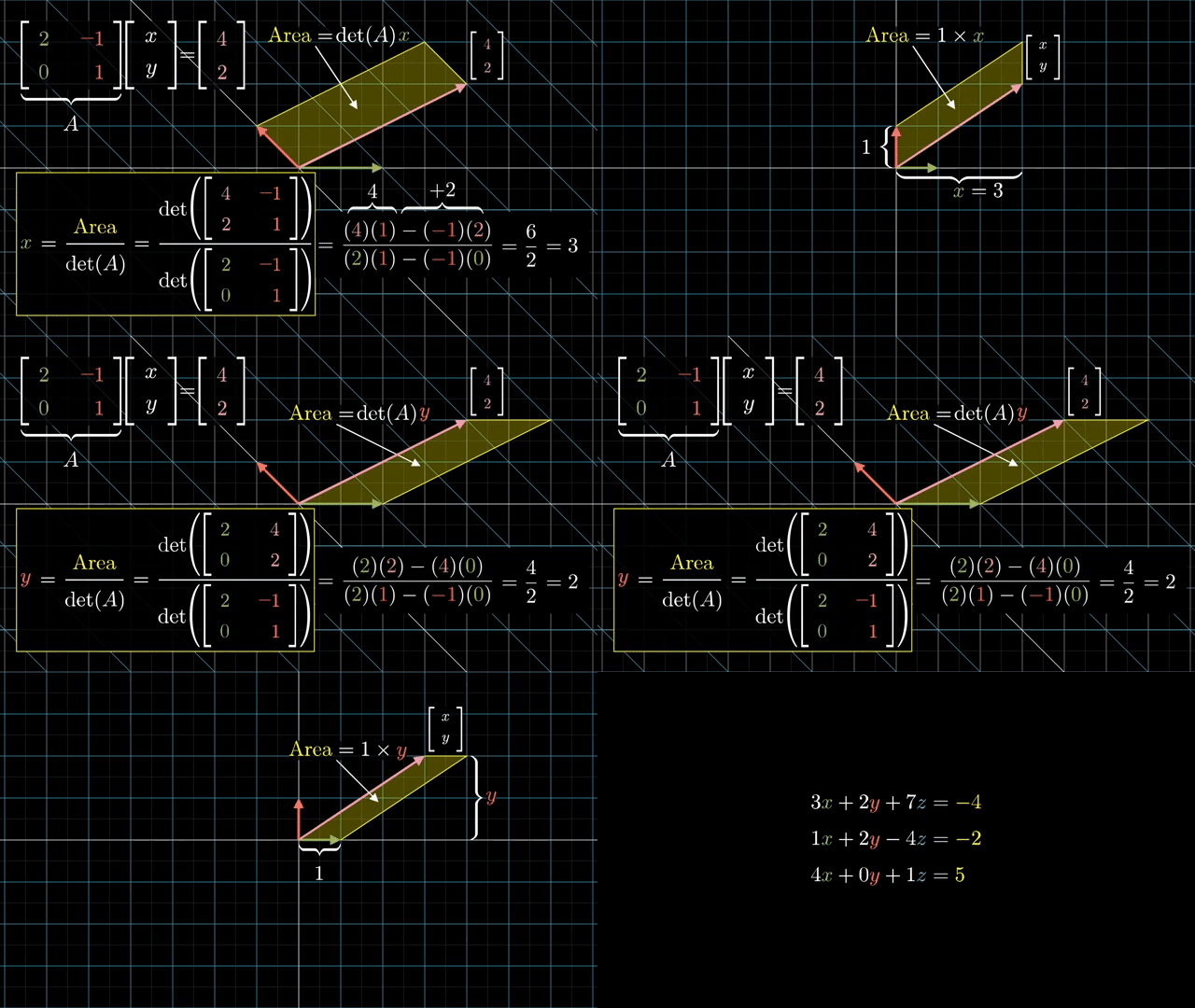
Keep both pictures: algebraic cofactors for symbols, signed volumes for intuition.
Chapter 13 asks how the same geometric object looks in Jennifer's coordinates versus yours; similarity invariants such as determinant and trace survive that translation even when matrix entries scramble.
You have now seen determinants as area and volume, as orientation trackers under linear maps, and as Cramer denominators. Change of basis reuses inverses to translate the same geometry into new coordinate labels.
Similarity invariants mean the numeric Cramer ratios are not the deepest object: the underlying column geometry is what survives a change of basis.
Chapter 13 makes that translation explicit with the matrix $B$ whose columns list Jennifer's basis vectors written in your coordinates.
Related cards
Video Content
Tasks
Card Info
- Topic: Mathematics
- Difficulty: Intermediate
- Completed: 0 users
Creator
