Failure modes and teaching payoff
Near-zero denominators amplify noise; singular systems need consistency checks, not blind division . Inconsistent $A\mathbf{x}=\mathbf{b}$ has $\mathbf{b}$ outside the column space: no exact solution exists.
Infinite solutions arise when the nullspace is nontrivial and $\mathbf{b}$ lies in the column space: an affine subspace of solutions rather than a unique point. Well-conditioned numerical solves pivot to avoid catastrophic cancellation.
Singular $A$ means the volume picture degenerates: Cramer denominators hit zero, and geometry tells you to stop dividing and start asking about consistency of $\mathbf{b}$ with $\mathrm{Col}(A)$.
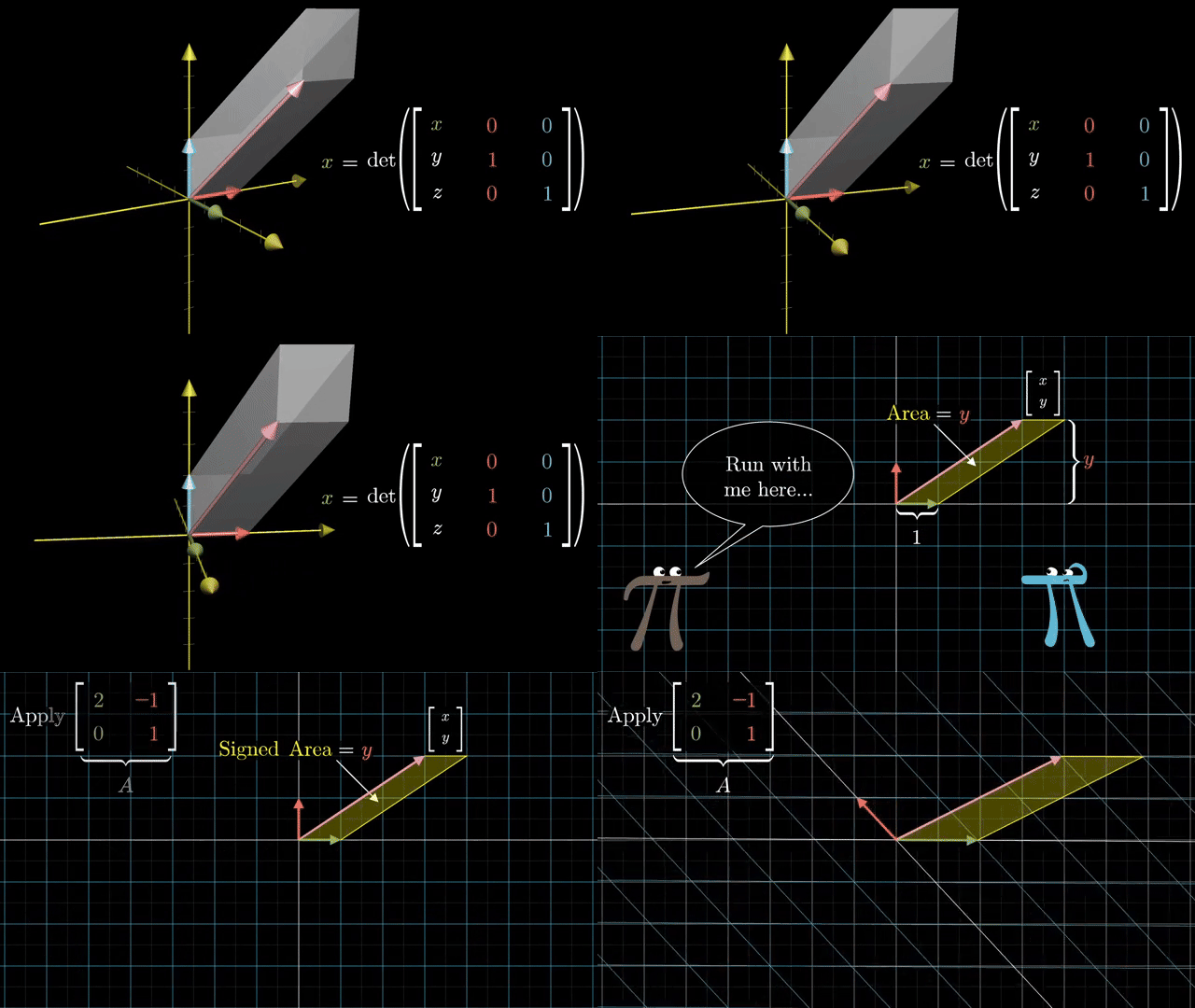
Despite numeric drawbacks, Cramer's rule remains valuable for small symbolic examples, theoretical arguments, and building intuition for determinant properties.
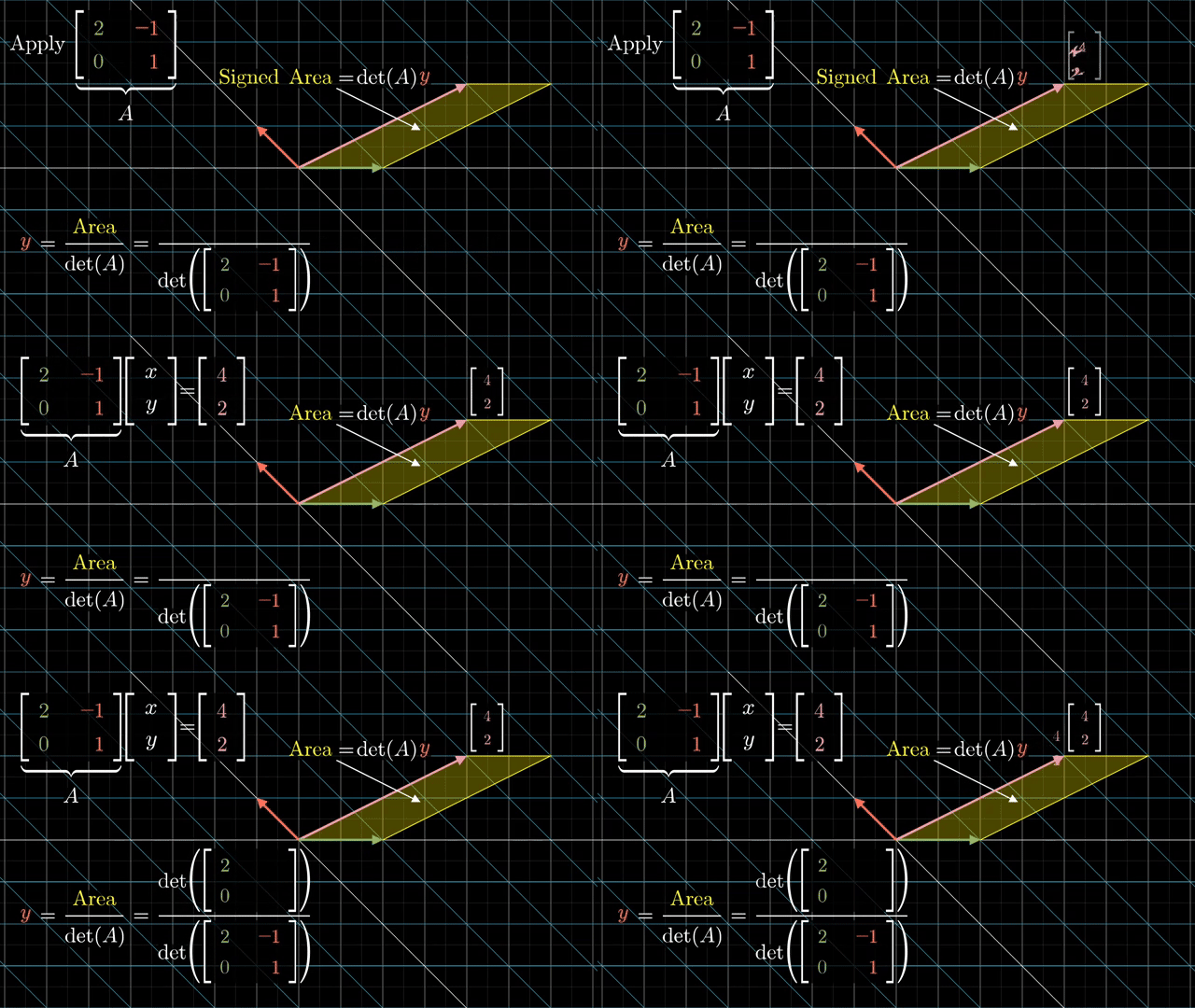
Beautiful geometry still motivates why determinants are antisymmetric, multilinear, and normalize to one on the identity.
When teaching linear systems, show Cramer once for $n=2$ or $n=3$, then pivot to elimination for computation. Students keep the volume picture without inheriting factorial cost.
Failure modes are part of the lesson: when $\det(A)$ is near zero, Cramer ratios scream ill-conditioning long before elimination finishes, because both numerator and denominator volumes are tiny.
Related cards
Video Content
Tasks
Card Info
- Topic: Mathematics
- Difficulty: Intermediate
- Completed: 0 users
Creator
