Algebraic cofactor mirror
Minors and cofactors reorganize the same volume ratios into Laplace expansion form . The cofactor matrix entry $C_{ij}$ is $(-1)^{i+j}$ times the minor obtained by deleting row $i$ and column $j$.
Classical adjugate identity: $A\,\mathrm{adj}(A)=\det(A)I$. Inverse formula $A^{-1}=\mathrm{adj}(A)/\det(A)$ is chiefly theoretical for small $n$ or symbolic work, not industry standard for $n=10^6$.
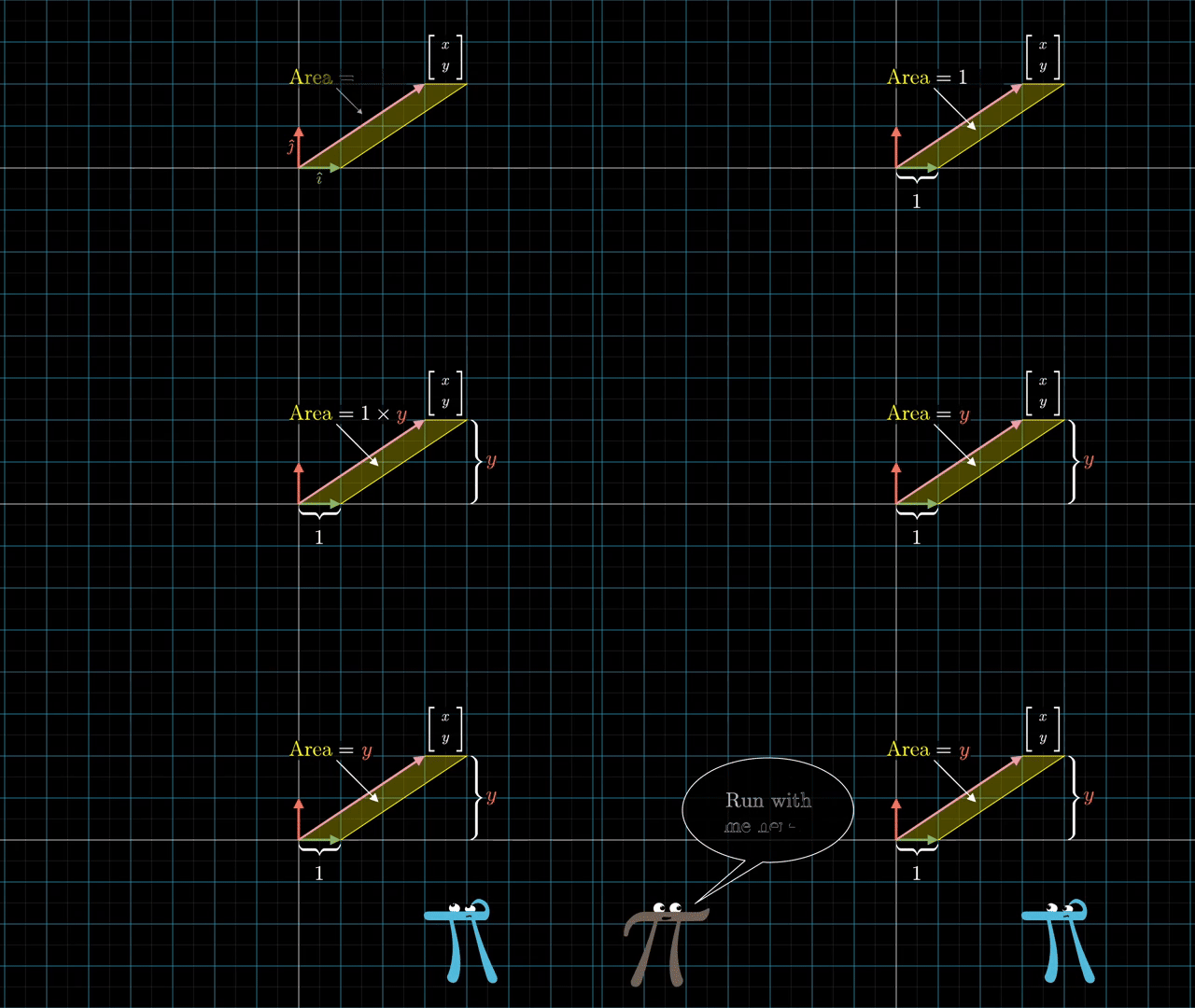
Cramer's coordinate formula in symbols:
$$x_i=\frac{\det(A_i(\mathbf{b}))}{\det(A)},$$
where $A_i(\mathbf{b})$ replaces column $i$ of $A$ by $\mathbf{b}$. Understanding geometry prevents the expansion feeling arbitrary.
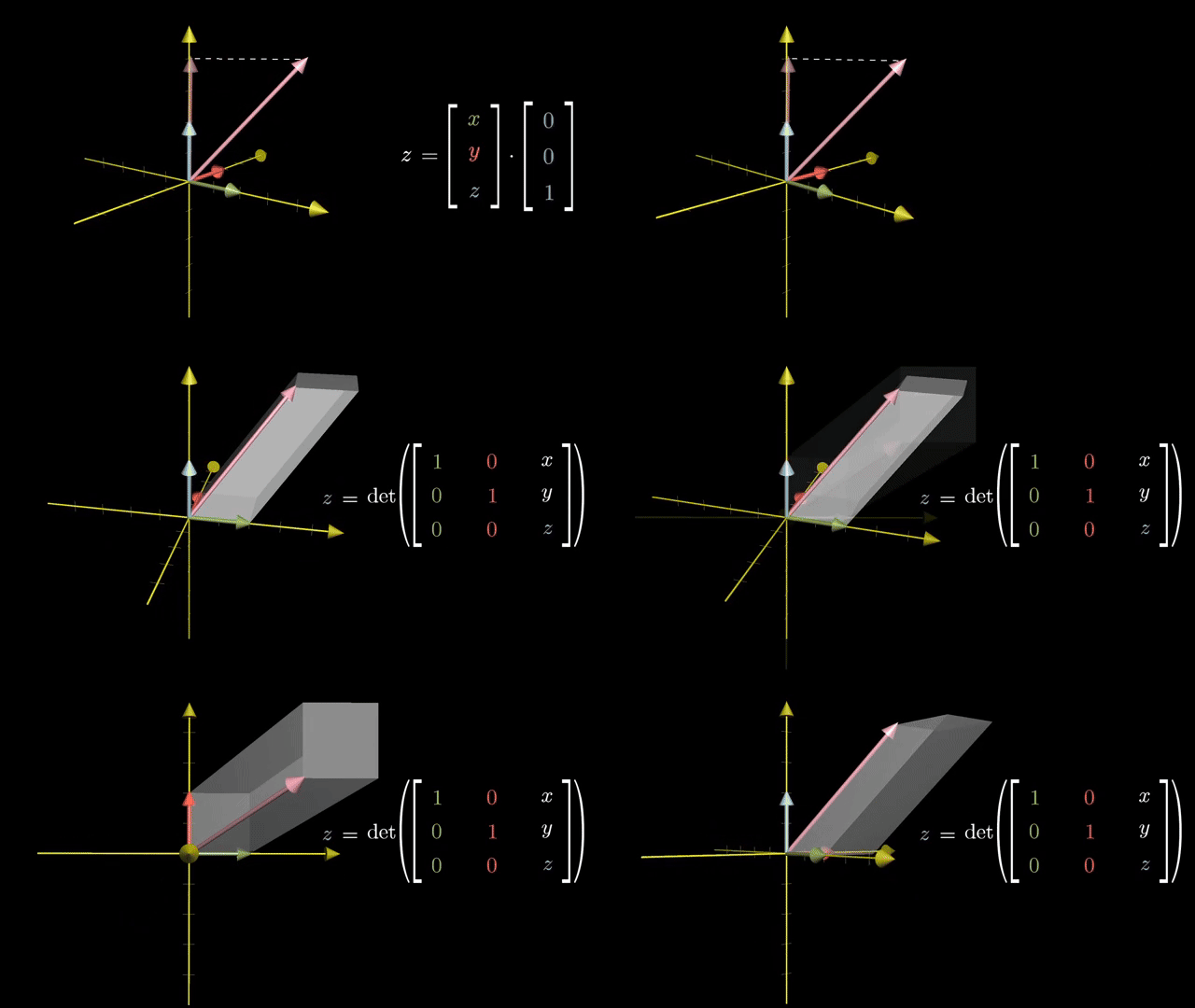
Cofactor expansion computes determinant by weighted lower-dimensional determinants recursively. Each step is a volume slice of the full parallelepiped story.
For $A=\begin{bmatrix}a&b\\c&d\end{bmatrix}$, cofactor expansion along a row recovers $ad-bc$, the same area formula you already trust from determinant geometry.
Laplace expansion along row $i$ writes $\det(A)$ as a sum of signed cofactors times entries. Each cofactor is a lower-dimensional determinant, so the algebra mirrors slicing a solid by parallel planes.
Adjugate entries count how much each input direction contributes to oriented volume after deleting one row and one column; that is the algebraic shadow of the geometric ratio story.
Related cards
Video Content
Tasks
Card Info
- Topic: Mathematics
- Difficulty: Intermediate
- Completed: 0 users
Creator
