2×2 picture: area ratios
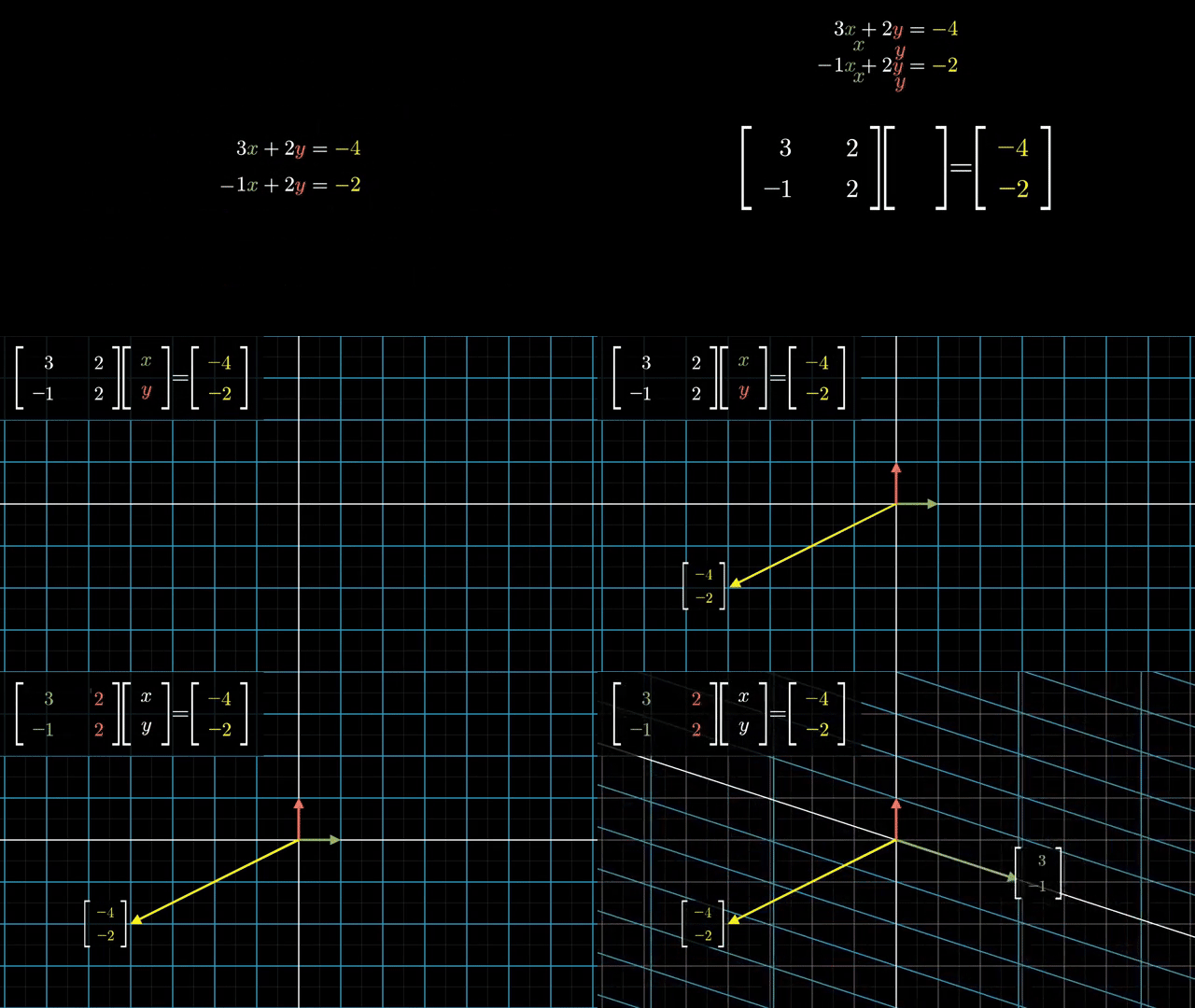
In $\mathbb{R}^2$, columns $\mathbf{a}_1,\mathbf{a}_2$ span a parallelogram. Replacing $\mathbf{a}_1$ by $\mathbf{b}$ changes the signed area; the ratio of areas gives $x_1$ when $\det(A)\neq0$ .
For $A=\begin{bmatrix}\mathbf{a}_1&\mathbf{a}_2\end{bmatrix}$, Cramer's rule gives $x_1=\det([\mathbf{b}\ \mathbf{a}_2])/\det(A)$ and $x_2=\det([\mathbf{a}_1\ \mathbf{b}])/\det(A)$. Swapping two columns flips the sign of $\det(A)$; track sign conventions carefully.
Draw the two parallelograms side by side: the original column span and the span with $\mathbf{b}$ replacing $\mathbf{a}_1$. The area ratio is exactly the geometric content of $x_1$ when orientation is fixed.
If $\det(A)=0$, Cramer's formulas break down because division by zero appears. Singular $A$ means columns are dependent; the geometric picture collapses to zero area or line span.

Example caution: if replacing column one by $\mathbf{b}$ doubles area magnitude while $|\det(A)|$ also doubles, $|x_1|$ need not double. Always track numerator and denominator together.
The 2×2 story is the template for every larger Cramer ratio: one column swap in the numerator, same denominator volume for all coordinates.
Related cards
Video Content
Tasks
Card Info
- Topic: Mathematics
- Difficulty: Intermediate
- Completed: 0 users
Creator
