The naive cross-interchange identity usually fails
For a general linear map $T:\mathbb{R}^3\to\mathbb{R}^3$, do not assume $T(\mathbf{a}\times\mathbf{b})=T\mathbf{a}\times T\mathbf{b}$. Cross products package oriented area and a normal direction; $T$ may stretch volume and flip orientation independently .
The correction involves how $T$ treats oriented volume. Volume scale factor on a unit cube is $\lvert\det T\rvert$. If $\det(T)=1$ and $T$ is a proper rotation in SO(3), cross structure is preserved: $T\mathbf{a}\times T\mathbf{b}=T(\mathbf{a}\times\mathbf{b})$.
Students often try to push symbols through $T$ too eagerly. The safe habit is to ask what $T$ does to a small oriented patch of area before assuming cross products commute with the map.

If $\det(T)=-1$, expect orientation reversal affecting cross signs. Improper orthogonal maps (reflections composed with rotations) flip handedness, so cross formulas pick up minus signs relative to the untransformed case.
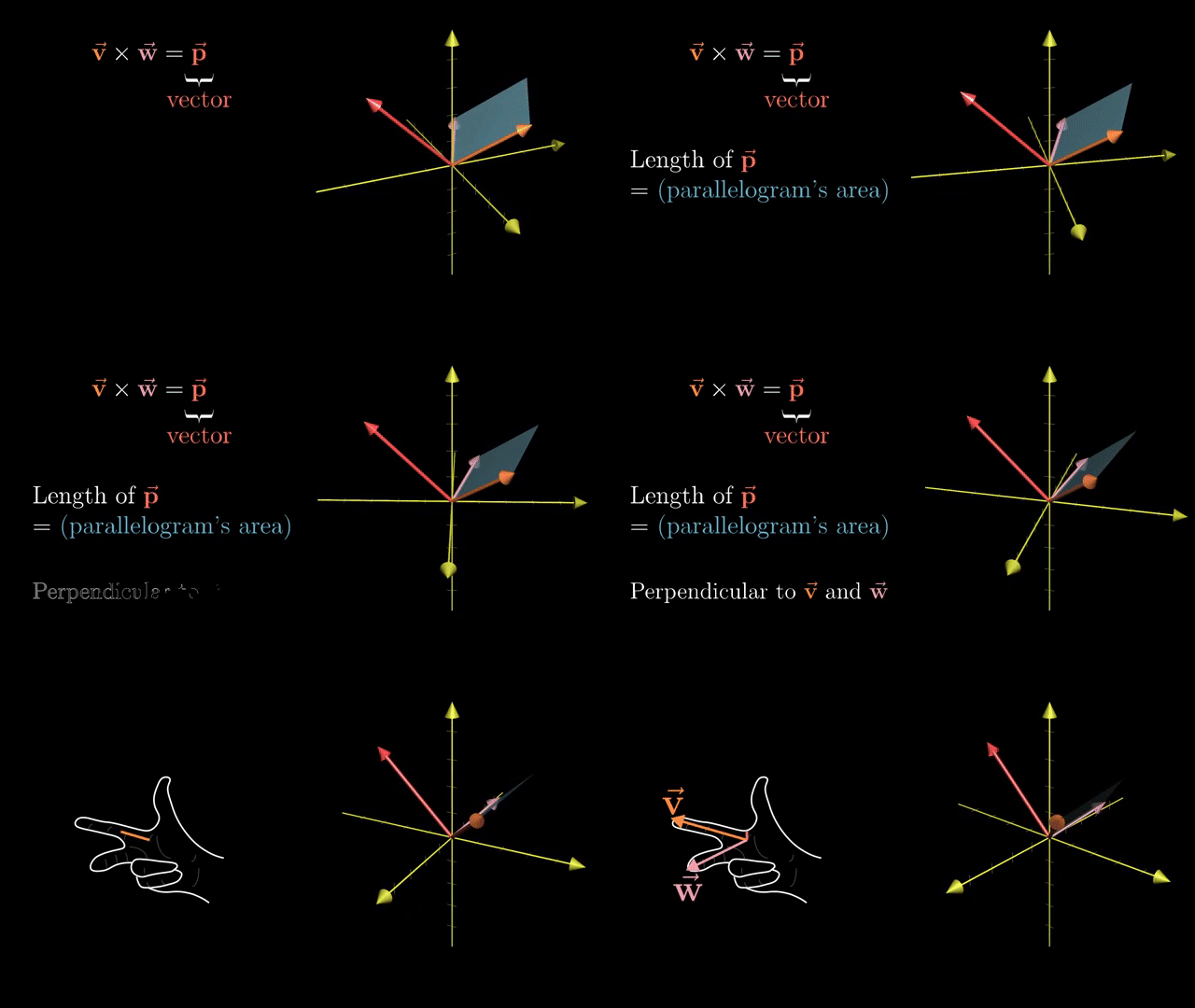
Cross-naturality is tied to $\det(T)$ rather than trace alone because cross products encode oriented volume, and determinant is exactly the oriented volume scaling factor of a linear map.
Trace records a different invariant (sum of eigenvalues). It can stay unchanged while volume scaling changes, so trace alone cannot govern cross behavior.
Related cards
Video Content
Tasks
Card Info
- Topic: Mathematics
- Difficulty: Advanced
- Completed: 0 users
Creator
