Torque and angular momentum hooks
Mechanics uses $\boldsymbol{\tau}=\mathbf{r}\times\mathbf{F}$ because only the perpendicular lever arm contributes to rotational tendency about an axis . Force components parallel to $\mathbf{r}$ produce no torque about the origin.
If $\mathbf{F}$ is parallel to $\mathbf{r}$, then $\mathbf{r}\times\mathbf{F}=\mathbf{0}$. Doubling the parallel force component does not change the cross product. The cross product filters out the part of $\mathbf{F}$ that cannot create rotation about the chosen pivot.
Torque depends on lever arm length and on the component of force perpendicular to that arm. The cross product encodes both factors simultaneously, which is why mechanics textbooks lean on $\mathbf{r}\times\mathbf{F}$ so heavily.
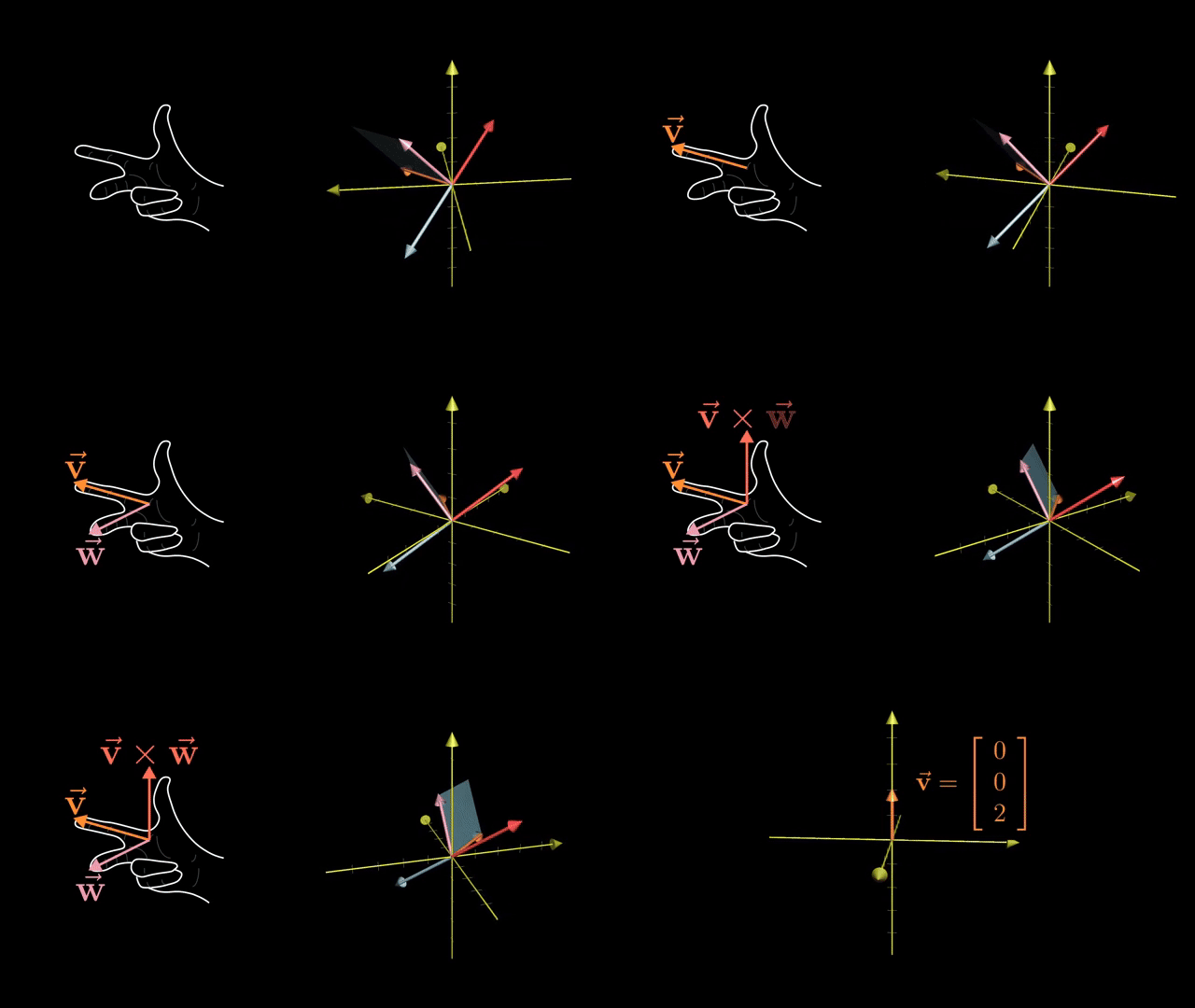
Lorentz force $\mathbf{F}=q\mathbf{v}\times\mathbf{B}$ (non-relativistic form) couples velocity perpendicular to magnetic field. Angular momentum $\mathbf{L}=\mathbf{r}\times\mathbf{p}$ is another familiar cross-product quantity.
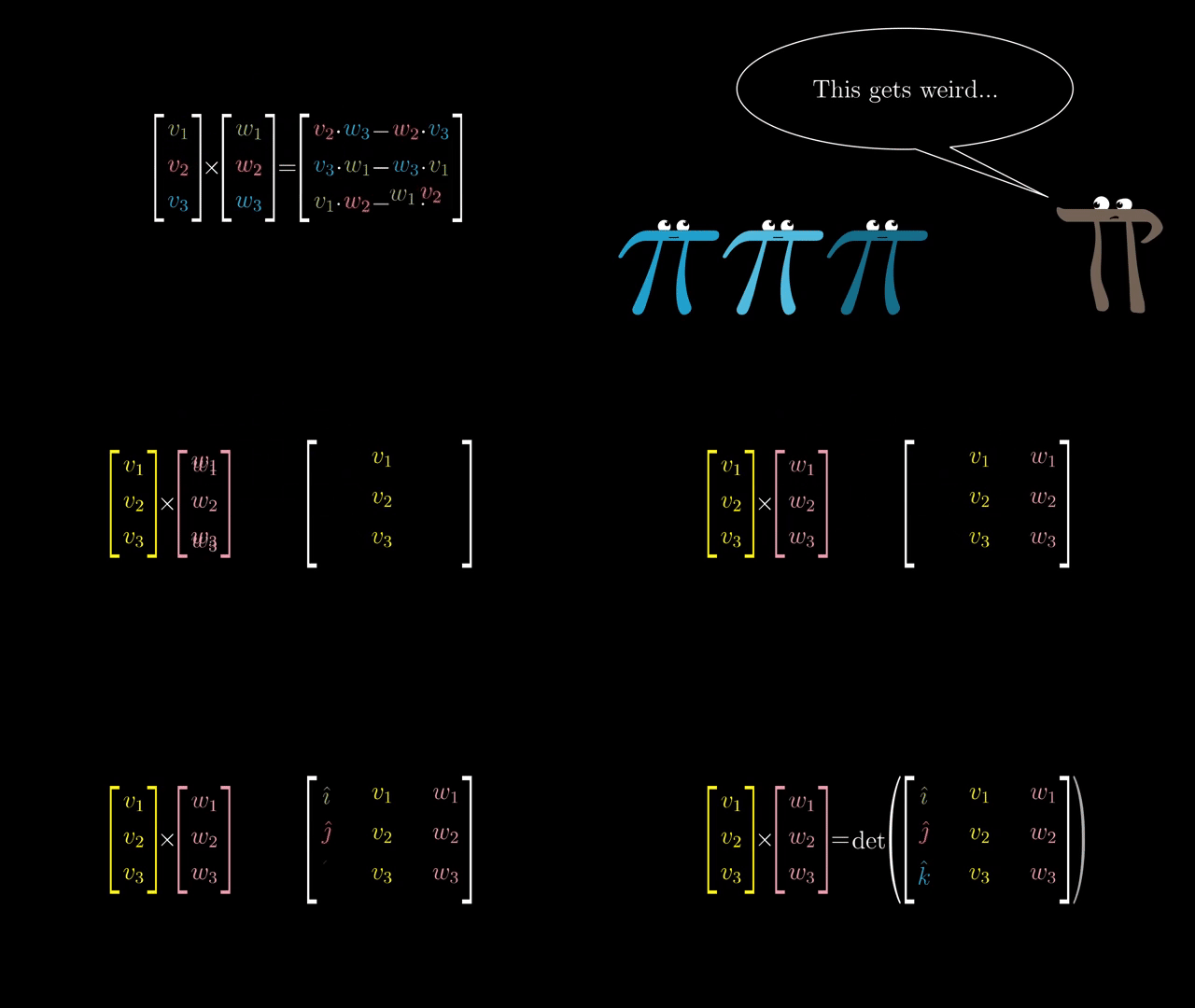
Track units when embedding SI vectors: meters, newtons, and tesla combine into consistent torque or force units only when cross products are formed with compatible three-vectors.
Angular momentum $\mathbf{L}=\mathbf{r}\times\mathbf{p}$ uses the same perpendicular filtering idea: only the transverse part of momentum relative to the position vector contributes to rotation about the origin.
Related cards
Video Content
Tasks
Card Info
- Topic: Mathematics
- Difficulty: Intermediate
- Completed: 0 users
Creator
