Connection to $2\times2$ determinant as area
Projecting to coordinate planes, cross magnitude recovers planar areas used in determinant videos from earlier chapters . For columns $\mathbf{a},\mathbf{b}\in\mathbb{R}^2$, embed with $z=0$ and read $\lvert\det[\mathbf{a}\ \mathbf{b}]\rvert$ as $\|\mathbf{a}\times\mathbf{b}\|$ after lifting to $\mathbb{R}^3$.
In $\mathbb{R}^2$ the determinant of $\begin{bmatrix}\mathbf{a}&\mathbf{b}\end{bmatrix}$ measures signed parallelogram area. In $\mathbb{R}^3$ the cross product packages the same area information together with a perpendicular direction.
This bridge explains why determinant signs matter: swapping columns flips orientation just as swapping cross inputs flips the normal vector.
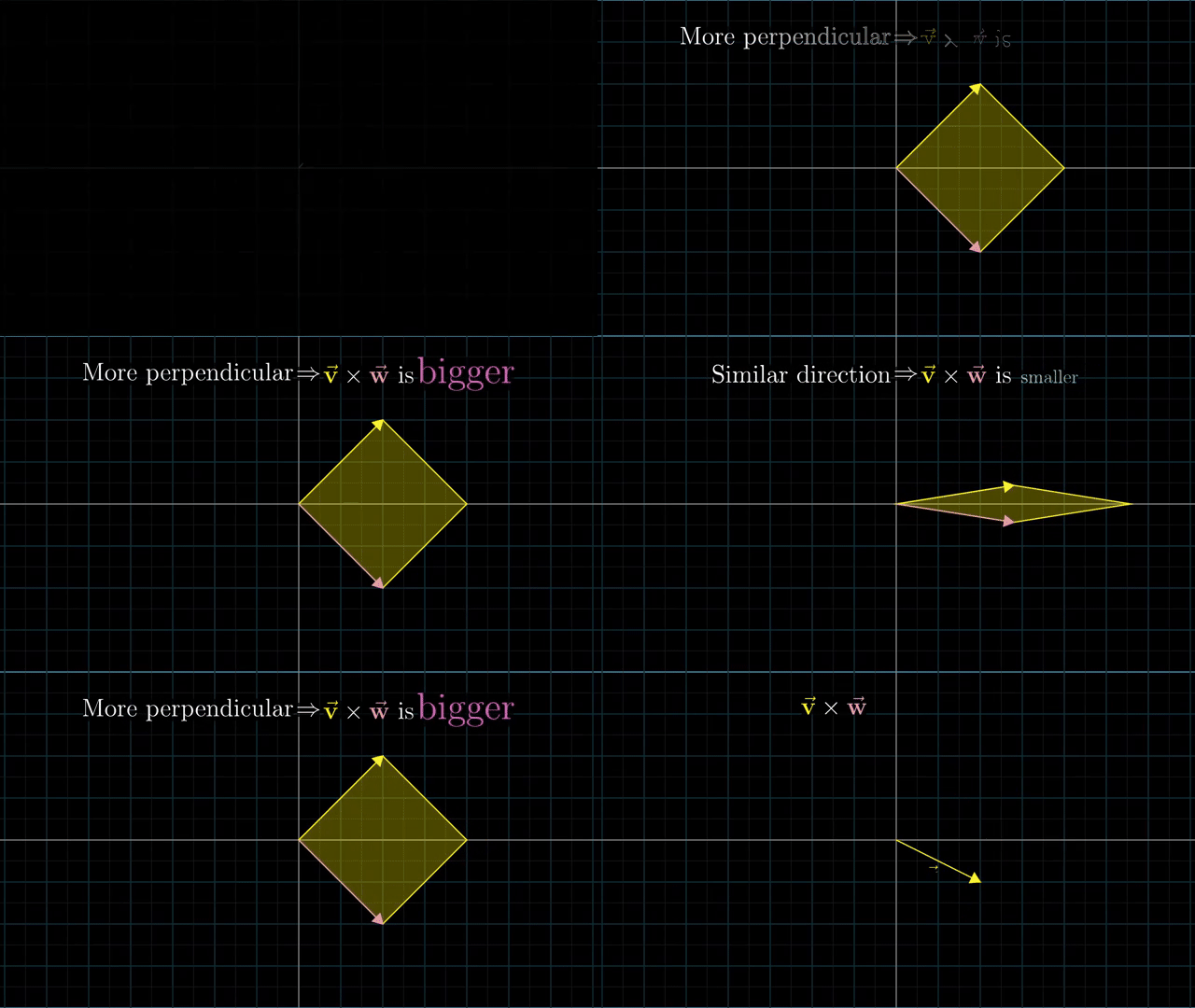
For right orthonormal $\mathbf{e}_1,\mathbf{e}_2,\mathbf{e}_3$, the scalar $\mathbf{e}_1\times\mathbf{e}_2\cdot\mathbf{e}_3$ equals $1$: orientation volume of the unit cube. Sign tracks handedness.
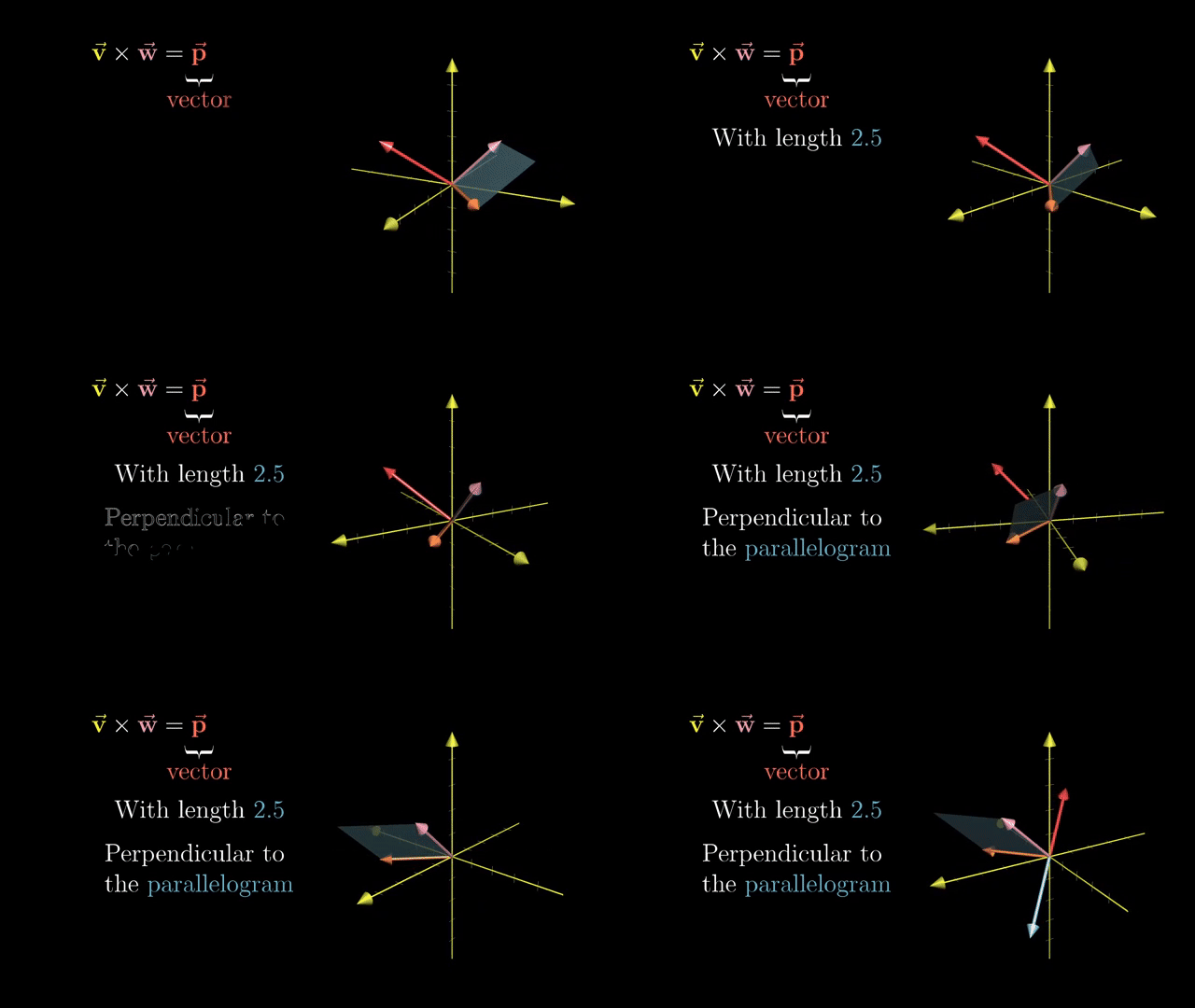
Cross product only outputs in $\mathbb{R}^3$ for this elementary definition. Generalizations in higher dimensions use exterior algebra; there is no single normal vector perpendicular to two independent vectors in $\mathbb{R}^4$.
Keep the 2D determinant story nearby: area in the plane and cross magnitude after embedding are two languages for the same geometric quantity.
When you compute $\lvert\det[\mathbf{a}\ \mathbf{b}]\rvert$ in homework, you are already doing cross magnitude in disguise.
Related cards
Video Content
Tasks
Card Info
- Topic: Mathematics
- Difficulty: Intermediate
- Completed: 0 users
Creator
