Orthogonality identities
By construction, $\mathbf{a}\cdot(\mathbf{a}\times\mathbf{b})=0$ and $\mathbf{a}\cdot(\mathbf{b}\times\mathbf{a})=0$: the cross output is perpendicular to both inputs . These identities are geometric facts, not coincidences of the determinant mnemonic.
The scalar triple product $\mathbf{a}\cdot(\mathbf{b}\times\mathbf{c})$ equals the signed volume of the parallelepiped. Zero triple product means coplanarity (from the origin): the three vectors lie in a common plane.
Use triple products as coplanarity tests in geometry problems before introducing heavy coordinate algebra. If the volume collapses, dependence is present regardless of how the vectors were named.
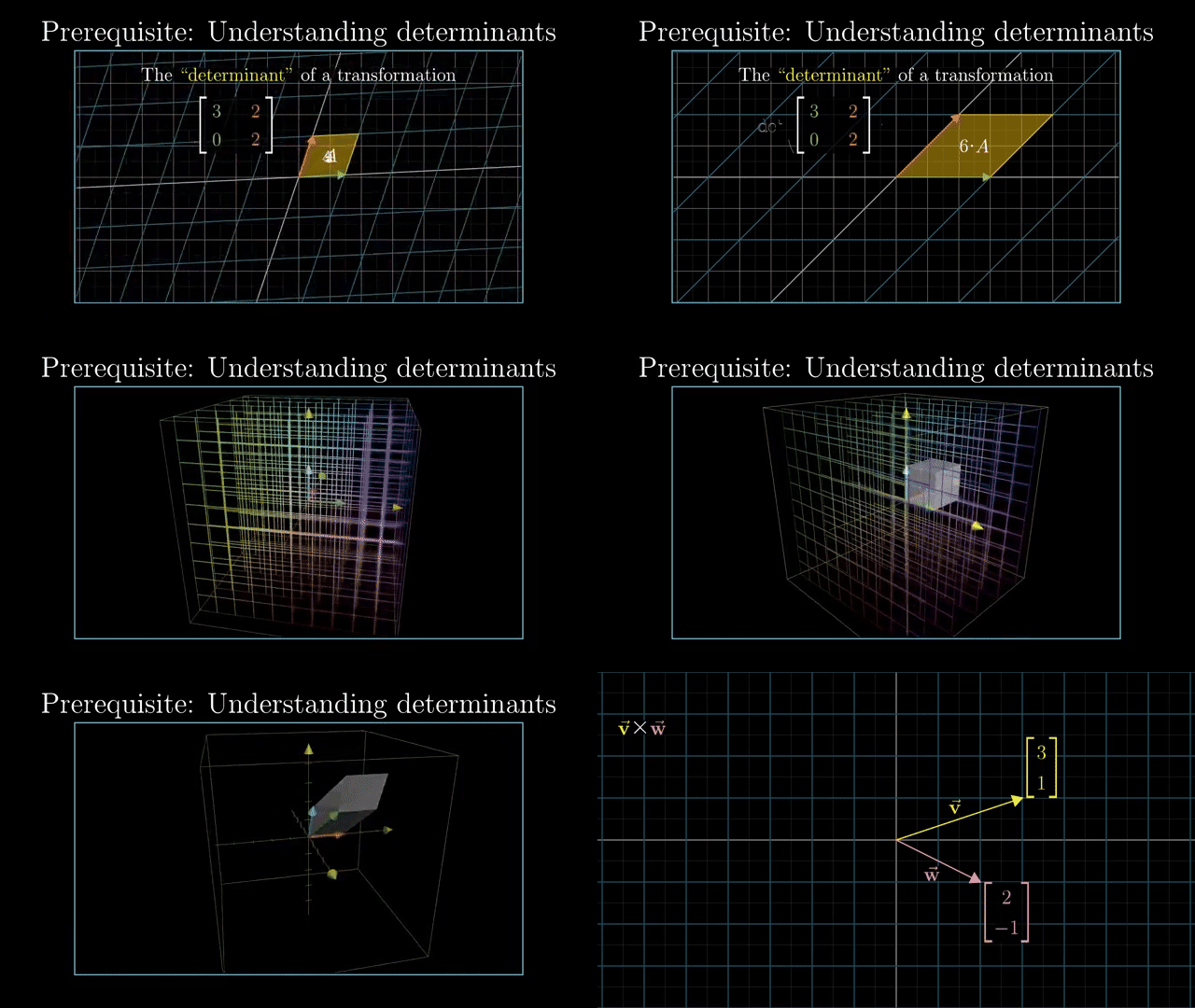
Right-hand rule convention links order to normal direction: curl from first vector toward second. In left-handed coordinate systems some texts flip sign conventions on cross entries; always declare handedness when comparing formulas.
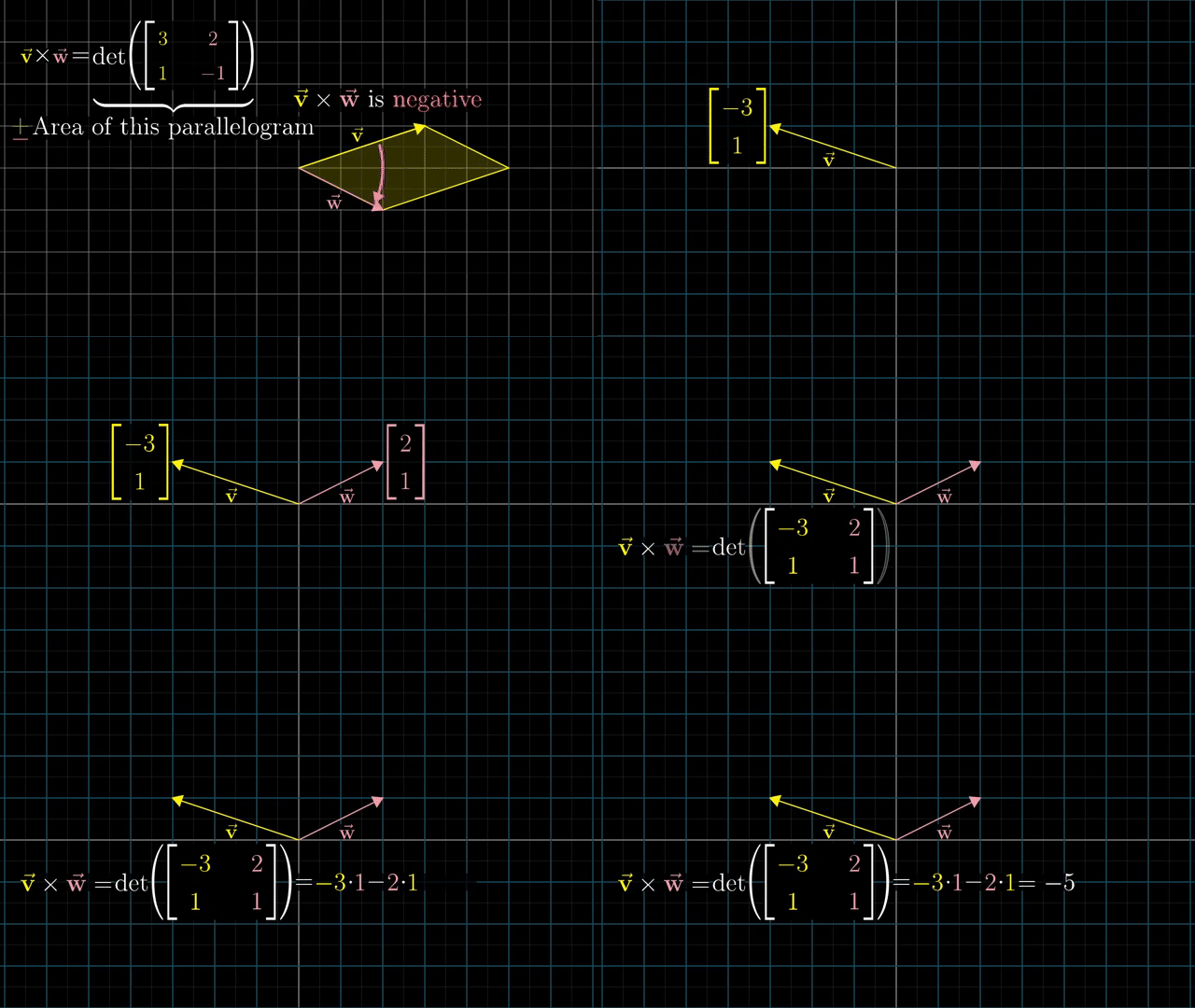
Quick check: $\hat{\mathbf{i}}\times\hat{\mathbf{k}}=-\hat{\mathbf{j}}$ in a right-handed orthonormal frame. Use orthogonality identities to verify components without expanding every determinant term.
Each basis cross $\hat{\mathbf{i}}\times\hat{\mathbf{j}}=\hat{\mathbf{k}}$ is a miniature instance of the right-hand rule you should recognize instantly.
Checking $\mathbf{a}\cdot(\mathbf{a}\times\mathbf{b})=0$ by expansion in components is good practice once; afterward trust the geometric definition.
Related cards
Video Content
Tasks
Card Info
- Topic: Mathematics
- Difficulty: Intermediate
- Completed: 0 users
Creator
