Geometric definition in $\mathbb{R}^3$
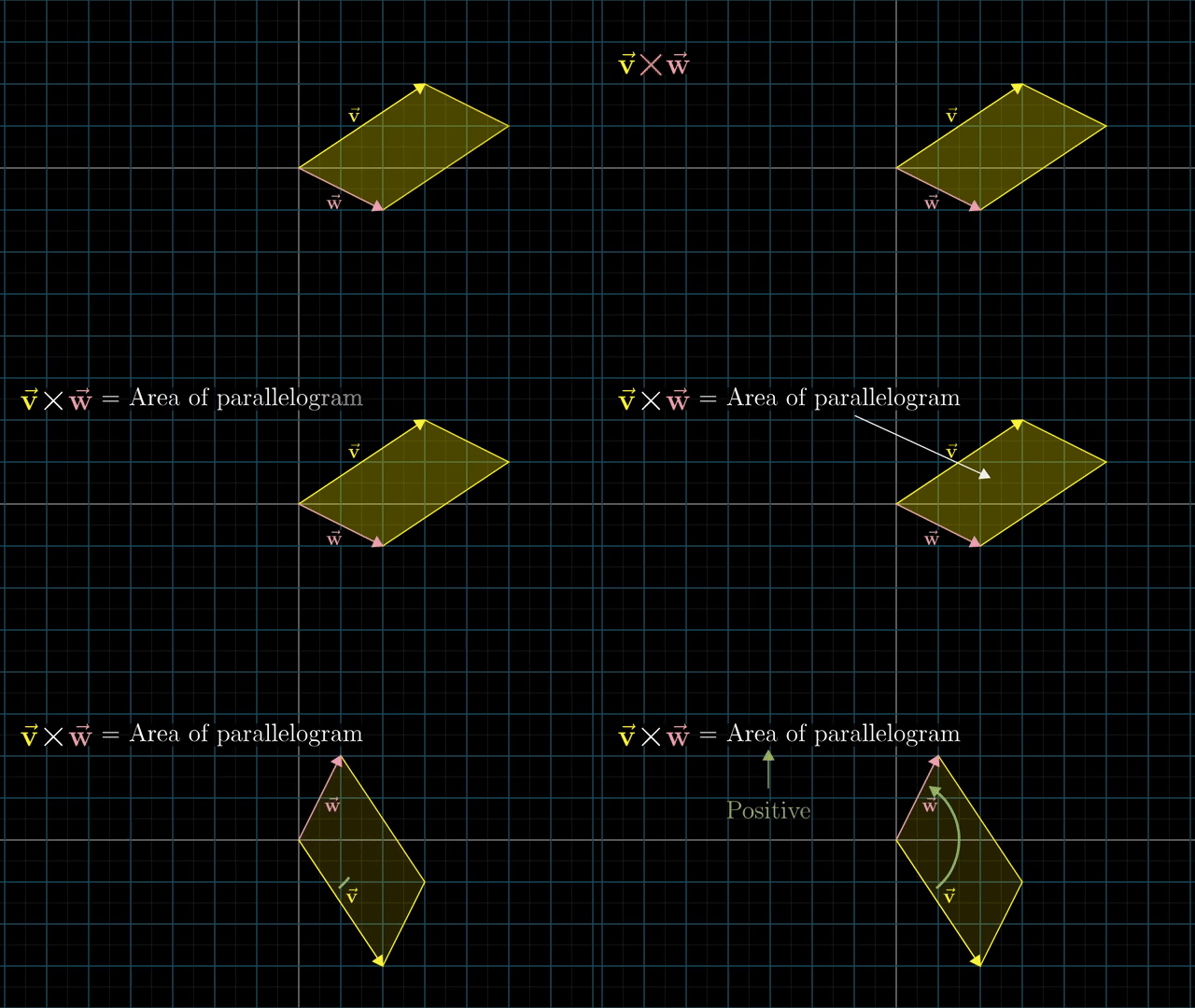
The cross product $\mathbf{a}\times\mathbf{b}$ in $\mathbb{R}^3$ is a vector perpendicular to both $\mathbf{a}$ and $\mathbf{b}$, with magnitude equal to the area of the parallelogram they span. Orientation follows the right-hand rule: curl fingers from $\mathbf{a}$ toward $\mathbf{b}$; the thumb points along $\mathbf{a}\times\mathbf{b}$ .
Magnitude satisfies $\|\mathbf{a}\times\mathbf{b}\|=\|\mathbf{a}\|\|\mathbf{b}\|\sin\theta$ because sine captures the height of the parallelogram relative to the base. Unlike the dot product, the output is a vector, not a scalar.
Compare with the dot product, which uses cosine and returns a scalar measuring alignment. Cross and dot together form the backbone of vector calculus in three dimensions: one detects parallel components, the other builds a perpendicular direction tied to area.
Anticommutativity $\mathbf{a}\times\mathbf{b}=-\mathbf{b}\times\mathbf{a}$ flips the normal direction while keeping the same area. Self-cross vanishes: $\mathbf{a}\times\mathbf{a}=\mathbf{0}$ since the parallelogram collapses.
Volume of the parallelepiped from $\mathbf{a},\mathbf{b},\mathbf{c}$ uses the scalar triple product: $\lvert\mathbf{c}\cdot(\mathbf{a}\times\mathbf{b})\rvert$. That connects cross products to signed volume in three dimensions.
Memorize the right-hand rule with a physical gesture: it links order of inputs to the direction of the output normal. Reversing inputs reverses the normal, matching anticommutativity.
Related cards
Video Content
Tasks
Card Info
- Topic: Mathematics
- Difficulty: Intermediate
- Completed: 0 users
Creator
